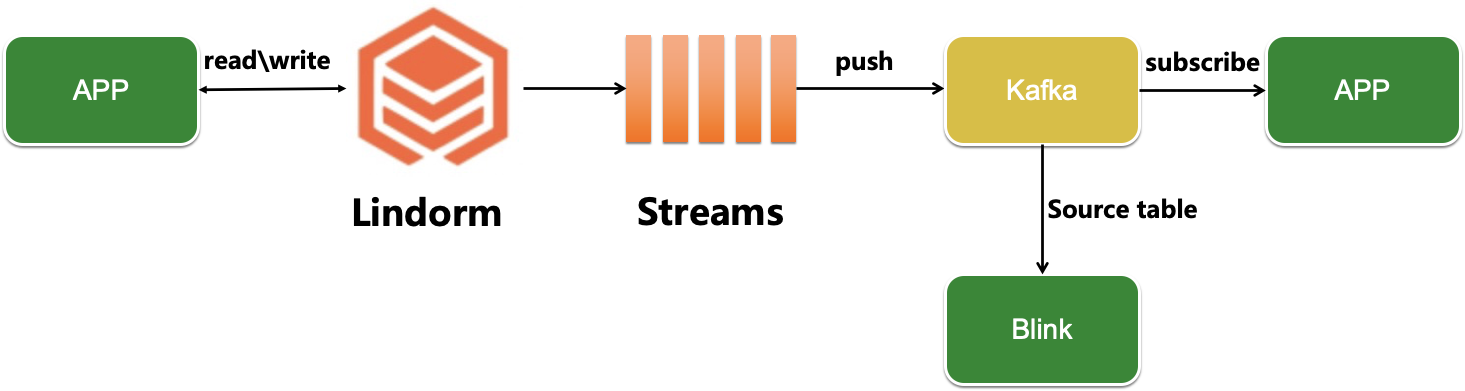
ApsaraDB for HBase Performance-enhanced Edition (Lindorm) is purpose-built for two high-demand use cases: real-time computing and application decoupling.
| Scenario | Problem solved | Key components |
|---|---|---|
| Real-time computing | Stream business events into a database and make them instantly available for computation | Lindorm, Lindorm Streams, Blink or Spark |
| Application decoupling | Eliminate dual-write complexity when propagating data changes to downstream consumers | Lindorm, Lindorm Streams, Message Queue for Apache Kafka |
Real-time computing
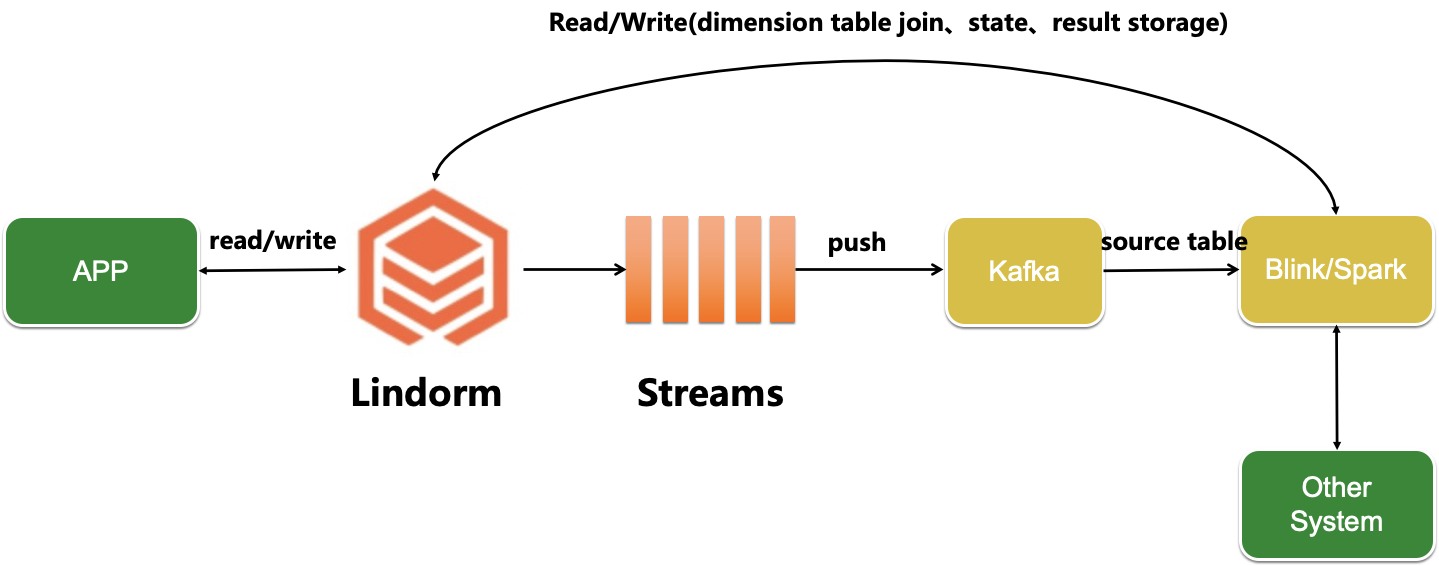
Algorithms, intelligent operations, and monitoring dashboards all require a database that ingests business events continuously and makes them available for immediate computation. Lindorm meets this need through its schema-free design and combination of high throughput, low latency, and horizontal scaling.
To build an end-to-end real-time data pipeline, integrate ApsaraDB for HBase with Lindorm Streams and either Blink or Apache Spark. Lindorm Streams captures every data change and feeds it to the stream-processing engine, which computes results in real time.
Application decoupling
When multiple downstream applications need to react to changes in a source system, the traditional approach forces the producer to write every update to both a database and a message queue. This dual-write pattern increases application complexity and creates a consistency risk: a partial failure leaves the database and the message queue out of sync.
Lindorm Streams eliminates the dual-write requirement. It captures data updates from ApsaraDB for HBase and forwards them to Message Queue for Apache Kafka in the correct message format, so downstream consumers receive events.