When using Dynamic Content Delivery Network (DCDN) to retrieve resources, DCDN generates a large amount of log data. DCDN is integrated with Simple Log Service (SLS) to deliver log data to SLS in real time for further analysis. Then, you can use the results to troubleshoot issues and make business decisions at the earliest opportunity.
Features
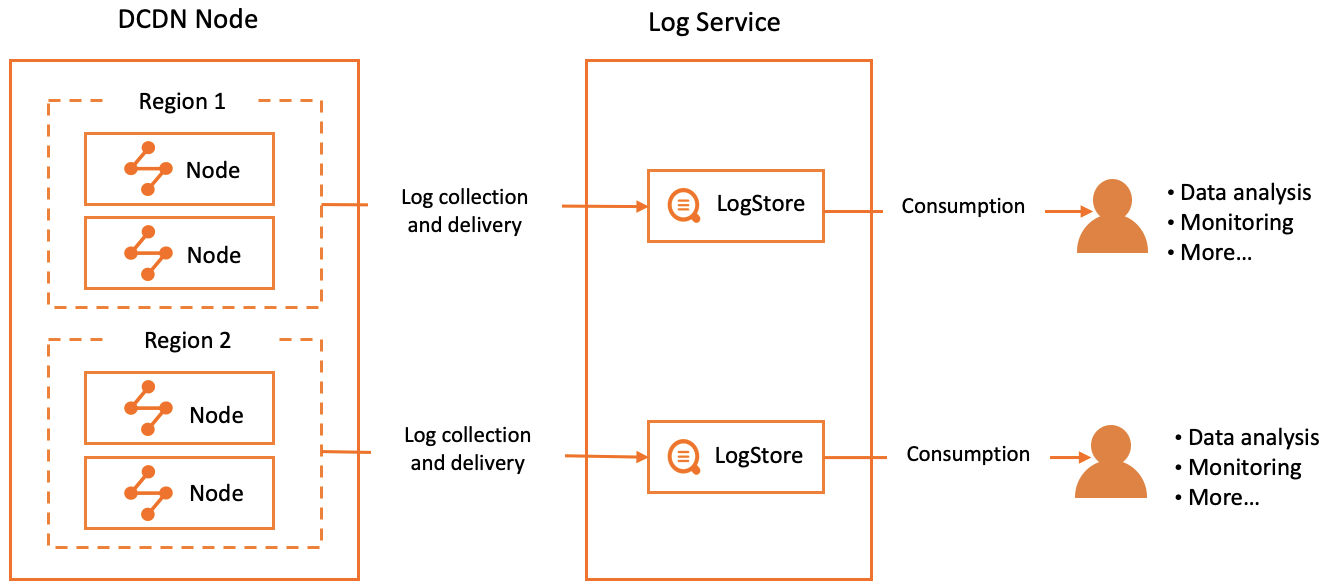
When you use DCDN, a large amount of network log data is generated. The real-time log delivery feature allows you to collect and deliver the logs to SLS. Then, you can consume the logs in SLS to monitor your business and identify issues. After you enable the real-time log delivery feature, you are charged for log entries delivered to SLS.
For more information, see What is Simple Log Service?
Usage notes
-
Traffic data from the DCDN console or API may differ from log-based data. Monitoring traffic is typically about 1.1 times the log-calculated amount. Why is the traffic amount found by using the monitoring and usage analytics feature or the usage statistics feature different from the traffic amount that is logged?
-
Resource monitoring collects data by client region and ISP. Billing is metered by traffic, bandwidth, and requests at DCDN POPs per billable region, so results may differ.
Benefits
High timeliness: After you enable the real-time log delivery feature, log data is automatically delivered to Simple Log Service. You can view the real-time log analysis results for logs that are generated within the previous 3 minutes in the Simple Log Service console.
Multiple fields: Real-time logs contain multiple log fields. For more information, see Fields collected in real-time logs.
Business compliance: The collection and delivery processes of real-time logs are compliant with related requirements.
Powerful data analysis capabilities: Simple Log Service can work together with DCDN. Visualized analysis templates are generated for logs after the logs are delivered from DCDN to Simple Log Service. This helps you analyze and monitor your workloads. Scenarios:
Fine-grained analysis on URLs: You can analyze the change in the number of requests from a URL, the profile of the requests from a specific location or source IP address, and the availability of a URL.
Analysis on business reliability: You can analyze the error codes that are returned from requested URLs, error domain names, error URLs, and error IP addresses.
Analysis on networks: You can analyze the response latency and cache hit ratio of networks.
Profile analysis: You can analyze profiles based on geographic locations, terminals, and source IP addresses.
For more information, see User access log analysis reports.
Billing
You are charged for the following billable items of real-time log delivery.
Billable item | References |
DCDN real-time log collection (included in DCDN bills) | |
Simple Log Service usage, such as log storage (included in Simple Log Service bills) |