Cloud Assistant is a native automated O&M tool developed for Elastic Compute Service (ECS). Cloud Assistant allows you to run commands on ECS instances in a password-free, logon-free manner without the use of jump servers. This topic describes the differences between running commands remotely on Windows instances by using Cloud Assistant and running commands locally on Windows instances.
Cloud Assistant
Cloud Assistant Agent runs as a service on ECS instances to communicate with other Alibaba Cloud services, obtain and run commands, and report command execution results. You can use Cloud Assistant Agent to run commands remotely on ECS instances, or connect to ECS instances by using different methods such as over SSH to run commands locally on the instances. These two methods of running commands use different communication links and may have different execution results. For more information about Cloud Assistant, see Overview.
Differences in support for features
Support for invoking programs that have a GUI
You can run PowerShell or batch scripts in the operating systems of ECS instances to invoke programs that have a GUI. However, you cannot use Cloud Assistant to run scripts to invoke programs that have a GUI.
Support for running the
net usecommand to mount File Storage NAS file systemsYou can run the
net usecommand locally on an ECS instance. However, errors are reported when you use Cloud Assistant to run thenet usecommand to mount NAS file systems. For example, when you use Cloud Assistant to run thenet use z: \\***.cn-zhang***.nas.aliyuncs.com\mysharecommand to mount a specific NAS file system, error information is displayed in the Command Output box.
Differences in the display orders of returned error information
Difference description
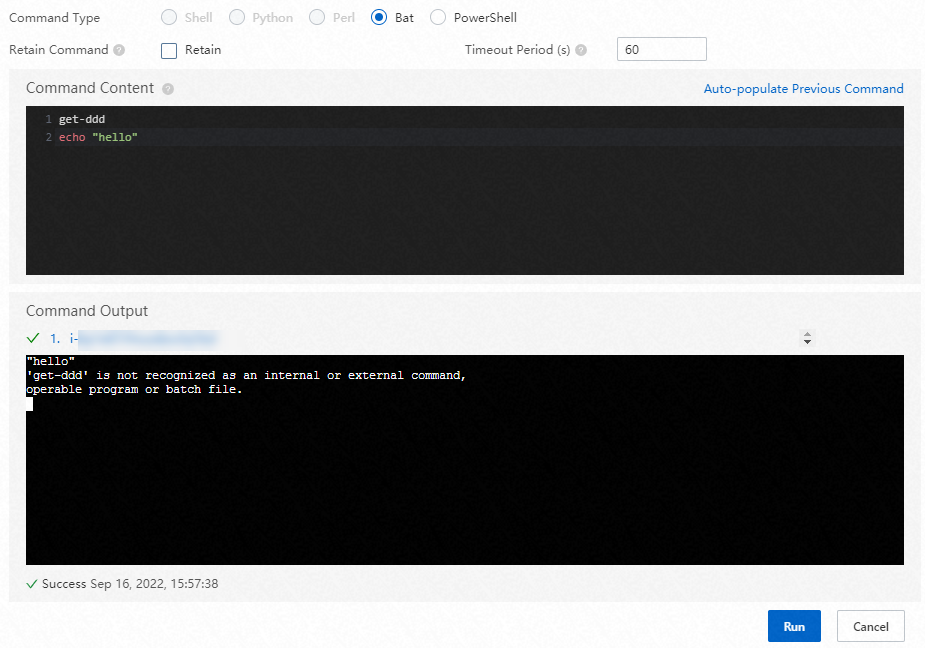
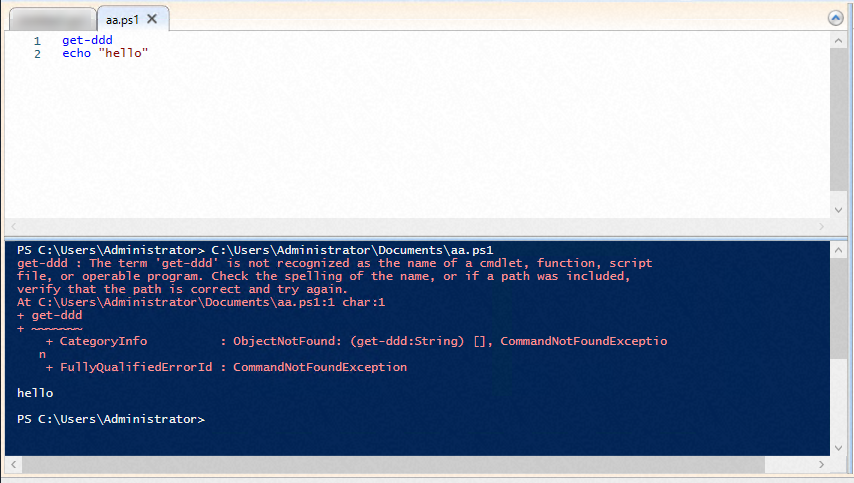
An error is reported when a command fails to be run on ECS instances. Error information may be displayed in different orders when you run the command remotely by using Cloud Assistant and when you run the command locally. The following figures show sample error information returned in the two scenarios.
Command run remotely by using Cloud Assistant
Command run locally
Cause
When Cloud Assistant is used to run a command on ECS instances, Cloud Assistant Agent polls and combines standard outputs (stdout), polls and combines standard errors (stderr), and then returns command outputs. When a command is run locally on ECS instances, command outputs are displayed in the order in which the command script is executed. If stderr occurs when a command is run remotely by using Cloud Assistant and when the command is run locally, error information may be displayed in different orders.