The Private Zone for Global Statistics provides an overview of resolution activity for all Traffic Analysis-enabled domains. Use this feature to monitor global resolution trends and performance metrics.
Use cases
Understand the operational health of the Internal DNS service
Monitor global resolution volume trends
Evaluate the resolution success rate and performance
Analyze the distribution of global request types and resolution quality
Procedure
Go to the Alibaba Cloud DNS - Traffic Analysis page.
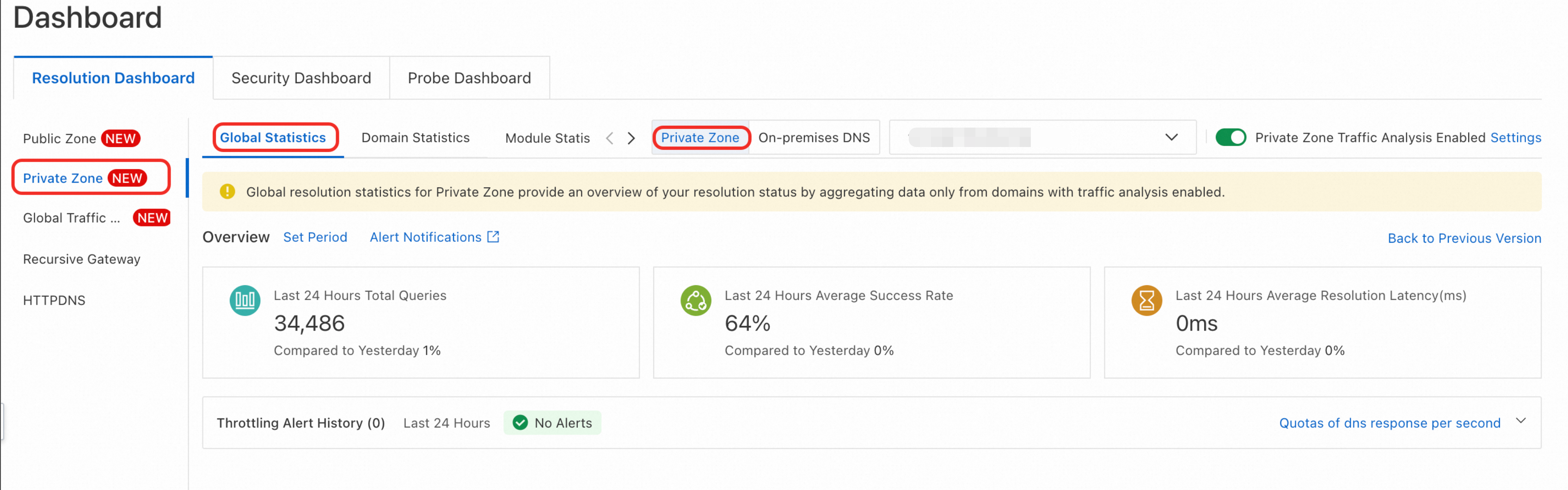
Switch to the Resolution Dashboard > Private Zone tab.
On the right, select Private Zone (default).
The Global Statistics are displayed by default.
Features
The Private Zone for Global Statistics aggregates data from domains with Traffic Analysis enabled to provide a high-level overview of resolution activity.
By default, the top-right corner of the page displays aggregated data for the current cloud account. You can also switch to other shared cloud accounts, or view data aggregated by dimensions such as region and VPC within a specific account.
1. Overview
This section displays the following metrics:
Metric | Description |
Total Queries (Last 24 Hours) | The total number of resolution requests in the last 24 hours, along with a day-over-day comparison. Use this metric to assess the overall load on your resolution service. |
Average resolution success rate (Last 24 Hours) | The average resolution success rate over the last 24 hours, with a day-over-day comparison. Use this metric to evaluate the availability and stability of your resolution service. |
Average resolution latency (ms) (Last 24 Hours) | The average resolution latency in the last 24 hours, with a day-over-day comparison. Use this metric to assess the response speed of your resolution service. |
You can perform the following actions in the Overview section:
Click Set Period to set the statistics period (daily, weekly, or monthly).
Click Alert Notifications to configure alert rules.

2. Rate limiting alarm history
This section displays rate limiting alarms from the last 24 hours:
The number of rate limiting alarm records in the last 24 hours.
An option to view the rate limiting rule configurations.

3. Resolution statistics
This section provides a time selector and data analysis across the following three tabs:
The time selector supports:
Quick time selection.
Custom time ranges (start date - end date).
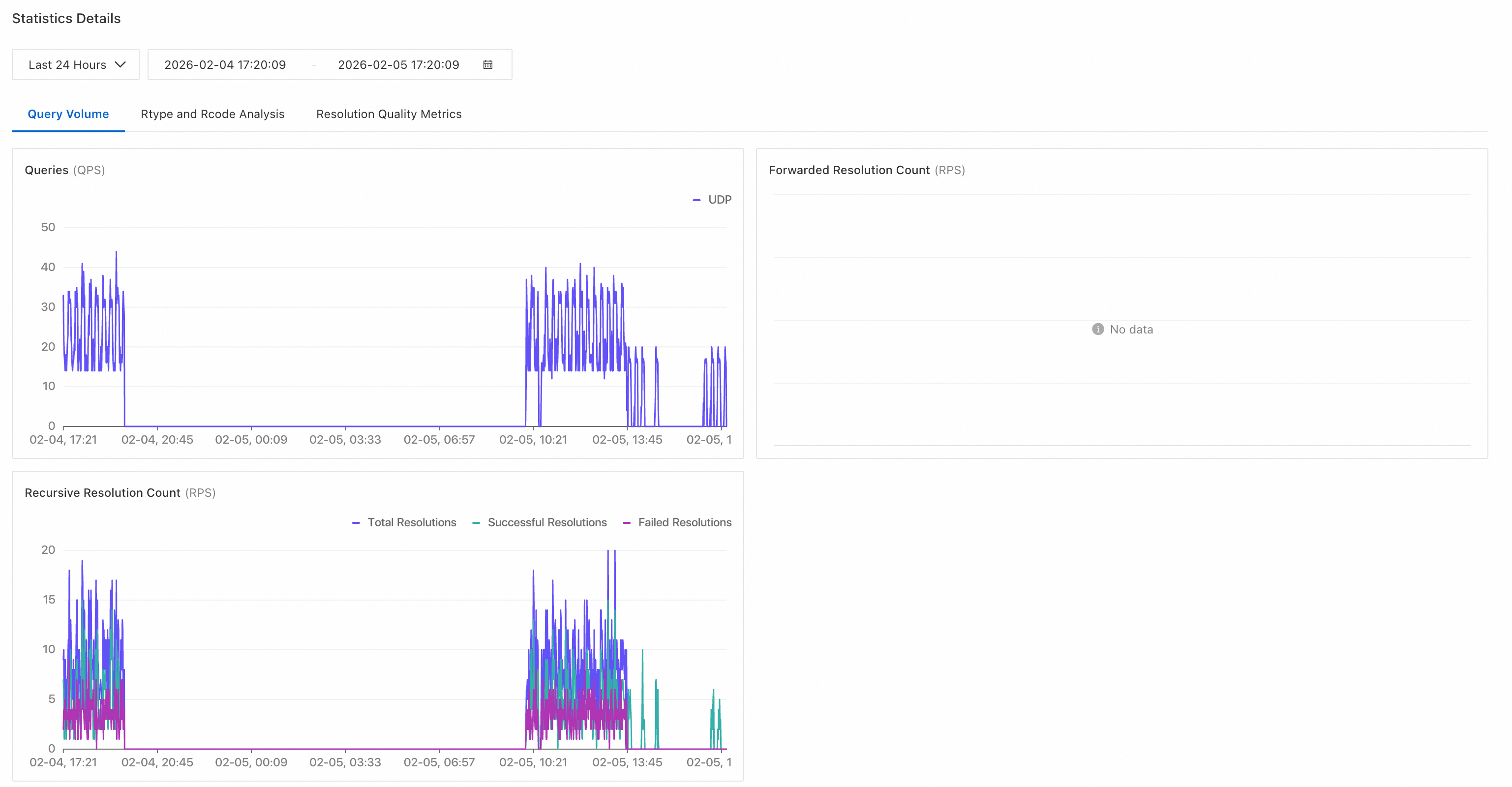
Query Volume
This tab shows:
Queries: The number of query requests processed by Internal DNS.
Forwarded Resolution Count: DNS queries resolved by a matching forwarding rule. For more information, see Forwarding Management.
Recursive Resolution Count: Recursive DNS resolutions provided by the recursion module. For more information, see Recursion Management.
Rtype and Rcode Analysis
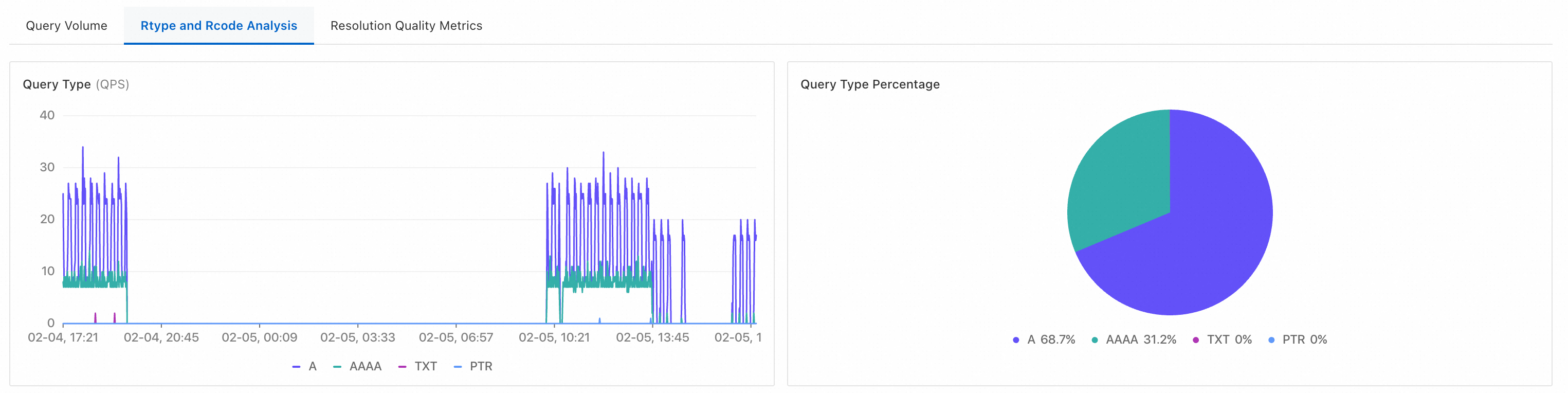
This tab shows:
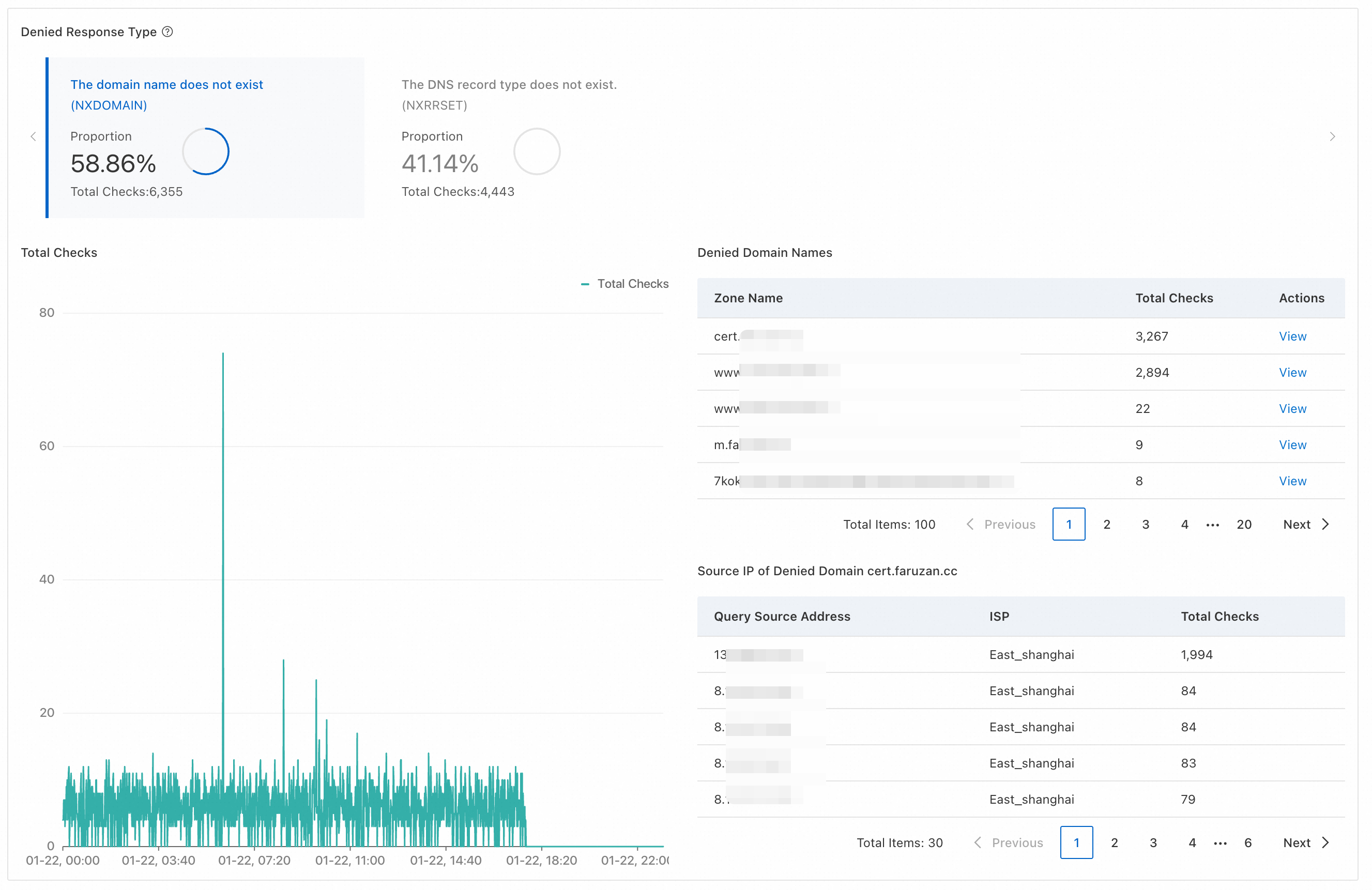
Request type statistics
Negative response type statistics
NoteType descriptions:
NXDOMAIN (Non-Existent Domain): The queried domain name does not exist.
NXRRSET: The domain name exists, but the requested record type (RRset) does not. This is also known as a NODATA scenario.
SERVFAIL (Server Failure): The query could not be processed because of a problem with the target DNS server.
REFUSED: The DNS server refuses to perform the specified operation for policy reasons. For example, the server may refuse to provide resolution to a specific requester or perform a specific operation on the specified data, such as a zone transfer.
You may want to provide resolution for specific requesters, or prevent certain operations, such as a zone transfer, on specified data.
FORMERR (Format Error): The DNS server could not interpret the query request.
NOTIMP (Not Implemented): The DNS server does not support the requested query type.
Click a negative response type card.
The table in the upper-right section aggregates data by domain name and displays the data in descending order of detection count.
Click View in the Actions column for a domain name. The table in the lower-right section then aggregates data by source address and displays the data in descending order of detection count.
Resolution Quality Metrics
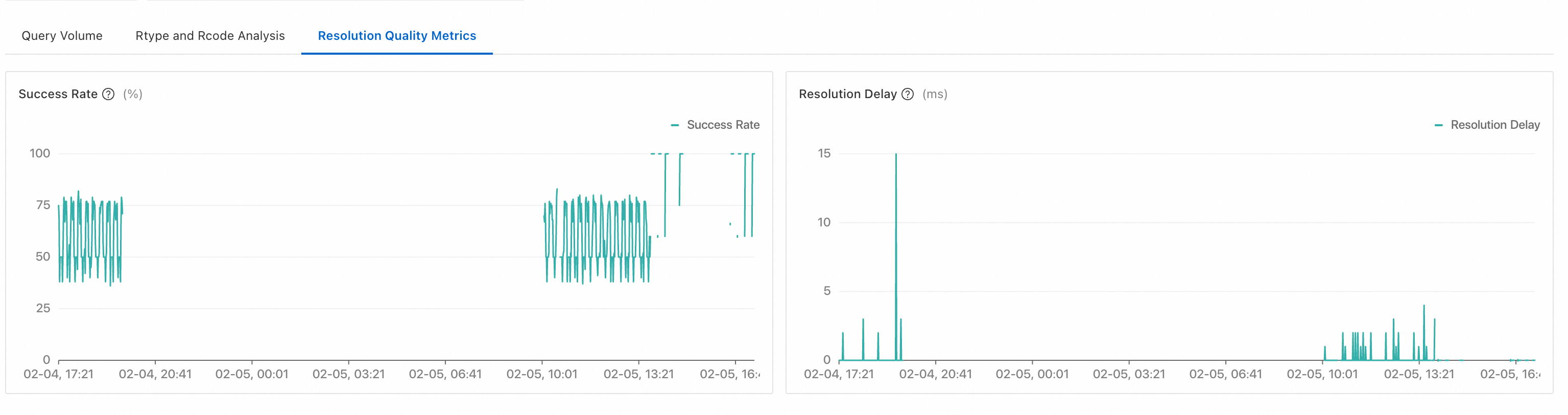
Success Rate
NoteHow resolution success rate is calculated
Resolution success rate = Number of valid responses that match the requested record type (QTYPE) / Total number of resolutionsValid response: A response that contains resource record data that matches the requested type. For example, a request for an A record is successful if an IPv4 address is returned. The request is considered failed if the response is an NXDOMAIN, NODATA, or another status that does not include an A record. Similarly, a request for an AAAA record is successful only if an IPv6 address is returned.
Recommendation: The resolution success rate is used to measure the stability and availability of the resolution service. This metric is heavily influenced by invalid queries because the domain names and record types that clients query cannot be controlled. For example, a client might query for randomly generated, non-existent domain names. In general, a stable curve indicates normal performance. You do not need to aim for the highest possible value. Instead, you should consider this metric as one part of a comprehensive analysis.
Resolution Delay
NoteResolution Delay: The average time elapsed from when the authoritative server receives a DNS query to when it sends a response.