When DNS records for a domain name such as www.api.test.com are configured in both the root domain test.com and the subdomain api.test.com, the longest zone match rule determines which record takes effect.
Effective Rules
If a root domain and a subdomain have the same effective scope, DNS resolution requests follow the longest domain (zone) match rule. If the longest domain (zone) is hit, the DNS record in that domain (zone) is used. If no corresponding DNS record is configured in the longest domain (zone), the system returns NXDOMAIN. If subdomain recursion is enabled, the system continues to query based on forwarding and public network recursion rules.
-
When the longest domain (zone) is hit, the system does not query the DNS records of the parent domain, even if no corresponding DNS record is configured in the hit domain (zone).
-
The longest domain (zone) match rule applies only to domains within the same logical module, such as Authoritative Zone or the forwarding module. If the domains (zones) are in different logical modules, they are resolved based on resolution priority rules. For more information, see Resolution rule priorities.
Scenario 1: Both the root domain and subdomain have a matching DNS record
Scenario
In Authoritative Zone, you add the root domain test.com and the subdomain api.test.com. You also add the following DNS records and associate both domains with the same VPC.
-
Add a DNS record for
test.com. The Hostname iswww.api, the Record Type is A , the Resolution Line is Default, and the Record Value is192.168.100.100. -
Add a DNS record for
api.test.com. Set Hostname towww, Record Type to A, Resolution Line to Default, and Record Value to192.168.200.200.
Validation
On an ECS instance in the associated VPC, run dig www.api.test.com. The following output is returned:
[root@iZm5edhllqvfr02faxxxxxxxx ~]# dig www.api.test.com

; <<>> DiG 9.11.4-P2-RedHat-9.11.4-26.P2.el7_9.16 <<>> www.api.test.com
;; global options: +cmd
;; Got answer:
;; ->>HEADER<<- opcode: QUERY, status: NOERROR, id: 63641
;; flags: qr aa rd ra; QUERY: 1, ANSWER: 1, AUTHORITY: 0, ADDITIONAL: 1

;; OPT PSEUDOSECTION:
; EDNS: version: 0, flags:; udp: 1436
;; QUESTION SECTION:
;www.api.test.com.		IN	A

;; ANSWER SECTION:
www.api.test.com.	60	IN	A	192.168.200.200

;; Query time: 0 msec
;; SERVER: 100.100.2.136#53(100.100.2.136)
;; WHEN: Tue Jul 23 17:36:07 CST 2024
;; MSG SIZE rcvd: 61The response returns the DNS record from the api.test.com subdomain. This result is consistent with the longest domain match rule.
Scenario 2: The subdomain has no matching DNS record but the root domain does
Scenario
In Authoritative Zone, you add the root domain test.com and the subdomain api.test.com. You also add the following DNS records and associate both domains with the same VPC.
-
Add a DNS record for
test.com. Set Hostname towww.api, Record Type to A , Resolution Line to Default, and Record Value to192.168.10.10. -
Add a DNS record for
api.test.comwith a Hostname ofabc, a Record Type of A , a Resolution Line of Default, and a Record Value of192.168.20.20.
Validation
On an ECS instance in the associated VPC, run dig www.api.test.com. The following output is returned: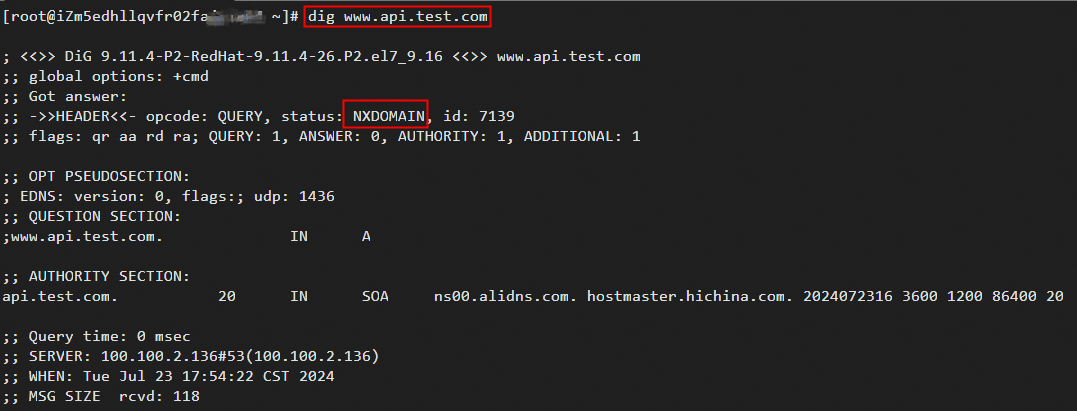
[root@iZm5edhllqvfr02faxxx ~]# dig www.api.test.com

; <<>> DiG 9.11.4-P2-RedHat-9.11.4-26.P2.el7_9.16 <<>> www.api.test.com
;; global options: +cmd
;; Got answer:
;; ->>HEADER<<- opcode: QUERY, status: NXDOMAIN, id: 7139
;; flags: qr aa rd ra; QUERY: 1, ANSWER: 0, AUTHORITY: 1, ADDITIONAL: 1

;; OPT PSEUDOSECTION:
; EDNS: version: 0, flags:; udp: 1436
;; QUESTION SECTION:
;www.api.test.com.		IN	A

;; AUTHORITY SECTION:
api.test.com.		20	IN	SOA	ns00.alidns.com. hostmaster.hichina.com. 2024072316 3600 1200 86400 20

;; Query time: 0 msec
;; SERVER: 100.100.2.136#53(100.100.2.136)
;; WHEN: Tue Jul 23 17:54:22 CST 2024
;; MSG SIZE rcvd: 118The DNS resolution request hits the subdomain. However, because no corresponding DNS record is configured in the subdomain, the system does not query the records of the parent domain and returns NXDOMAIN.