Database Gateway connects on-premises databases and databases hosted on third-party clouds to Alibaba Cloud — without public IP addresses, complex network configuration, or dedicated circuits.
Once connected, these databases work with Alibaba Cloud services such as Data Transmission Service (DTS), Data Disaster Recovery, and Data Management (DMS) for migration, synchronization, backup, and centralized management.
How it works
-
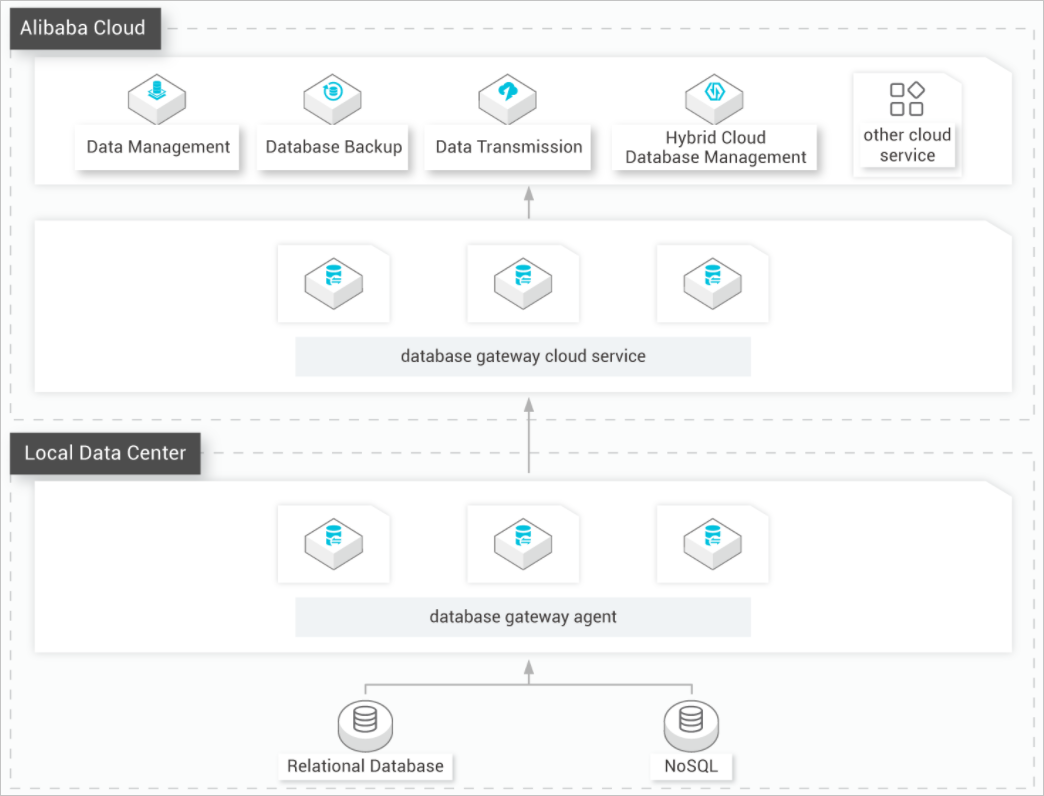
Install a Database Gateway agent on a machine in your environment.
-
The agent establishes secure, isolated channels with the Database Gateway service. Channels are isolated per account and per gateway.
-
Alibaba Cloud services (such as DMS or Data Disaster Recovery) reach your database over the established channel.
Use cases
-
Manage databases across multiple clouds from a single control plane
-
Migrate data from on-premises databases or third-party cloud databases to Alibaba Cloud
-
Synchronize data from on-premises or third-party cloud databases to Alibaba Cloud databases
-
Back up on-premises databases or third-party cloud databases to Alibaba Cloud
For details, see Scenarios.
Key benefits
Security and reliability
Database Gateway keeps your databases off the public internet:
-
No public IP address is required to establish a connection.
-
All data transmission links are encrypted with Transport Layer Security (TLS) using asymmetric encryption.
-
Starting an agent requires a temporary token generated in the Database Gateway console. The token is sent over an encrypted link for identity verification, is valid for 15 minutes, and can only be used once — so AccessKey pairs are never stored locally.
-
API operations return only the database gateways created within your own account, preventing unauthorized discovery.
-
Accessing a database connected to a gateway requires both a temporary AccessKey pair and the gateway ID.
Ease of use
Connect a database to Alibaba Cloud without configuring complex networks or routing rules.
Cost-effective
Connections from databases to Alibaba Cloud are free. No Elastic Compute Service (ECS) instance, virtual private cloud (VPC), or Express Connect circuit is required — run the agent on any machine with sufficient memory. Database Gateway also compresses data before transmission to reduce network costs.
High availability
In addition to disaster recovery measures on a single Database Gateway agent, you can deploy multiple agents across servers or data centers to form a high-availability cluster. Database Gateway performs automatic failover across servers and data centers, recovering connections within seconds. For details, see Create high-availability clusters of on-premises agents.
Related services
| Service | Description |
|---|---|
| DTS | Data Transmission Service (DTS) is a real-time data streaming service that supports relational databases, NoSQL databases, and online analytical processing (OLAP) databases. It provides data migration, data synchronization, change tracking, data integration, and data processing. Use Database Gateway with DTS to connect on-premises or third-party cloud databases to Alibaba Cloud at low cost, then use those databases as the source or destination for migration, synchronization, or change tracking tasks. |
| Data Disaster Recovery | Data Disaster Recovery is a cost-effective and highly reliable one-stop data backup and data recovery service with enterprise-level capabilities for hybrid cloud environments — covering databases in data centers, private clouds, and public clouds. It supports data restoration in seconds and works with Data Lake Analytics for queries of backup sets. Use Database Gateway with Data Disaster Recovery to back up on-premises databases or databases in third-party cloud private networks to Alibaba Cloud at low cost. |
| DMS | Data Management (DMS) is a one-stop data management platform for managing data throughout its lifecycle — including global asset management, data governance, database design and development, data integration, data development, and data consumption. Use Database Gateway with DMS to centrally manage self-managed databases in on-premises data centers, databases from third-party cloud providers, and self-managed databases on third-party cloud servers. |