Database Autonomy Service (DAS) provides the performance insight feature for ApsaraDB RDS for SQL Server. You can use this feature to implement load monitoring, association analysis, and performance optimization of your ApsaraDB RDS for SQL Server instance. This feature helps you evaluate database loads and troubleshoot performance issues to increase the stability of your ApsaraDB RDS for SQL Server instance.
Usage note
The RDS instance that runs SQL Server 2008 R2 with standard SSDs or enhanced SSDs (ESSDs) is not supported.
Scenarios
Performance insight can be used in the following scenarios:
Performance metric analysis
Performance insight monitors the key metrics of your RDS instance and displays the status and trend of the loads on the instance. You can identify the sources and distribution of loads within a specific time range based on the trend charts of the key metrics.
Load evaluation
ApsaraDB RDS for SQL Server provides a trend chart of average active sessions (AAS) to eliminate the need to analyze the complicated trend charts of various metrics. The AAS trend chart shows all crucial performance data that you may need to evaluate the sources and bottlenecks of loads. For example, you can check whether the RDS instance is heavily loaded due to high CPU utilization, lock-waiting, or I/O latency, and identify the SQL statements that cause heavy loads.
NoteThe AAS metric indicates the average number of active sessions in the RDS instance within a specific time range. The changes to the value of the AAS metric reflect the changes of loads on the RDS instance. The performance insight feature uses AAS as a key metric to measure loads on the RDS instance.
Identification of the causes of performance issues
You can analyze the AAS trend chart and the multi-dimensional load source details to determine whether a performance issue is caused by improper instance specifications or the database architecture. You can also identify the SQL statements that cause the performance issue.
Procedure
Log on to the DAS console.
In the left-side navigation pane, click Instance Monitoring.
On the page that appears, find the database instance that you want to manage and click the instance ID. The instance details page appears.
In the left-side navigation pane, choose Performance Optimization > Performance Insight.
Overview of the Performance Insight tab
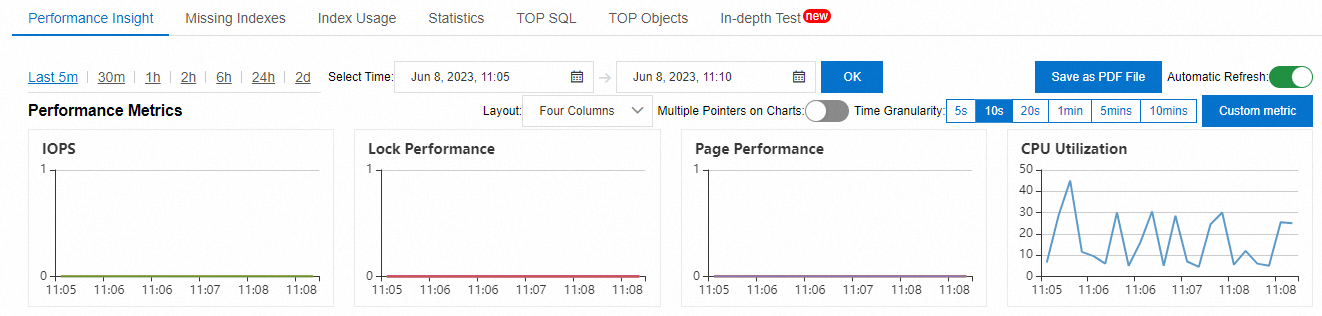
Performance Metric
This section displays the trend charts of key metrics over a specific time range to help you understand the load status and resource bottlenecks of the RDS instance.
You can select or customize a different time range to view the trend charts of key metrics within that time range.
NoteBy default, the performance insight feature displays the data within the last 5 minutes. The default monitoring frequency is also 5 minutes. We recommend that you change the monitoring frequency of the RDS instance to 1 minute. If you do not change the monitoring frequency to 1 minute, only a data point is displayed in the trend charts. For more information, see Set the monitoring frequency of an ApsaraDB RDS for SQL Server instance.
Average Active Sessions (AAS)
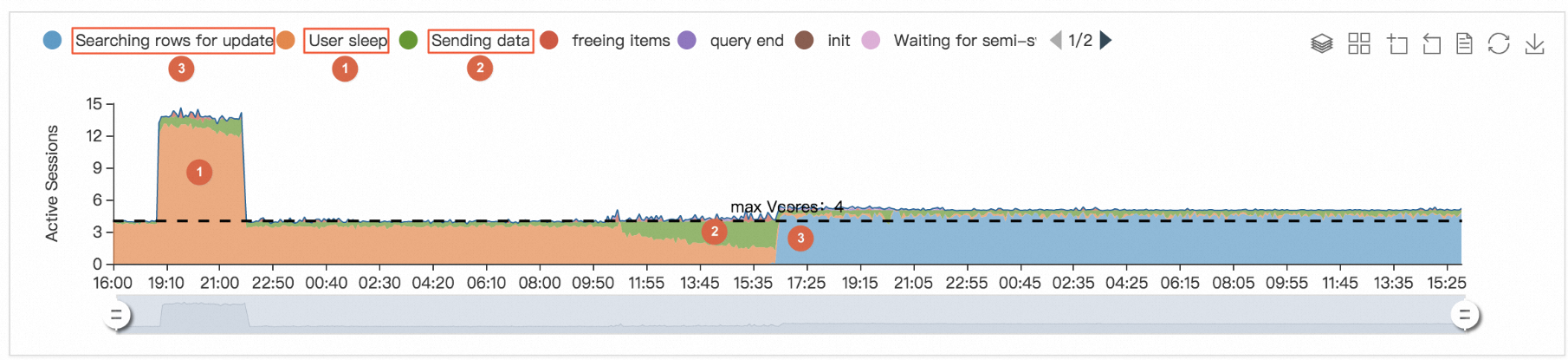
This section displays the AAS trend chart. After you identify the status of loads on the RDS instance based on the trend charts of key metrics, you can view the AAS trend chart to further identify the sources of loads.
 Note
NoteThe max Vcores metric indicates the maximum number of CPU cores that can be used by the RDS instance. The value of the max Vcores metric determines the processing capability of the RDS instance.
The AAS trend chart helps you identify the sources of loads on the RDS instance. In the example shown in the preceding figure, you can identify the sources of loads in three typical stages:
In the first stage, all loads come from User Sleep sessions.
In the second stage, the number of User Sleep sessions gradually decreases, and a majority of the loads come from Sending Data sessions.
In the third stage, the number of Sending Data sessions gradually decreases, and a majority of the loads come from Searching rows for update sessions.
This example proves that the AAS trend chart whose data is updated in real time can help you intuitively obtain the sources, distribution, and change patterns of the loads on an RDS instance.
Load sources from multiple dimensions
You can learn the trend of the loads for an ApsaraDB RDS for SQL Server instance by analyzing the trend chart of AAS. You can find the specific SQL statements that cause performance bottlenecks, and the related users, hosts, and databases.
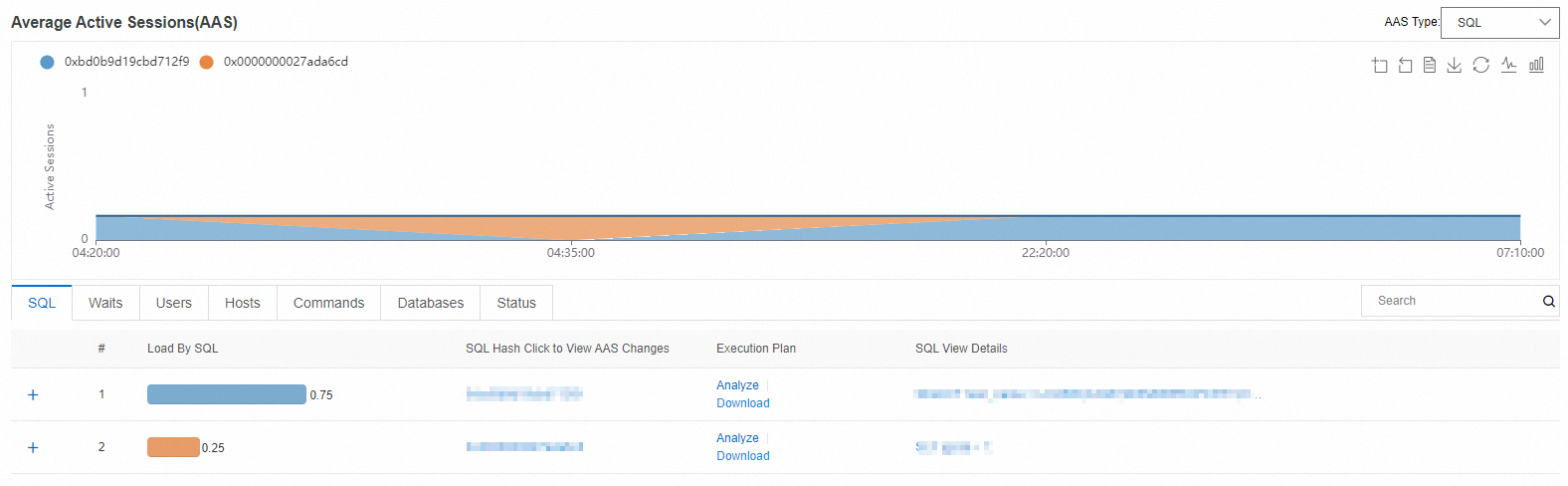
This section displays the details about the sources of loads from multiple dimensions in a table. You can use the table to identify the SQL statements that cause heavy loads. You can also use the table to identify the AAS of each SQL statement.
NoteThe preceding figure shows that the value of the top 1 SQL statement is 0.75, which indicates that the AAS of the SQL statement in the given time range is 0.75.
The performance insight feature supports seven types of AAS. You can select an AAS type from the AAS Type drop-down list in the upper-right corner of the Average Active Sessions (AAS) section.
Item
Description
SQL
The AAS trends of the top 10 SQL statements.
Waits
The AAS trends of wait categories of the active sessions.
Users
The AAS trends of the users that have logged on to the RDS instance.
Hosts
The AAS trends of the hostnames or IP addresses of the clients from which the users log on to the RDS instance.
Commands
The AAS trends of different types of SQL statements.
Databases
The AAS trends of the databases in which your workloads run.
Status
The ASS trends of active sessions.