Data Management Service (DMS) is a web-based tool for connecting to and managing your ApsaraDB for ClickHouse cluster without a CLI. With DMS, you can:
Run SQL queries and view results in a browser-based SQL console
Create and manage databases and tables
Import and export data, clone databases, and run security audits
To connect from a terminal or application instead, see the other connection methods in the ApsaraDB for ClickHouse documentation.
Prerequisites
Before you begin, ensure that you have:
An ApsaraDB for ClickHouse cluster
A database account and password for the cluster
DMS server IP addresses in the cluster whitelist (added automatically when you create a new cluster; if automatic addition fails, add them manually using the ranges in DMS IP address ranges)
Log on to your cluster
Log on to the ApsaraDB for ClickHouse console.
In the upper-left corner, select the region where your cluster is located.
On the Cluster List page, click the Instance List tab for your cluster type, then click the cluster ID.
On the Cluster Information page, click Log On to Database in the upper-right corner.
Configure the following parameters. To verify your credentials before logging on, click Test Connection in the lower-left corner. If the connection test fails, check the cluster information that you entered based on the error message.
The first time you use DMS to log on to an ApsaraDB for ClickHouse cluster, the control mode defaults to Flexible Management. To change the control mode later, edit the instance. For details, see Edit an instance and Control modes.
Parameter Description Database type Defaults to ClickHouse. No change required. Instance region Defaults to the current cluster region. To log on to a cluster in a different region, select the region from the drop-down list. Instance ID Defaults to the current cluster ID. To log on to a different cluster, select the cluster ID from the drop-down list. Database account The account for the database. Database password The password for the database account. Remember password Select this option to log on automatically in the future without re-entering credentials. Click Log On.
Run a query
In the SQL Console window, enter the SQL statement to execute.
In the menu bar, click Execute (F8) and view the results.
The following example shows how to create a local table.
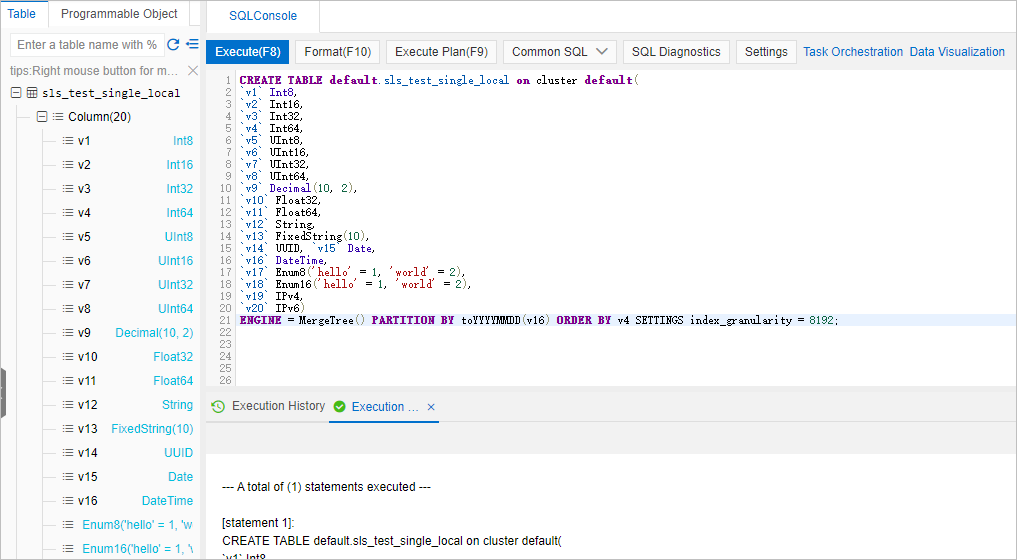
DMS supports various SQL statements and provides a visual interface for create, read, update, and delete (CRUD) operations. For details, see Introduction to the SQL window.
What's next
Introduction to the SQL window — learn about the full range of SQL and CRUD operations available in DMS
Edit an instance — change the control mode or other instance settings
Control modes — understand the available control modes and when to use each