This topic describes how to view container monitoring data to understand the status of your application's pods, including information about CPU, physical memory, network traffic, and network packets.
Prerequisites
-
Your application is deployed in an ACK environment.
-
The ACK cluster for your application is connected to Managed Service for Prometheus. For more information, see Prometheus instances for ACK.
-
An agent is installed for the application using the ack-onepilot component. For more information, see Install a Java agent by using the ack-onepilot component for ACK and ACS.
Procedure
Log on to the ARMS console. In the left-side navigation pane, choose .
On the Application List page, select the region in the top navigation bar and then click the name of the application.
NoteIcons in the Language column have the following meanings:
 : a Java application connected to Application Monitoring.
 : a Golang application connected to Application Monitoring.
 : a Python application connected to Application Monitoring.
-: an application connected to Managed Service for OpenTelemetry.
-
In the left-side navigation pane, click Application Details.
-
On the Application Details page, select a pod, specify a time range, and then click the container monitor tab.
CPU
The CPU section displays the CPU metrics of the pod for the specified time range, including the following:
-
Cumulative CPU usage
-
CPU quota

Optional: In the CPU section, you can:
Move the pointer over a chart and view the statistics.
Drag the bars horizontally to view the statistics of specified time periods.
Click the legend to hide or show the data.
Physical memory
The Physical Memory section displays the physical memory metrics of the pod for the specified time range, including the following:
-
Memory usage
-
Memory quota

Optional: In the Physical Memory section, you can:
Move the pointer over a chart and view the statistics.
Drag the bars horizontally to view the statistics of specified time periods.
Click the legend to hide or show the data.
Network traffic
The Traffic section displays the network traffic metrics of the pod for the specified time range, including the following:
-
Bytes received
-
Bytes sent
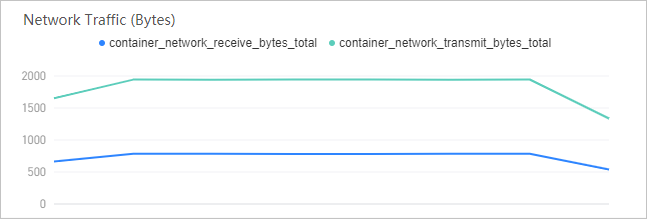
Optional: In the Traffic section, you can:
Move the pointer over a chart and view the statistics.
Drag the bars horizontally to view the statistics of specified time periods.
Click the legend to hide or show the data.
Network packets
The Network packets section displays the network packet metrics of the pod for the specified time range, including the following:
-
Sent packets dropped
-
Packets sent
-
Received packets dropped
-
Network send errors
-
Network receive errors
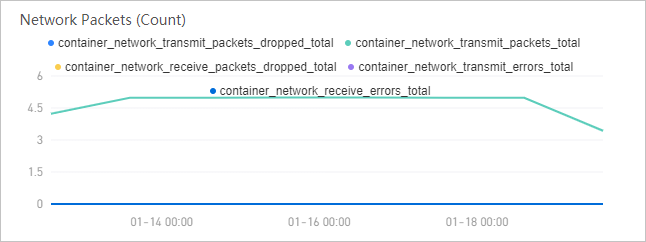
Optional: In the Network packets section, you can:
Move the pointer over a chart and view the statistics.
Drag the bars horizontally to view the statistics of specified time periods.
Click the legend to hide or show the data.