In the cloud-native observability realm, OpenTelemetry has become the de facto standard. Compared to Java, which possesses mature bytecode enhancement technology, the Go language, as a static compiled language, has long lacked a mature, low-intrusion automatic instrumentation solution. Current existing solutions mainly include:
To this end, the Alibaba Cloud Observability team and the Programming Language team explored the Go compile-time instrumentation solution and donated its core capabilities to the OpenTelemetry community, forming the opentelemetry-go-compile-instrumentation [1] project. With the joint efforts of companies such as Datadog and Quesma, we published the first Preview version V0.1.0 [2].
The core of the automatic instrumentation tool lies in utilizing the -toolexec parameter of the Go compiler. The -toolexec intercepts the Go command and replaces it with our instrumentation tool. In this way, before the code is compiled, we have the opportunity to analyze and modify it. The entire process can be summarized into two phases:
Before compilation starts, the tool analyzes the build flow of the application (go build -n) and detects third-party libraries used in the project, such as net/http, grpc, and redis. Then, it automatically generates a file named otel.runtime.go and imports the corresponding Hook code (monitoring logic, referred to as Hook code hereafter) into the build dependencies.
When the compiler processes the target function, the tool uses -toolexec to intercept the compilation, and then modifies the code of the target function. It inserts a segment of Trampoline Code at the function entry, and the Trampoline Code jumps to the pre-written Hook function.
● Before entering the function (Before): The Hook records the start time, fetches context information (such as HTTP headers), and starts a span.
● Function execution: Execute the original business logic.
● After exiting the function (After): The Hook catches the return value or Panic, ends the span, and records the duration.
The advantage of this method is zero runtime overhead (except for the necessary running time of monitoring logic). Because the instrumentation is directly compiled into the binary file, it does not require switching between Kernel space and user space, such as in eBPF, nor does it require loading at start, such as with a Java agent.
Let's go through a simple HTTP example to see how it is used.
package main

import ...

func main() {
    http.HandleFunc("/greet", func(w http.ResponseWriter, r *http.Request) {
        w.Write([ ]byte("Hello, OpenTelemetry!"))
    })
    log.Fatal(http.ListenAndServe(":8080", nil))
}You need to manually import the OpenTelemetry SDK, manually create a tracer, and manually start and end a span in the handler.
package main

import...

func initTracer() func(context.Context) error {
  /* ... dozens of lines of initialization code... */
}

func main() {
    // 1. Initialize the tracer.
    shutdown := initTracer()
    defer shutdown(context.Background())
    // 2. Wrap the handler.
    handler := http.HandlerFunc(func(w http.ResponseWriter, r *http. Request) {
        // 3. Manually extract the context and start the span.
        tracer := otel.Tracer("demo-server")
        ctx, span := tracer.Start(r.Context(), "GET /greet")
        // 4. Ensure that the span ends.
        defer span.End()
        // 5. You may also need to manually record attributes.
        span.SetAttributes(attribute.String("http.method", "GET"))
        w.Write([]byte("Hello, OpenTelemetry! "))
        })
        // 6. ListenAndServe may also need to be wrapped...
        log.Fatal(http.ListenAndServe(":8080", handler))
}
For microservices with hundreds or thousands of APIs, the cost of this modification is catastrophic.
./otel-linux-amd64 go build -o myapp
export OTEL_EXPORTER_OTLP_ENDPOINT="http://localhost:4317" export OTEL_SERVICE_NAME="my-app" ./myapp
The compiler will silently "weave" the monitoring logic of HTTP requests into the application binary file. After the OpenTelemetry export endpoint (such as Jaeger or console) is configured, you can run the generated server. When the /greet API is accessed, tracing data is automatically generated and reported, containing information such as the URI of the request, duration, and status code.
During the deep practice of eBPF technology, although we acknowledge its power, we also found that it is difficult to perfectly handle the application layer context. More importantly, we continuously received user feedback that everyone is troubled by the tedious manual tracking and high maintenance costs.
To solve this pain point, we began to explore the Go compile-time automatic instrumentation solution, published it to Application Real-Time Monitoring Service (ARMS) of Alibaba Cloud Observability [3], continually iterated in this most rigorous "experimental field," and gradually evolved it into a mature solution. It not only achieves tracing analysis with zero code modification but also extends support for rich advanced features such as metric statistics, runtime monitoring, and even continuous profiling. It can even complete the event tracking of the enterprise internal SDK via custom extension features [4].
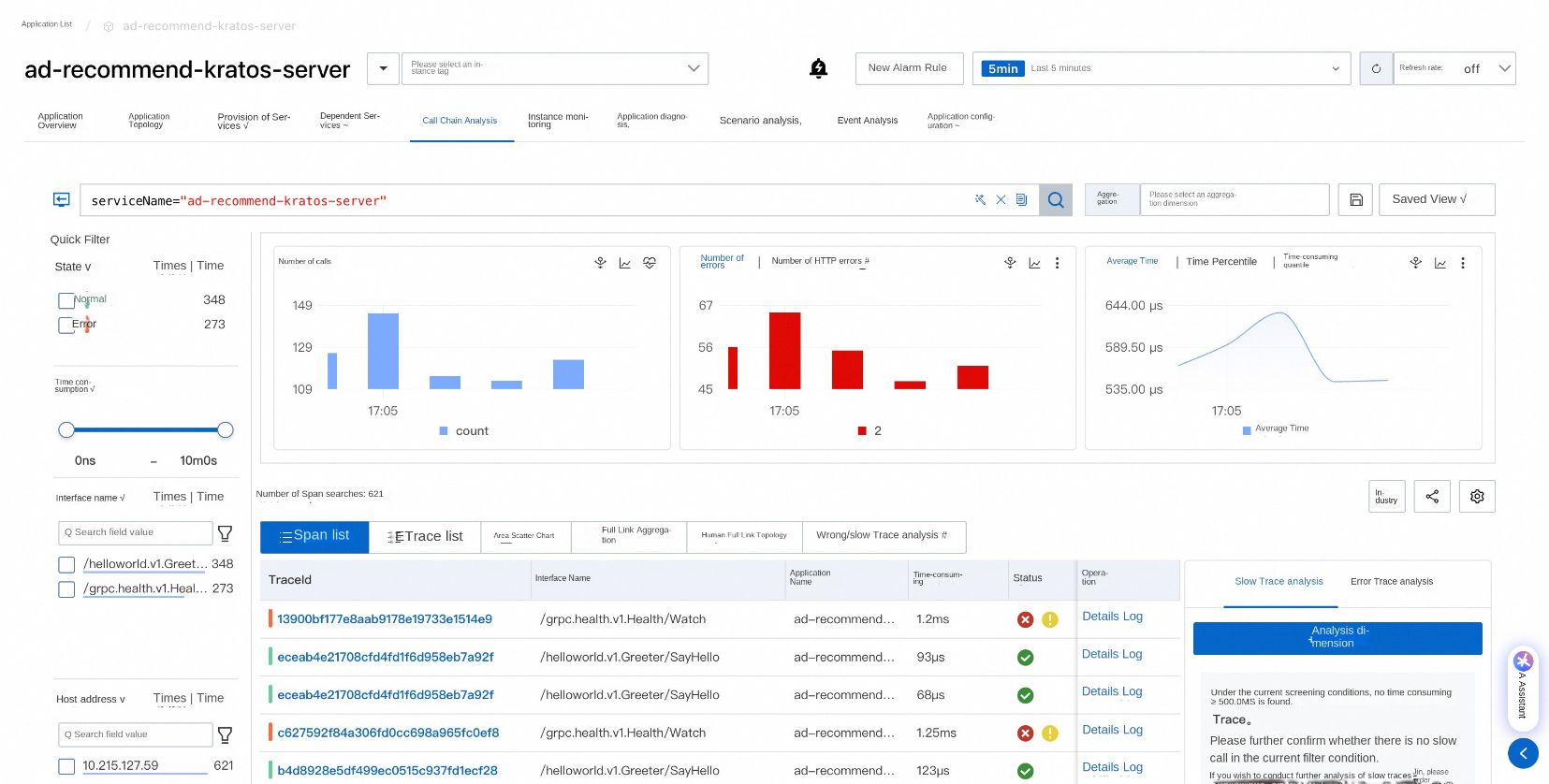
Tracing analysis
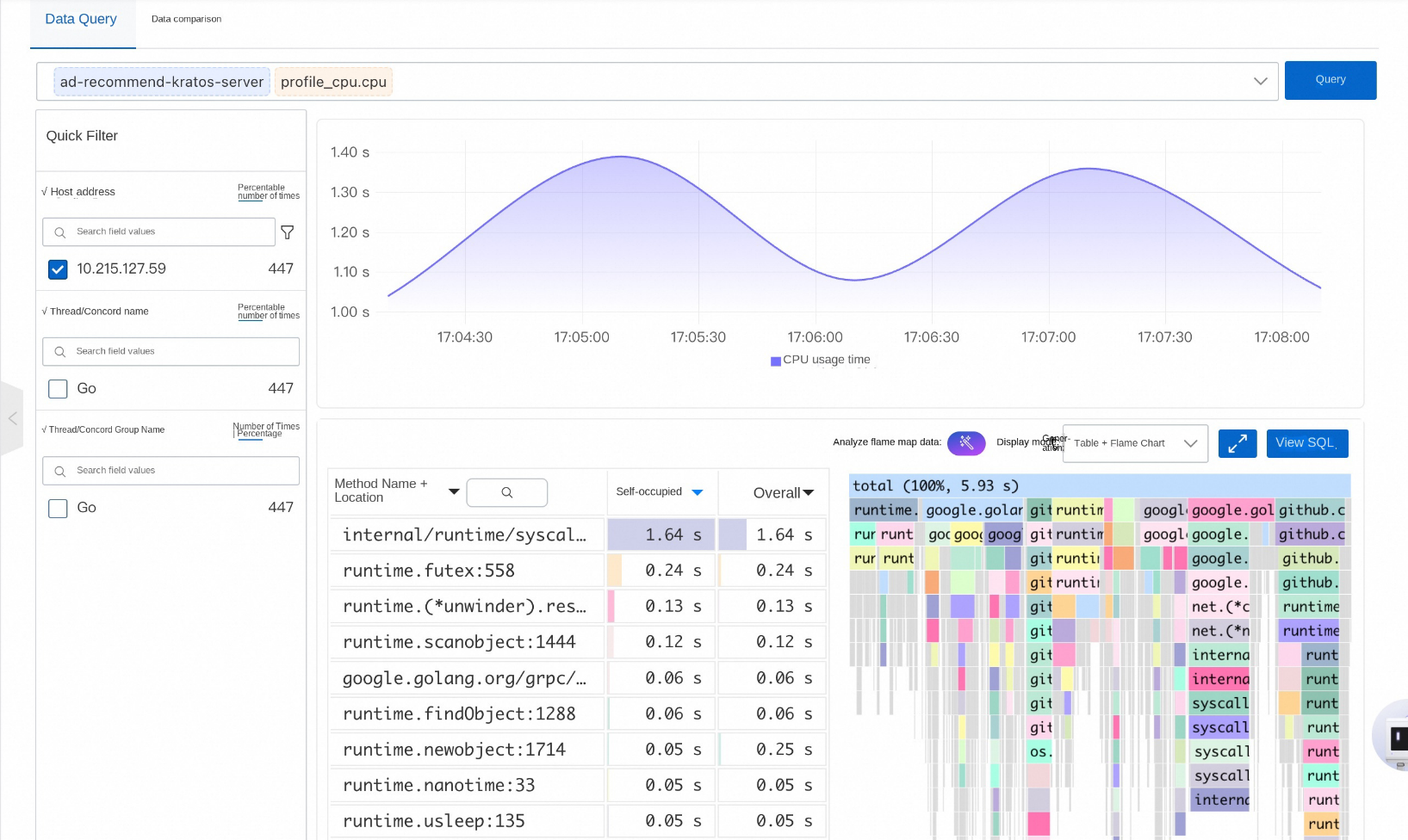
Continuous profiling
This solution has been successfully verified by customers in many realms such as e-commerce, short plays, AI video, and automotive. After seeing the immense value it brings to users and verifying its stability and feasibility, we decided to contribute its core capabilities to the OpenTelemetry community, hoping it will become an inclusive technology. At the same time, we collaborated with Datadog, a top vendor in the observability realm, to jointly promote and finally facilitate the birth of this official project [1].
Currently, the project is in an active development stage. We welcome everyone to try it out, provide feedback, and participate in contributions to jointly build a better cloud-native observability ecosystem.
[1] OpenTelemetry Go compile instrumentation project: https://github.com/open-telemetry/opentelemetry-go-compile-instrumentation
[2] Release link: https://github.com/open-telemetry/opentelemetry-go-compile-instrumentation/releases/tag/v0.1.0
[3] Alibaba Cloud ARMS Go agent Commercial Edition: https://www.alibabacloud.com/help/en/arms/application-monitoring/user-guide/monitoring-the-golang-applications/
[4] Custom extension: https://www.alibabacloud.com/help/en/arms/application-monitoring/use-cases/use-golang-agent-to-customize-scalability
Android Crash Monitoring: A Complete Troubleshooting Flow for Production Environment Crashes

736 posts | 60 followers
FollowAlibaba Cloud Native Community - November 18, 2024
Alibaba Cloud Native Community - February 2, 2026
Alibaba Cloud Native Community - July 4, 2023
Alibaba Cloud Native Community - October 15, 2024
Alibaba Cloud Native Community - April 18, 2025
Alibaba Container Service - October 12, 2024
736 posts | 60 followers
Follow DevOps Solution
Accelerate software development and delivery by integrating DevOps with the cloud
Learn More Managed Service for OpenTelemetry
Allows developers to quickly identify root causes and analyze performance bottlenecks for distributed applications.
Learn More Managed Service for Prometheus
Multi-source metrics are aggregated to monitor the status of your business and services in real time.
Learn More Application Real-Time Monitoring Service
Build business monitoring capabilities with real time response based on frontend monitoring, application monitoring, and custom business monitoring capabilities
Learn MoreMore Posts by Alibaba Cloud Native Community

