本文為您介紹如何進行PyODPS的列運算。
前提條件
請提前完成如下操作:
在DataWorks上完成商務程序建立,本例使用DataWorks簡單模式。詳情請參見建立商務程序。
操作步驟
建立表並匯入資料。
下載鳶尾花資料集iris.data,重新命名為iris.csv。
建立表pyodps_iris並上傳資料集iris.csv。操作方法請參見建表並上傳資料。
建表語句如下。
CREATE TABLE if not exists pyodps_iris
(
sepallength  DOUBLE comment '片長度(cm)',
sepalwidth   DOUBLE comment '片寬度(cm)',
petallength  DOUBLE comment '瓣長度(cm)',
petalwidth   DOUBLE comment '瓣寬度(cm)',
name         STRING comment '種類'
);
- 登入DataWorks控制台。
在左側導覽列上單擊工作空間。
選擇目標工作空間操作列中的。
在資料開發頁面,按右鍵已經建立的商務程序,選擇。
在建立節點對話方塊,輸入節點名稱,並單擊確認。
在PyODPS節點輸入範例程式碼。
範例程式碼如下。
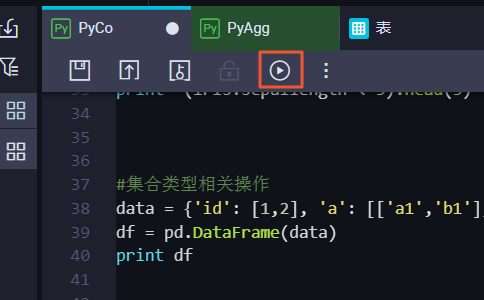
from odps import DataFrame import numpy as np import pandas as pd iris = DataFrame(o.get_table('pyodps_iris')) #判斷是否為null。 print iris.sepallength.isnull().head(5) #邏輯判斷。 print (iris.sepallength > 5).ifelse('gt5','lte5').rename('cmp5').head(5) #多條件判斷。 print iris.sepallength.switch(4.9,'eq4.9',5.0,'eq5.0',default='noeq').rename('equalness').head(5) from odps.df import switch print switch(iris.sepallength == 4.9,'eq4.9',iris.sepallength == 5.0,'eq5.0',default='noeq').rename('equalness').head(5) #修該資料集某一列的一部分值。 iris[iris.sepallength > 5,'cmp5'] = 'gt5' iris[iris.sepallength <=5,'cmp5'] = 'lte5' print iris.head(5) #數學計算。 print (iris.sepallength * 10).log().head(5) fields = [iris.sepallength,(iris.sepallength /2).rename('sepallength/2'),(iris.sepallength ** 2).rename('sepallength的平方')] print iris[fields].head(5) print (iris.sepallength < 5).head(5) #集合類型相關操作。 data = {'id': [1,2], 'a': [['a1','b1'],['c1']], 'b': [{'a2': 0, 'b2': 1, 'c2': 2},{'d2': 3, 'e2': 4}]} df = pd.DataFrame(data) print df df1 = DataFrame(df, unknown_as_string=True, as_type={'a': 'list<string>','b' : 'dict<string,int64>'}) print df1.dtypes print df1.head() print df1[df1.id,df1.a[0],df1.b.len()].head() print df1.a.explode().head() print df1.a.explode(pos=True).head() print df1.b.explode().head() print df1.b.explode(['key','value']).head() #explode與其他並列多行輸出。 print df1[df1.id,df1.a.explode()].head() #isin,notin,cut。 #isin用於判斷Sequence裡的元素是否在某個集合元素裡;notin反之。 print iris.sepallength.isin([4.9,5.1]).rename('sepallength').head() #cut提供離散化的操作,可以將Sequence的資料拆成幾個區段。 print iris.sepallength.cut(range(6),labels=['0-1','1-2','2-3','3-4','4-5']).rename('sepallength_cut').head(5) #include_under和include_over可以分別包括向下和向上的區間。 labels = ['0-1', '1-2', '2-3', '3-4', '4-5', '5-'] iris.sepallength.cut(range(6), labels=labels, include_over=True).rename('sepallength_cut').head(5)單擊運行。
在作業記錄中查看結果。
運行結果如下。
Executing user script with PyODPS 0.8.0

Sql compiled:
CREATE TABLE tmp_pyodps_32e39a9a_8ae6_4815_b465_4b9dfa3bf1b9 LIFECYCLE 1 AS
SELECT t1.`sepallength` IS NULL AS `sepallength`
FROM DQC_0221_dev.`pyodps_iris` t1

  sepallength
0       False
1       False
2       False
3       False
4       False
Sql compiled:
CREATE TABLE tmp_pyodps_d684aded_8ad8_4119_8558_1fddd774dd3f LIFECYCLE 1 AS
SELECT IF(t1.`sepallength` > 5, 'gt5', 'lte5') AS `cmp5`
FROM DQC_0221_dev.`pyodps_iris` t1

   cmp5
0  lte5
1  lte5
2  lte5
3  lte5
4   gt5
Sql compiled:
CREATE TABLE tmp_pyodps_cfc5bdb9_6d3e_4711_8acc_913b29b96c9a LIFECYCLE 1 AS
SELECT CASE t1.`sepallength` WHEN 4.9 THEN 'eq4.9' WHEN 5.0 THEN 'eq5.0' ELSE 'noeq' END AS `equalness`
FROM DQC_0221_dev.`pyodps_iris` t1

  equalness
0     eq4.9
1      noeq
2      noeq
3     eq5.0
4      noeq
Sql compiled:
CREATE TABLE tmp_pyodps_d1fd70b4_2ad8_4dc9_838e_f566f7f5841e LIFECYCLE 1 AS
SELECT CASE WHEN t1.`sepallength` == 4.9 THEN 'eq4.9' WHEN t1.`sepallength` == 5.0 THEN 'eq5.0' ELSE 'noeq' END AS `equalness`
FROM DQC_0221_dev.`pyodps_iris` t1

  equalness
0     eq4.9
1      noeq
2      noeq
3     eq5.0
4      noeq
Sql compiled:
CREATE TABLE tmp_pyodps_d9e5d64e_1f21_4ffb_993f_70d3f36b6553 LIFECYCLE 1 AS
SELECT t1.`sepallength`, t1.`sepalwidth`, t1.`petallength`, t1.`petalwidth`, t1.`name`, IF(t1.`sepallength` <= 5, 'lte5', IF(t1.`sepallength` > 5, 'gt5', CAST(NULL AS STRING))) AS `cmp5`
FROM DQC_0221_dev.`pyodps_iris` t1

   sepallength  sepalwidth  petallength  petalwidth         name  cmp5
0          4.9         3.0          1.4         0.2  Iris-setosa  lte5
1          4.7         3.2          1.3         0.2  Iris-setosa  lte5
2          4.6         3.1          1.5         0.2  Iris-setosa  lte5
3          5.0         3.6          1.4         0.2  Iris-setosa  lte5
4          5.4         3.9          1.7         0.4  Iris-setosa   gt5
Sql compiled:
CREATE TABLE tmp_pyodps_4bfb0aa0_7ec5_4f35_9480_d36baf2b8079 LIFECYCLE 1 AS
SELECT LN(t1.`sepallength` * 10) AS `sepallength`
FROM DQC_0221_dev.`tmp_pyodps_d9e5d64e_1f21_4ffb_993f_70d3f36b6553` t1

   sepallength
0     3.891820
1     3.850148
2     3.828641
3     3.912023
4     3.988984
Sql compiled:
CREATE TABLE tmp_pyodps_deb6fa45_fbb1_41d2_8174_76d35eebea9c LIFECYCLE 1 AS
SELECT t1.`sepallength`, t1.`sepallength` / 2 AS `sepallength/2`, POW(t1.`sepallength`, 2) AS `sepallength的平方`
FROM DQC_0221_dev.`tmp_pyodps_d9e5d64e_1f21_4ffb_993f_70d3f36b6553` t1

   sepallength  sepallength/2  sepallength的平方
0          4.9           2.45           24.01
1          4.7           2.35           22.09
2          4.6           2.30           21.16
3          5.0           2.50           25.00
4          5.4           2.70           29.16
Sql compiled:
CREATE TABLE tmp_pyodps_fa326546_c5e8_466f_915d_e783b7dcacdf LIFECYCLE 1 AS
SELECT t1.`sepallength` < 5 AS `sepallength`
FROM DQC_0221_dev.`tmp_pyodps_d9e5d64e_1f21_4ffb_993f_70d3f36b6553` t1


  sepallength
0        True
1        True
2        True
3       False
4       False
          a                               b  id
0  [a1, b1]  {u'c2': 2, u'a2': 0, u'b2': 1}   1
1      [c1]            {u'd2': 3, u'e2': 4}   2
odps.Schema {
  a   list<string>
  b   dict<string,int64>
  id  int64
}
          a                               b  id
0  [a1, b1]  {u'c2': 2, u'a2': 0, u'b2': 1}   1
1      [c1]            {u'd2': 3, u'e2': 4}   2
   id   a  b
0   1  a1  3
1   2  c1  2
    a
0  a1
1  b1
2  c1
   a_pos   a
0      0  a1
1      1  b1
2      0  c1
  b_key  b_value
0    c2        2
1    a2        0
2    b2        1
3    d2        3
4    e2        4
  key  value
0  c2      2
1  a2      0
2  b2      1
3  d2      3
4  e2      4

   id   a
0   1  a1
1   1  b1
2   2  c1
Sql compiled:
CREATE TABLE tmp_pyodps_fb28d9b9_fa45_4712_a564_dd751641286e LIFECYCLE 1 AS
SELECT t1.`sepallength` IN (4.9, 5.1) AS `sepallength`
FROM DQC_0221_dev.`tmp_pyodps_d9e5d64e_1f21_4ffb_993f_70d3f36b6553` t1

   sepallength
0         True
1        False
2        False
3        False
4        False
5        False
6        False
7        False
8         True
9        False
10       False
11       False
12       False
13       False
14       False
15       False
16        True
17       False
18        True
19       False
20        True
21       False
22        True
23       False
24       False
25       False
26       False
27       False
28       False
29       False
30       False
31       False
32       False
33        True
34       False
35       False
36        True
37       False
38        True
39       False
40       False
41       False
42       False
43        True
44       False
45        True
46       False
47       False
48       False
49       False
50       False
51       False
52       False
53       False
54       False
55       False
56        True
57       False
58       False
59       False
Sql compiled:
CREATE TABLE tmp_pyodps_1f85e8e1_a9f0_473f_ac0e_d526fdd80dc4 LIFECYCLE 1 AS
SELECT CASE WHEN (0 < t1.`sepallength`) AND (t1.`sepallength` <= 1) THEN '0-1' WHEN (1 < t1.`sepallength`) AND (t1.`sepallength` <= 2) THEN '1-2' WHEN (2 < t1.`sepallength`) AND (t1.`sepallength` <= 3) THEN '2-3' WHEN (3 < t1.`sepallength`) AND (t1.`sepallength` <= 4) THEN '3-4' WHEN (4 < t1.`sepallength`) AND (t1.`sepallength` <= 5) THEN '4-5' END AS `sepallength_cut`
FROM DQC_0221_dev.`tmp_pyodps_d9e5d64e_1f21_4ffb_993f_70d3f36b6553` t1
  sepallength_cut
0             4-5
1             4-5
2             4-5
3             4-5
4            None
Sql compiled:
CREATE TABLE tmp_pyodps_080a677e_904b_4edc_a961_160f8c664d7f LIFECYCLE 1 AS
SELECT CASE WHEN (0 < t1.`sepallength`) AND (t1.`sepallength` <= 1) THEN '0-1' WHEN (1 < t1.`sepallength`) AND (t1.`sepallength` <= 2) THEN '1-2' WHEN (2 < t1.`sepallength`) AND (t1.`sepallength` <= 3) THEN '2-3' WHEN (3 < t1.`sepallength`) AND (t1.`sepallength` <= 4) THEN '3-4' WHEN (4 < t1.`sepallength`) AND (t1.`sepallength` <= 5) THEN '4-5' WHEN 5 < t1.`sepallength` THEN '5-' END AS `sepallength_cut`
FROM DQC_0221_dev.`tmp_pyodps_d9e5d64e_1f21_4ffb_993f_70d3f36b6553` t1