O acesso a arquivos (objetos) no Object Storage Service (OSS) pode consumir muita largura de banda. Em clientes com controle de tráfego limitado, isso pode afetar outras aplicações. Para evitar esse problema, use o recurso de limitação de largura de banda de conexão única do OSS para controlar o tráfego durante operações como upload e download de arquivos. Assim, você garante largura de banda de rede suficiente para outras aplicações.
Observações de uso
Inclua o parâmetro x-oss-traffic-limit nas solicitações PutObject, AppendObject, PostObject, CopyObject, UploadPart, UploadPartCopy e GetObject e especifique um valor de limitação. O valor deve estar entre 819200 e 838860800. A unidade é bit/s.
Limitar solicitações de cliente
É possível limitar solicitações de cliente apenas com kits de desenvolvimento de software (SDKs). Os exemplos a seguir mostram como limitar solicitações de upload ou download com SDKs comuns. Para exemplos de código com outros SDKs, consulte Visão geral do SDK.
Limitação simples de upload e download
Limitação de upload multipart
Limitar largura de banda por URL de arquivo
Para arquivos com permissões de leitura pública ou leitura/gravação pública, adicione o parâmetro de limitação x-oss-traffic-limit=<value> à URL do arquivo para limitar o acesso. Por exemplo, a URL https://examplebucket.oss-cn-hangzhou.aliyuncs.com/video.mp4?x-oss-traffic-limit=819200 limita a velocidade de download do arquivo video.mp4 a 100 KB/s. A figura a seguir mostra o efeito da limitação: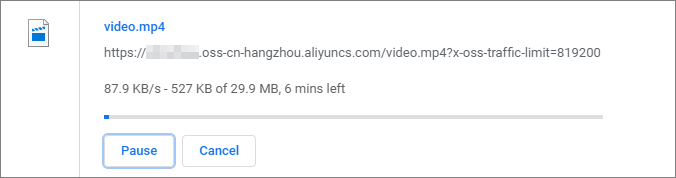
Limitar largura de banda por URL assinada
Ao usar um SDK para gerar uma URL assinada e acessar um arquivo privado, inclua o parâmetro de limitação no cálculo da assinatura. Os exemplos a seguir mostram como adicionar o parâmetro de limitação a uma URL assinada com SDKs comuns. Para exemplos de código com outros SDKs, consulte Visão geral do SDK.
import com.aliyun.oss.*;
import com.aliyun.oss.common.auth.*;
import com.aliyun.oss.common.comm.SignVersion;
import com.aliyun.oss.model.GeneratePresignedUrlRequest;
import com.aliyun.oss.model.GetObjectRequest;
import java.io.File;
import java.io.FileInputStream;
import java.io.InputStream;
import java.net.URL;
import java.util.Date;

public class Demo {
    public static void main(String[] args) throws Throwable {
        // In this example, the endpoint of the China (Hangzhou) region is used. Specify your actual endpoint.
        String endpoint = "https://oss-cn-hangzhou.aliyuncs.com";
        // Obtain access credentials from environment variables. Before you run the sample code, make sure that the OSS_ACCESS_KEY_ID and OSS_ACCESS_KEY_SECRET environment variables are configured.
        EnvironmentVariableCredentialsProvider credentialsProvider = CredentialsProviderFactory.newEnvironmentVariableCredentialsProvider();
        // Specify the name of the bucket. Example: examplebucket.
        String bucketName = "examplebucket";
        // Specify the full path of the object. Do not include the bucket name in the full path. Example: exampledir/exampleobject.txt.
        String objectName = "exampledir/exampleobject.txt";

        // Specify the full path of the local file that you want to upload. Example: D:\\localpath\\examplefile.txt.
        // If you do not specify the path of the local file, the local file is uploaded from the path of the project to which the sample program belongs.
        String localFileName = "D:\\localpath\\examplefile.txt";

        // Specify the full path to which you want to download the object. If a file that has the same name already exists, the downloaded object overwrites the file. Otherwise, the downloaded object is saved in the path.
        // If you do not specify a path for the downloaded object, the downloaded object is saved to the path of the project to which the sample program belongs.
        String downLoadFileName = "D:\\localpath\\exampleobject.txt";

        // Set the bandwidth limit to 100 KB/s.
        int limitSpeed = 100 * 1024 * 8;
        // Specify the region in which the bucket is located. For example, if the bucket is located in the China (Hangzhou) region, set the region to cn-hangzhou.
        String region = "cn-hangzhou";

        // Create an OSS Client instance.
        // Call the shutdown method to release associated resources when the OSS Client is no longer in use.
        ClientBuilderConfiguration clientBuilderConfiguration = new ClientBuilderConfiguration();
        clientBuilderConfiguration.setSignatureVersion(SignVersion.V4);
        OSS ossClient = OSSClientBuilder.create()
        .endpoint(endpoint)
        .credentialsProvider(credentialsProvider)
        .clientConfiguration(clientBuilderConfiguration)
        .region(region)
        .build();

        try {
            // Generate a signed URL that includes the bandwidth throttling parameter for object upload and set the validity period of the URL to 60 seconds.
            Date date = new Date();
            date.setTime(date.getTime() + 60 * 1000);
            GeneratePresignedUrlRequest request = new GeneratePresignedUrlRequest(bucketName, objectName, HttpMethod.PUT);
            request.setExpiration(date);
            request.setTrafficLimit(limitSpeed);
            URL signedUrl = ossClient.generatePresignedUrl(request);
            System.out.println("put object url" + signedUrl);

            // Configure bandwidth throttling for object upload.
            InputStream inputStream = new FileInputStream(localFileName);
            ossClient.putObject(signedUrl, inputStream, -1, null, true);

            // Generate a signed URL that includes the bandwidth throttling parameter for object download and set the validity period of the URL to 60 seconds.
            date = new Date();
            date.setTime(date.getTime() + 60 * 1000);
            request = new GeneratePresignedUrlRequest(bucketName, objectName, HttpMethod.GET);
            request.setExpiration(date);
            request.setTrafficLimit(limitSpeed);
            signedUrl = ossClient.generatePresignedUrl(request);
            System.out.println("get object url" + signedUrl);

            // Configure bandwidth throttling for object download.
            GetObjectRequest getObjectRequest =  new GetObjectRequest(signedUrl, null);
            ossClient.getObject(getObjectRequest, new File(downLoadFileName));
        } catch (OSSException oe) {
            System.out.println("Caught an OSSException, which means your request made it to OSS, "
                    + "but was rejected with an error response for some reason.");
            System.out.println("Error Message:" + oe.getErrorMessage());
            System.out.println("Error Code:" + oe.getErrorCode());
            System.out.println("Request ID:" + oe.getRequestId());
            System.out.println("Host ID:" + oe.getHostId());
        } catch (ClientException ce) {
            System.out.println("Caught an ClientException, which means the client encountered "
                    + "a serious internal problem while trying to communicate with OSS, "
                    + "such as not being able to access the network.");
            System.out.println("Error Message:" + ce.getMessage());
        } finally {
            if (ossClient != null) {
                ossClient.shutdown();
            }
        }
    }
}
<?php
if (is_file(__DIR__ . '/../autoload.php')) {
require_once __DIR__ . '/../autoload.php';
}
if (is_file(__DIR__ . '/../vendor/autoload.php')) {
require_once __DIR__ . '/../vendor/autoload.php';
}
use OSS\Credentials\EnvironmentVariableCredentialsProvider;
use OSS\OssClient;
use OSS\Core\OssException;
// Obtain access credentials from environment variables. Before you run the sample code, make sure that the OSS_ACCESS_KEY_ID and OSS_ACCESS_KEY_SECRET environment variables are configured.
$provider = new EnvironmentVariableCredentialsProvider();
// Specify the endpoint of the region in which the bucket is located. For example, if the bucket is located in the China (Hangzhou) region, set the endpoint to https://oss-cn-hangzhou.aliyuncs.com.
$endpoint = "yourEndpoint";
// Specify the name of the bucket. Example: examplebucket.
$bucket= "examplebucket";
// Specify the full path of the object. Example: exampledir/exampleobject.txt. Do not include the bucket name in the full path.
$object = "exampledir/exampleobject.txt";
$config = array(
"provider" => $provider,
"endpoint" => $endpoint,
"signatureVersion" => OssClient::OSS_SIGNATURE_VERSION_V4,
"region"=> "cn-hangzhou"
);
$ossClient = new OssClient($config);
// Set the bandwidth limit to 100 KB/s, which is equal to 819,200 bit/s.
$options = array(
OssClient::OSS_TRAFFIC_LIMIT => 819200,
);
// Generate a signed URL for object upload with single-connection bandwidth throttling configured and set the validity period of the URL to 60 seconds.
$timeout = 60;
$signedUrl = $ossClient->signUrl($bucket, $object, $timeout, "PUT", $options);
print($signedUrl);
// Generate a signed URL for object download with single-connection bandwidth throttling configured and set the validity period of the URL to 120 seconds.
$timeout = 120;
$signedUrl = $ossClient->signUrl($bucket, $object, $timeout, "GET", $options);
print($signedUrl);# -*- coding: utf-8 -*-
import oss2
from oss2.credentials import EnvironmentVariableCredentialsProvider
from oss2.models import OSS_TRAFFIC_LIMIT
# Obtain access credentials from environment variables. Before you run the sample code, make sure that the OSS_ACCESS_KEY_ID and OSS_ACCESS_KEY_SECRET environment variables are configured.
auth = oss2.ProviderAuthV4(EnvironmentVariableCredentialsProvider())
# Specify the endpoint of the region in which the bucket is located. For example, if the bucket is located in the China (Hangzhou) region, set the endpoint to https://oss-cn-hangzhou.aliyuncs.com.
endpoint = "https://oss-cn-hangzhou.aliyuncs.com"
# Specify the ID of the region that maps to the endpoint. Example: cn-hangzhou. This parameter is required if you use the signature algorithm V4.
region = "cn-hangzhou"
# Specify the name of the bucket.
bucket = oss2.Bucket(auth, endpoint, "examplebucket", region=region)
# Specify the full path of the object. Do not include the bucket name in the full path. Example: exampledir/exampleobject.txt.
object_name = 'exampledir/exampleobject.txt'
# Specify the full path of the local file that you want to upload. Example: D:\\localpath\\examplefile.txt. By default, if you do not specify the path of the local file, the local file is uploaded from the path of the project to which the sample program belongs.
local_file_name = 'D:\\localpath\\examplefile.txt'
# Specify the local path to which you want to download the object. If a file that has the same name already exists, the downloaded object overwrites the file. If no file that has the same name exists, the downloaded object is saved in the path.
# If you do not specify a path for the downloaded object, the downloaded object is saved to the path of the project to which the sample program belongs.
down_file_name = 'D:\\localpath\\exampleobject.txt'
# Configure the params parameter to set the bandwidth limit to 100 KB/s, which is equal to 819,200 bit/s.
limit_speed = (100 * 1024 * 8)
params = dict()
params[OSS_TRAFFIC_LIMIT] = str(limit_speed)
# Generate a signed URL that includes the bandwidth throttling parameter for object upload and set the validity period of the URL to 60 seconds.
url = bucket.sign_url('PUT', object_name, 60, params=params)
print('put object url:', url)
# Configure bandwidth throttling for object upload.
result = bucket.put_object_with_url_from_file(url, local_file_name)
print('http response status:', result.status)
# Generate a signed URL that includes the bandwidth throttling parameter for object download and set the validity period of the URL to 60 seconds.
url = bucket.sign_url('GET', object_name, 60, params=params)
print('get object url:', url)
# Configure bandwidth throttling for object download.
result = bucket.get_object_with_url_to_file(url, down_file_name)
print('http response status:', result.status)using System.Text;
using Aliyun.OSS;
using Aliyun.OSS.Common;
// Specify the endpoint of the region in which the bucket is located. For example, if the bucket is located in the China (Hangzhou) region, set the endpoint to https://oss-cn-hangzhou.aliyuncs.com.
var endpoint = "https://oss-cn-hangzhou.aliyuncs.com";
// Obtain access credentials from environment variables. Before you run the sample code, make sure that the OSS_ACCESS_KEY_ID and OSS_ACCESS_KEY_SECRET environment variables are configured.
var accessKeyId = Environment.GetEnvironmentVariable("OSS_ACCESS_KEY_ID");
var accessKeySecret = Environment.GetEnvironmentVariable("OSS_ACCESS_KEY_SECRET");
// Specify the name of the bucket. Example: examplebucket.
var bucketName = "examplebucket";
// Specify the full path of the object. Do not include the bucket name in the full path. Example: exampledir/exampleobject.txt.
var objectName = "exampledir/exampleobject.txt";
var objectContent = "More than just cloud.";
var downloadFilename = "D:\\localpath\\examplefile.txt";
// Specify the region in which the bucket is located. For example, if the bucket is located in the China (Hangzhou) region, set the region to cn-hangzhou.
const string region = "cn-hangzhou";
// Create a ClientConfiguration instance and modify parameters as required.
var conf = new ClientConfiguration();
// Use the signature algorithm V4.
conf.SignatureVersion = SignatureVersion.V4;
// Create an OSSClient instance.
var client = new OssClient(endpoint, accessKeyId, accessKeySecret, conf);
client.SetRegion(region);
try
{
// Generate a signed URL to upload the object.
var generatePresignedUriRequest = new GeneratePresignedUriRequest(bucketName, objectName, SignHttpMethod.Put)
{
Expiration = DateTime.Now.AddHours(1),
};
// Set the bandwidth limit to 100 KB/s, which is equal to 819,200 bit/s.
generatePresignedUriRequest.AddQueryParam("x-oss-traffic-limit", "819200");
var signedUrl = client.GeneratePresignedUri(generatePresignedUriRequest);
// Use the signed URLs to upload the object.
var buffer = Encoding.UTF8.GetBytes(objectContent);
using (var ms = new MemoryStream(buffer))
{
client.PutObject(signedUrl, ms);
}
Console.WriteLine("Put object by signatrue succeeded. {0} ", signedUrl.ToString());
var metadata = client.GetObjectMetadata(bucketName, objectName);
var etag = metadata.ETag;
// Generate a signed URL to download the object.
// Set the bandwidth limit to 100 KB/s, which is equal to 819,200 bit/s.
var req = new GeneratePresignedUriRequest(bucketName, objectName, SignHttpMethod.Get);
req.AddQueryParam("x-oss-traffic-limit", "819200");
var uri = client.GeneratePresignedUri(req);
// Use the signed URL to download the object.
OssObject ossObject = client.GetObject(uri);
using (var file = File.Open(downloadFilename, FileMode.OpenOrCreate))
{
using (Stream stream = ossObject.Content)
{
int length = 4 * 1024;
var buf = new byte[length];
do
{
length = stream.Read(buf, 0, length);
file.Write(buf, 0, length);
} while (length != 0);
}
}
Console.WriteLine("Get object by signatrue succeeded. {0} ", uri.ToString());
}
catch (Exception ex)
{
Console.WriteLine("Put object failed, {0}", ex.Message);
}#include <alibabacloud/oss/OssClient.h>
#include <fstream>
using namespace AlibabaCloud::OSS;
int main(void)
{
/* Initialize OSS account information. */
/* Set yourEndpoint to the endpoint of the region where the bucket is located. For example, for the China (Hangzhou) region, set the endpoint to https://oss-cn-hangzhou.aliyuncs.com. */
std::string Endpoint = "yourEndpoint";
/* Set yourRegion to the region where the bucket is located. For example, for the China (Hangzhou) region, set the region to cn-hangzhou. */
std::string Region = "yourRegion";
/* Specify the bucket name, for example, examplebucket. */
std::string BucketName = "examplebucket";
/* Specify the full path of the object. The full path cannot contain the bucket name. For example, exampledir/exampleobject.txt. */
std::string ObjectName = "exampledir/exampleobject.txt";
/* Initialize network resources. */
InitializeSdk();
ClientConfiguration conf;
conf.signatureVersion = SignatureVersionType::V4;
/* Obtain access credentials from environment variables. Before you run this sample code, make sure that the OSS_ACCESS_KEY_ID and OSS_ACCESS_KEY_SECRET environment variables are set. */
auto credentialsProvider = std::make_shared<EnvironmentVariableCredentialsProvider>();
OssClient client(Endpoint, credentialsProvider, conf);
client.SetRegion(Region);
/* Set the validity period of the signature. The maximum validity period is 32,400 seconds. */
std::time_t expires = std::time(nullptr) + 1200;
/* Generate a URL for uploading the file. */
GeneratePresignedUrlRequest putrequest(BucketName, ObjectName, Http::Put);
putrequest.setExpires(expires);
/* Set the upload bandwidth limit to 100 KB/s. */
putrequest.setTrafficLimit(819200);
auto genOutcome = client.GeneratePresignedUrl(putrequest);
std::shared_ptr<std::iostream> content = std::make_shared<std::stringstream>();
*content << "test cpp sdk";
/* Print the result of the signed URL for the upload. */
std::cout << "Signed URL for upload: " << genOutcome.result() << std::endl;
/* Use the signed URL to upload the file. */
auto outcome = client.PutObjectByUrl(genOutcome.result(), content);
/* Generate a URL for downloading the file. */
GeneratePresignedUrlRequest getrequest(BucketName, ObjectName, Http::Get);
getrequest.setExpires(expires);
/* Set the download bandwidth limit to 100 KB/s. */
getrequest.setTrafficLimit(819200);
genOutcome = client.GeneratePresignedUrl(getrequest);
/* Print the result of the signed URL for the download. */
std::cout << "Signed URL for download: " << genOutcome.result() << std::endl;
/* Use the signed URL to download the file. */
auto goutcome = client.GetObjectByUrl(genOutcome.result());
/* Release network resources. */
ShutdownSdk();
return 0;
}