Este tópico descreve como consultar dados em tabelas internas ou por meio de foreign tables no Hologres. O objetivo é permitir que você experimente o desempenho superior das consultas de dados no Hologres.
Pré-requisitos
Adquira uma instância do Hologres. Para mais informações, consulte Adquirir uma instância do Hologres.
Conceda as permissões necessárias ao usuário RAM que executará as operações. Para mais informações, consulte Conceder permissões a um usuário RAM.
Informações de fundo
O Hologres responde rapidamente às solicitações de consulta de dados. Este tópico explica como criar um banco de dados, definir foreign tables e tabelas internas e importar dados para as tabelas internas no Hologres. Além disso, aborda como consultar dados diretamente nas tabelas internas ou utilizando foreign tables, permitindo que você vivencie a alta performance das consultas no Hologres.
Procedimento
-
Esta etapa mostra como criar um banco de dados no Hologres. Use esse banco de dados para armazenar os dados da sua instância do Hologres para consultas futuras.
-
No banco de dados criado, crie uma tabela para armazenar dados de exemplo. As tabelas dividem-se em duas categorias:
Foreign tables mapeiam campos de fontes de dados externas e não armazenam dados no Hologres.
Tabelas internas servem para armazenar dados dentro do Hologres.
-
Nesta etapa, você aprenderá a importar dados para tabelas internas no Hologres visando consultas posteriores. Neste exemplo, utilizamos dados dos conjuntos TPC Benchmark H (TPC-H).
-
Aqui demonstramos como executar consultas nas tabelas. Utilizamos as 22 instruções SQL do TPC-H como exemplo, o que permite avaliar a rapidez e a estabilidade das consultas de dados no Hologres.
Etapa 1: Criar um banco de dados
Faça login no console do Hologres. No painel de navegação à esquerda, clique em Instances.
Na página Instances, clique no nome da instância desejada.
No painel de navegação à esquerda da página Instance Details, clique em Database Management.
-
Na página DB Authorization, clique em Create Database no canto superior direito.

-
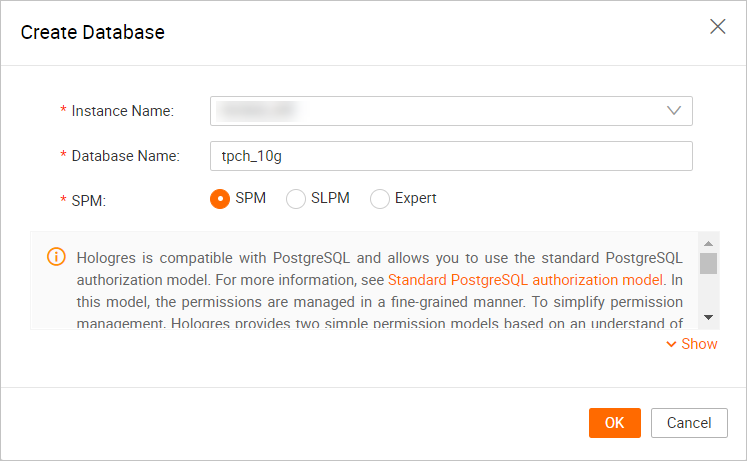
Na caixa de diálogo Create Database, configure os seguintes parâmetros.
Parâmetro
Descrição
Instance Name
Nome da instância do Hologres onde você deseja criar o banco de dados. Por padrão, o sistema exibe o nome da instância conectada. Também é possível selecionar outra instância do Hologres na lista suspensa.
Database Name
Nome do banco de dados. Neste exemplo, usamos tpch_10g.
NotaO nome do banco de dados deve ser exclusivo.
Permission Model
Selecione uma política de acesso para o banco de dados criado. Para mais detalhes sobre políticas de acesso, consulte:
-
SPM: modelo de permissão simples (SPM). Ao escolher SPM, as permissões são concedidas no nível do banco de dados. As funções disponíveis incluem admin, developer, writer e viewer. Esse modelo facilita o gerenciamento seguro de permissões em objetos do banco de dados por meio de poucas funções de gestão.
-
SLPM: modelo de permissão no nível de schema (SLPM). Com o SLPM, as permissões são atribuídas no nível do schema. As funções oferecidas são <db>.admin, <db>.<schema>.developer, <db>.<schema>.writer e <db>.<schema>.viewer. Em comparação ao SPM, o SLPM proporciona um controle de permissões mais granular.
-
modelo de autorização padrão do PostgreSQL: o Hologres é compatível com o PostgreSQL e utiliza seu sistema de permissões nativo.
-
Etapa 2: Criar tabelas
Após criar o banco de dados, defina as tabelas necessárias. Escolha entre foreign tables ou tabelas internas dependendo do local onde seus dados estão armazenados.
-
Criar uma foreign table
-
Conecte-se ao banco de dados.
Na página de desenvolvimento do HoloWeb, clique em Metadata Management.
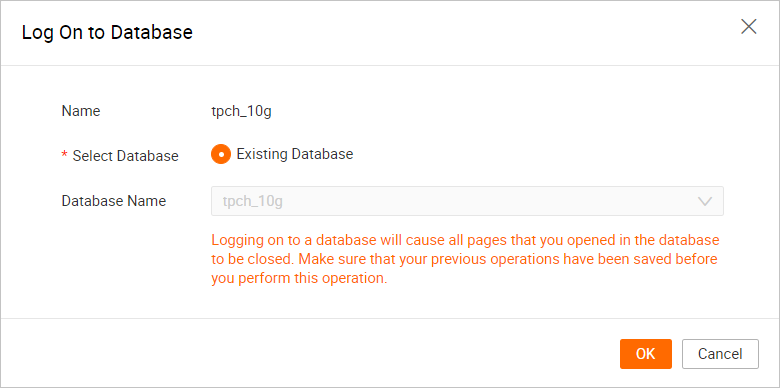
Na página Metadata Management, clique duas vezes no nome do banco de dados criado na árvore de diretórios à esquerda e, em seguida, clique em OK.
-
Crie as foreign tables.
Na página SQL Editor, clique no ícone
 no canto superior esquerdo.
-
Na nova página Ad-hoc Query, selecione o Instance Name e o Database desejados. Depois, insira as instruções abaixo no editor SQL e clique em Run.
As instruções SQL a seguir criam foreign tables para consultas futuras. Essas tabelas mapeiam campos das tabelas source, como odps_customer_10g e odps_lineitem_10g, localizadas no projeto MaxCompute MAXCOMPUTE_PUBLIC_DATA.
DROP FOREIGN TABLE IF EXISTS odps_customer_10g;
DROP FOREIGN TABLE IF EXISTS odps_lineitem_10g;
DROP FOREIGN TABLE IF EXISTS odps_nation_10g;
DROP FOREIGN TABLE IF EXISTS odps_orders_10g;
DROP FOREIGN TABLE IF EXISTS odps_part_10g;
DROP FOREIGN TABLE IF EXISTS odps_partsupp_10g;
DROP FOREIGN TABLE IF EXISTS odps_region_10g;
DROP FOREIGN TABLE IF EXISTS odps_supplier_10g;

IMPORT FOREIGN SCHEMA "MAXCOMPUTE_PUBLIC_DATA#default" LIMIT to
(
    odps_customer_10g,
    odps_lineitem_10g,
    odps_nation_10g,
    odps_orders_10g,
    odps_part_10g,
    odps_partsupp_10g,
    odps_region_10g,
    odps_supplier_10g
)
FROM SERVER odps_server INTO public OPTIONS(if_table_exist'error',if_unsupported_type'error');
-
-
Criar tabelas internas
-
Conecte-se ao banco de dados.
Na página de desenvolvimento do HoloWeb, clique em Metadata Management.
Na página Metadata Management, clique duas vezes no nome do banco de dados criado na árvore de diretórios à esquerda e, em seguida, clique em OK.
-
Crie as tabelas internas.
Na página SQL Editor, clique em New SQL Window no canto superior esquerdo.
-
Na nova página Ad-hoc Query, selecione o Instance Name e o Database criados anteriormente. Em seguida, insira as instruções abaixo no editor SQL e clique em Run.
Os comandos SQL seguintes criam as tabelas internas LINEITEM, ORDERS, PARTSUPP, PART, CUSTOMER, SUPPLIER, NATION e REGION. Essas tabelas armazenarão os dados para consultas posteriores.
DROP TABLE IF EXISTS LINEITEM;

BEGIN;
CREATE TABLE LINEITEM (
    L_ORDERKEY bigint NOT NULL,
    L_PARTKEY int NOT NULL,
    L_SUPPKEY int NOT NULL,
    L_LINENUMBER int NOT NULL,
    L_QUANTITY DECIMAL(15, 2) NOT NULL,
    L_EXTENDEDPRICE DECIMAL(15, 2) NOT NULL,
    L_DISCOUNT DECIMAL(15, 2) NOT NULL,
    L_TAX DECIMAL(15, 2) NOT NULL,
    L_RETURNFLAG text NOT NULL,
    L_LINESTATUS text NOT NULL,
    L_SHIPDATE date NOT NULL,
    L_COMMITDATE date NOT NULL,
    L_RECEIPTDATE date NOT NULL,
    L_SHIPINSTRUCT text NOT NULL,
    L_SHIPMODE text NOT NULL,
    L_COMMENT text NOT NULL,
    PRIMARY KEY (L_ORDERKEY, L_LINENUMBER)
);
CALL set_table_property ('LINEITEM', 'clustering_key', 'L_SHIPDATE,L_ORDERKEY');
CALL set_table_property ('LINEITEM', 'segment_key', 'L_SHIPDATE');
CALL set_table_property ('LINEITEM', 'distribution_key', 'L_ORDERKEY');
CALL set_table_property ('LINEITEM', 'bitmap_columns', 'L_RETURNFLAG,L_LINESTATUS,L_SHIPINSTRUCT,L_SHIPMODE');
CALL set_table_property ('LINEITEM', 'dictionary_encoding_columns', 'l_comment:off,l_returnflag,l_linestatus,l_shipinstruct,l_shipmode');
COMMIT;

DROP TABLE IF EXISTS ORDERS;

BEGIN;
CREATE TABLE ORDERS (
    O_ORDERKEY bigint NOT NULL PRIMARY KEY,
    O_CUSTKEY int NOT NULL,
    O_ORDERSTATUS text NOT NULL,
    O_TOTALPRICE DECIMAL(15, 2) NOT NULL,
    O_ORDERDATE date NOT NULL,
    O_ORDERPRIORITY text NOT NULL,
    O_CLERK text NOT NULL,
    O_SHIPPRIORITY int NOT NULL,
    O_COMMENT text NOT NULL
);
CALL set_table_property ('ORDERS', 'segment_key', 'O_ORDERDATE');
CALL set_table_property ('ORDERS', 'colocate_with', 'lineitem');
CALL set_table_property ('ORDERS', 'distribution_key', 'O_ORDERKEY');
CALL set_table_property ('ORDERS', 'bitmap_columns', 'O_ORDERSTATUS,O_ORDERPRIORITY,O_CLERK,O_SHIPPRIORITY');
CALL set_table_property ('ORDERS', 'dictionary_encoding_columns', 'o_comment:off,o_orderstatus,o_orderpriority,o_clerk');
COMMIT;

DROP TABLE IF EXISTS PARTSUPP;

BEGIN;
CREATE TABLE PARTSUPP (
    PS_PARTKEY int NOT NULL,
    PS_SUPPKEY int NOT NULL,
    PS_AVAILQTY int NOT NULL,
    PS_SUPPLYCOST DECIMAL(15, 2) NOT NULL,
    PS_COMMENT text NOT NULL,
    PRIMARY KEY (PS_PARTKEY, PS_SUPPKEY)
);
CALL set_table_property ('PARTSUPP', 'distribution_key', 'PS_PARTKEY');
CALL set_table_property ('PARTSUPP', 'colocate_with', 'lineitem');
CALL set_table_property ('PARTSUPP', 'bitmap_columns', 'ps_availqty');
CALL set_table_property ('PARTSUPP', 'dictionary_encoding_columns', '');
COMMIT;

DROP TABLE IF EXISTS PART;

BEGIN;
CREATE TABLE PART (
    P_PARTKEY int NOT NULL PRIMARY KEY,
    P_NAME text NOT NULL,
    P_MFGR text NOT NULL,
    P_BRAND text NOT NULL,
    P_TYPE text NOT NULL,
    P_SIZE int NOT NULL,
    P_CONTAINER text NOT NULL,
    P_RETAILPRICE DECIMAL(15, 2) NOT NULL,
    P_COMMENT text NOT NULL
);
CALL set_table_property ('PART', 'distribution_key', 'P_PARTKEY');
CALL set_table_property ('PART', 'colocate_with', 'lineitem');
CALL set_table_property ('PART', 'bitmap_columns', 'P_SIZE,P_MFGR,P_BRAND,P_TYPE,P_CONTAINER');
CALL set_table_property ('PART', 'dictionary_encoding_columns', 'p_name:off,p_comment:off,p_mfgr,p_brand,p_type,p_container');
COMMIT;

DROP TABLE IF EXISTS CUSTOMER;

BEGIN;
CREATE TABLE CUSTOMER (
    C_CUSTKEY int NOT NULL PRIMARY KEY,
    C_NAME text NOT NULL,
    C_ADDRESS text NOT NULL,
    C_NATIONKEY int NOT NULL,
    C_PHONE text NOT NULL,
    C_ACCTBAL DECIMAL(15, 2) NOT NULL,
    C_MKTSEGMENT text NOT NULL,
    C_COMMENT text NOT NULL
);
CALL set_table_property ('CUSTOMER', 'distribution_key', 'C_CUSTKEY');
CALL set_table_property ('CUSTOMER', 'colocate_with', 'lineitem');
CALL set_table_property ('CUSTOMER', 'bitmap_columns', 'C_NATIONKEY,C_MKTSEGMENT');
CALL set_table_property ('CUSTOMER', 'dictionary_encoding_columns', 'c_name:off,c_address:off,c_phone:off,c_comment:off,c_mktsegment');
COMMIT;

DROP TABLE IF EXISTS SUPPLIER;

BEGIN;
CREATE TABLE SUPPLIER (
    S_SUPPKEY int NOT NULL PRIMARY KEY,
    S_NAME text NOT NULL,
    S_ADDRESS text NOT NULL,
    S_NATIONKEY int NOT NULL,
    S_PHONE text NOT NULL,
    S_ACCTBAL DECIMAL(15, 2) NOT NULL,
    S_COMMENT text NOT NULL
);
CALL set_table_property ('SUPPLIER', 'distribution_key', 'S_SUPPKEY');
CALL set_table_property ('SUPPLIER', 'colocate_with', 'lineitem');
CALL set_table_property ('SUPPLIER', 'bitmap_columns', 'S_NATIONKEY');
CALL set_table_property ('SUPPLIER', 'dictionary_encoding_columns', '');
COMMIT;

DROP TABLE IF EXISTS NATION;

BEGIN;
CREATE TABLE NATION (
    N_NATIONKEY int NOT NULL PRIMARY KEY,
    N_NAME text NOT NULL,
    N_REGIONKEY int NOT NULL,
    N_COMMENT text NOT NULL
);
CALL set_table_property ('NATION', 'distribution_key', 'N_NATIONKEY');
CALL set_table_property ('NATION', 'colocate_with', 'lineitem');
CALL set_table_property ('NATION', 'bitmap_columns', '');
CALL set_table_property ('NATION', 'dictionary_encoding_columns', '');
COMMIT;

DROP TABLE IF EXISTS REGION;

BEGIN;
CREATE TABLE REGION (
    R_REGIONKEY int NOT NULL PRIMARY KEY,
    R_NAME text NOT NULL,
    R_COMMENT text
);
CALL set_table_property ('REGION', 'distribution_key', 'R_REGIONKEY');
CALL set_table_property ('REGION', 'colocate_with', 'lineitem');
CALL set_table_property ('REGION', 'bitmap_columns', '');
CALL set_table_property ('REGION', 'dictionary_encoding_columns', '');
COMMIT;
-
Etapa 3: Importar dados de exemplo
Com as tabelas internas prontas, siga os passos abaixo para carregar dados nelas.
Foreign tables apenas mapeiam campos de origens externas e não retêm dados no Hologres. Utilize-as para consultar informações armazenadas no projeto MaxCompute MAXCOMPUTE_PUBLIC_DATA.
Na página SQL Editor, clique em New SQL Window no canto superior esquerdo.
-
Na página Ad-hoc Query, selecione o Instance Name e o Database criados, insira as instruções a seguir no editor SQL e clique em Run.
Os comandos SQL abaixo importam dados de tabelas como
public.odps_customer_10gepublic.odps_lineitem_10g, pertencentes ao projeto público MaxComputeMAXCOMPUTE_PUBLIC_DATA, e os carregam nas tabelas internas correspondentes para consultas subsequentes.INSERT INTO public.customer SELECT * FROM public.odps_customer_10g ; INSERT INTO public.lineitem SELECT * FROM public.odps_lineitem_10g ; INSERT INTO public.nation SELECT * FROM public.odps_nation_10g ; INSERT INTO public.orders SELECT * FROM public.odps_orders_10g ; INSERT INTO public.part SELECT * FROM public.odps_part_10g ; INSERT INTO public.partsupp SELECT * FROM public.odps_partsupp_10g ; INSERT INTO public.region SELECT * FROM public.odps_region_10g ; INSERT INTO public.supplier SELECT * FROM public.odps_supplier_10g ; vacuum nation; vacuum region; vacuum supplier; vacuum customer; vacuum part; vacuum partsupp; vacuum orders; vacuum lineitem; analyze nation; analyze region; analyze lineitem; analyze orders; analyze customer; analyze part; analyze partsupp; analyze supplier; analyze lineitem (l_orderkey,l_partkey,l_suppkey); analyze orders (o_custkey); analyze partsupp(ps_partkey,ps_suppkey);
Etapa 4: Consultar dados nas tabelas
Na página SQL Editor, clique em New SQL Window no canto superior esquerdo.
-
Na nova página Ad-hoc Query, selecione o Instance Name e o Database criados, insira as instruções abaixo no editor SQL e clique em Run.
NotaAs instruções SQL a seguir consultam dados em tabelas internas. Caso prefira usar uma foreign table, substitua o nome da tabela na instrução pelo nome da foreign table correspondente.
A tabela abaixo contém links para as 22 instruções SQL do TPC-H. Clique no link desejado para visualizar a instrução específica.
Nome
Instrução de consulta
22 instruções de consulta TPC-H
-
-
-
Q1
select l_returnflag, l_linestatus, sum(l_quantity) as sum_qty, sum(l_extendedprice) as sum_base_price, sum(l_extendedprice * (1 - l_discount)) as sum_disc_price, sum(l_extendedprice * (1 - l_discount) * (1 + l_tax)) as sum_charge, avg(l_quantity) as avg_qty, avg(l_extendedprice) as avg_price, avg(l_discount) as avg_disc, count(*) as count_order from lineitem where l_shipdate <= date '1998-12-01' - interval '120' day group by l_returnflag, l_linestatus order by l_returnflag, l_linestatus; -
Q2
select s_acctbal, s_name, n_name, p_partkey, p_mfgr, s_address, s_phone, s_comment from part, supplier, partsupp, nation, region where p_partkey = ps_partkey and s_suppkey = ps_suppkey and p_size = 48 and p_type like '%STEEL' and s_nationkey = n_nationkey and n_regionkey = r_regionkey and r_name = 'EUROPE' and ps_supplycost = ( select min(ps_supplycost) from partsupp, supplier, nation, region where p_partkey = ps_partkey and s_suppkey = ps_suppkey and s_nationkey = n_nationkey and n_regionkey = r_regionkey and r_name = 'EUROPE' ) order by s_acctbal desc, n_name, s_name, p_partkey limit 100; -
Q3
select l_orderkey, sum(l_extendedprice * (1 - l_discount)) as revenue, o_orderdate, o_shippriority from customer, orders, lineitem where c_mktsegment = 'MACHINERY' and c_custkey = o_custkey and l_orderkey = o_orderkey and o_orderdate < date '1995-03-23' and l_shipdate > date '1995-03-23' group by l_orderkey, o_orderdate, o_shippriority order by revenue desc, o_orderdate limit 10; -
Q4
select o_orderpriority, count(*) as order_count from orders where o_orderdate >= date '1996-07-01' and o_orderdate < date '1996-07-01' + interval '3' month and exists ( select * from lineitem where l_orderkey = o_orderkey and l_commitdate < l_receiptdate ) group by o_orderpriority order by o_orderpriority; -
Q5
select n_name, sum(l_extendedprice * (1 - l_discount)) as revenue from customer, orders, lineitem, supplier, nation, region where c_custkey = o_custkey and l_orderkey = o_orderkey and l_suppkey = s_suppkey and c_nationkey = s_nationkey and s_nationkey = n_nationkey and n_regionkey = r_regionkey and r_name = 'EUROPE' and o_orderdate >= date '1996-01-01' and o_orderdate < date '1996-01-01' + interval '1' year group by n_name order by revenue desc; -
Q6
select sum(l_extendedprice * l_discount) as revenue from lineitem where l_shipdate >= date '1996-01-01' and l_shipdate < date '1996-01-01' + interval '1' year and l_discount between 0.02 - 0.01 and 0.02 + 0.01 and l_quantity < 24; -
Q7
set hg_experimental_enable_double_equivalent=on; select supp_nation, cust_nation, l_year, sum(volume) as revenue from ( select n1.n_name as supp_nation, n2.n_name as cust_nation, extract(year from l_shipdate) as l_year, l_extendedprice * (1 - l_discount) as volume from supplier, lineitem, orders, customer, nation n1, nation n2 where s_suppkey = l_suppkey and o_orderkey = l_orderkey and c_custkey = o_custkey and s_nationkey = n1.n_nationkey and c_nationkey = n2.n_nationkey and ( (n1.n_name = 'CANADA' and n2.n_name = 'BRAZIL') or (n1.n_name = 'BRAZIL' and n2.n_name = 'CANADA') ) and l_shipdate between date '1995-01-01' and date '1996-12-31' ) as shipping group by supp_nation, cust_nation, l_year order by supp_nation, cust_nation, l_year; -
Q8
set hg_experimental_enable_double_equivalent=on; select o_year, sum(case when nation = 'BRAZIL' then volume else 0 end) / sum(volume) as mkt_share from ( select extract(year from o_orderdate) as o_year, l_extendedprice * (1 - l_discount) as volume, n2.n_name as nation from part, supplier, lineitem, orders, customer, nation n1, nation n2, region where p_partkey = l_partkey and s_suppkey = l_suppkey and l_orderkey = o_orderkey and o_custkey = c_custkey and c_nationkey = n1.n_nationkey and n1.n_regionkey = r_regionkey and r_name = 'AMERICA' and s_nationkey = n2.n_nationkey and o_orderdate between date '1995-01-01' and date '1996-12-31' and p_type = 'LARGE ANODIZED COPPER' ) as all_nations group by o_year order by o_year; -
Q9
set hg_experimental_enable_double_equivalent=on; select nation, o_year, sum(amount) as sum_profit from ( select n_name as nation, extract(year from o_orderdate) as o_year, l_extendedprice * (1 - l_discount) - ps_supplycost * l_quantity as amount from part, supplier, lineitem, partsupp, orders, nation where s_suppkey = l_suppkey and ps_suppkey = l_suppkey and ps_partkey = l_partkey and p_partkey = l_partkey and o_orderkey = l_orderkey and s_nationkey = n_nationkey and p_name like '%maroon%' ) as profit group by nation, o_year order by nation, o_year desc; -
Q10
select c_custkey, c_name, sum(l_extendedprice * (1 - l_discount)) as revenue, c_acctbal, n_name, c_address, c_phone, c_comment from customer, orders, lineitem, nation where c_custkey = o_custkey and l_orderkey = o_orderkey and o_orderdate >= date '1993-02-01' and o_orderdate < date '1993-02-01' + interval '3' month and l_returnflag = 'R' and c_nationkey = n_nationkey group by c_custkey, c_name, c_acctbal, c_phone, n_name, c_address, c_comment order by revenue desc limit 20; -
Q11
select ps_partkey, sum(ps_supplycost * ps_availqty) as value from partsupp, supplier, nation where ps_suppkey = s_suppkey and s_nationkey = n_nationkey and n_name = 'EGYPT' group by ps_partkey having sum(ps_supplycost * ps_availqty) > ( select sum(ps_supplycost * ps_availqty) * 0.0001000000 from partsupp, supplier, nation where ps_suppkey = s_suppkey and s_nationkey = n_nationkey and n_name = 'EGYPT' ) order by value desc; -
Q12
select l_shipmode, sum(case when o_orderpriority = '1-URGENT' or o_orderpriority = '2-HIGH' then 1 else 0 end) as high_line_count, sum(case when o_orderpriority <> '1-URGENT' and o_orderpriority <> '2-HIGH' then 1 else 0 end) as low_line_count from orders, lineitem where o_orderkey = l_orderkey and l_shipmode in ('FOB', 'AIR') and l_commitdate < l_receiptdate and l_shipdate < l_commitdate and l_receiptdate >= date '1997-01-01' and l_receiptdate < date '1997-01-01' + interval '1' year group by l_shipmode order by l_shipmode; -
Q13
select c_count, count(*) as custdist from ( select c_custkey, count(o_orderkey) as c_count from customer left outer join orders on c_custkey = o_custkey and o_comment not like '%special%deposits%' group by c_custkey ) c_orders group by c_count order by custdist desc, c_count desc; -
Q14
select 100.00 * sum(case when p_type like 'PROMO%' then l_extendedprice * (1 - l_discount) else 0 end) / sum(l_extendedprice * (1 - l_discount)) as promo_revenue from lineitem, part where l_partkey = p_partkey and l_shipdate >= date '1997-06-01' and l_shipdate < date '1997-06-01' + interval '1' month; -
Q15
with revenue0(SUPPLIER_NO, TOTAL_REVENUE) as ( select l_suppkey, sum(l_extendedprice * (1 - l_discount)) from lineitem where l_shipdate >= date '1995-02-01' and l_shipdate < date '1995-02-01' + interval '3' month group by l_suppkey ) select s_suppkey, s_name, s_address, s_phone, total_revenue from supplier, revenue0 where s_suppkey = supplier_no and total_revenue = ( select max(total_revenue) from revenue0 ) order by s_suppkey; -
Q16
select p_brand, p_type, p_size, count(distinct ps_suppkey) as supplier_cnt from partsupp, part where p_partkey = ps_partkey and p_brand <> 'Brand#45' and p_type not like 'SMALL ANODIZED%' and p_size in (47, 15, 37, 30, 46, 16, 18, 6) and ps_suppkey not in ( select s_suppkey from supplier where s_comment like '%Customer%Complaints%' ) group by p_brand, p_type, p_size order by supplier_cnt desc, p_brand, p_type, p_size; -
Q17
select sum(l_extendedprice) / 7.0 as avg_yearly from lineitem, part where p_partkey = l_partkey and p_brand = 'Brand#51' and p_container = 'WRAP PACK' and l_quantity < ( select 0.2 * avg(l_quantity) from lineitem where l_partkey = p_partkey ); -
Q18
select c_name, c_custkey, o_orderkey, o_orderdate, o_totalprice, sum(l_quantity) from customer, orders, lineitem where o_orderkey in ( select l_orderkey from lineitem group by l_orderkey having sum(l_quantity) > 312 ) and c_custkey = o_custkey and o_orderkey = l_orderkey group by c_name, c_custkey, o_orderkey, o_orderdate, o_totalprice order by o_totalprice desc, o_orderdate limit 100; -
Q19
select sum(l_extendedprice* (1 - l_discount)) as revenue from lineitem, part where ( p_partkey = l_partkey and p_brand = 'Brand#52' and p_container in ('SM CASE', 'SM BOX', 'SM PACK', 'SM PKG') and l_quantity >= 3 and l_quantity <= 3 + 10 and p_size between 1 and 5 and l_shipmode in ('AIR', 'AIR REG') and l_shipinstruct = 'DELIVER IN PERSON' ) or ( p_partkey = l_partkey and p_brand = 'Brand#43' and p_container in ('MED BAG', 'MED BOX', 'MED PKG', 'MED PACK') and l_quantity >= 12 and l_quantity <= 12 + 10 and p_size between 1 and 10 and l_shipmode in ('AIR', 'AIR REG') and l_shipinstruct = 'DELIVER IN PERSON' ) or ( p_partkey = l_partkey and p_brand = 'Brand#52' and p_container in ('LG CASE', 'LG BOX', 'LG PACK', 'LG PKG') and l_quantity >= 21 and l_quantity <= 21 + 10 and p_size between 1 and 15 and l_shipmode in ('AIR', 'AIR REG') and l_shipinstruct = 'DELIVER IN PERSON' ); -
Q20
select s_name, s_address from supplier, nation where s_suppkey in ( select ps_suppkey from partsupp where ps_partkey in ( select p_partkey from part where p_name like 'drab%' ) and ps_availqty > ( select 0.5 * sum(l_quantity) from lineitem where l_partkey = ps_partkey and l_suppkey = ps_suppkey and l_shipdate >= date '1996-01-01' and l_shipdate < date '1996-01-01' + interval '1' year ) ) and s_nationkey = n_nationkey and n_name = 'KENYA' order by s_name; -
Q21
select s_name, count(*) as numwait from supplier, lineitem l1, orders, nation where s_suppkey = l1.l_suppkey and o_orderkey = l1.l_orderkey and o_orderstatus = 'F' and l1.l_receiptdate > l1.l_commitdate and exists ( select * from lineitem l2 where l2.l_orderkey = l1.l_orderkey and l2.l_suppkey <> l1.l_suppkey ) and not exists ( select * from lineitem l3 where l3.l_orderkey = l1.l_orderkey and l3.l_suppkey <> l1.l_suppkey and l3.l_receiptdate > l3.l_commitdate ) and s_nationkey = n_nationkey and n_name = 'PERU' group by s_name order by numwait desc, s_name limit 100; -
Q22
select
        cntrycode,
        count(*) as numcust,
        sum(c_acctbal) as totacctbal
from
        (
                select
                        substring(c_phone from 1 for 2) as cntrycode,
                        c_acctbal
                from
                        customer
                where
                        substring(c_phone from 1 for 2) in
                                ('24', '32', '17', '18', '12', '14', '22')
                        and c_acctbal > (
                                select
                                        avg(c_acctbal)
                                from
                                        customer
                                where
                                        c_acctbal > 0.00
                                        and substring(c_phone from 1 for 2) in
                                                ('24', '32', '17', '18', '12', '14', '22')
                        )
                        and not exists (
                                select
                                        *
                                from
                                        orders
                                where
                                        o_custkey = c_custkey
                        )
        ) as custsale
group by
        cntrycode
order by
        cntrycode;
-