This topic describes the factors affecting savings plan discounts and how to purchase the right plan.
Factors that affect savings plan discounts
The discount for a savings plan follows two simple principles: the longer the term, the higher the upfront payment; and the more specific the plan, the greater the discount. Evaluate the following factors to choose the optimal plan for your needs:
Commitment term: The duration for which you commit to using a service. Longer terms—such as 3 or 5 years—provide greater discounts compared to shorter ones like 1 year.
Payment option: A higher upfront payment provides a larger discount. The available options are All Upfront, Partial Upfront, and No Upfront.
Service configurations: The specific configurations of the cloud service you are offsetting, such as region and product specifications.
The following diagram illustrates the discounts for an ECS Savings Plan.

How savings plan discounts are applied
The system applies both savings plan and reserved instances to your pay-as-you-go instance bills. If you have multiple discount benefits, the application priority is as follows:
Reserved instances and Resource Plans (such as Storage Capacity Units)
Savings plans
In addition, the system also applies savings plans to your pay-as-you-go bills according to the following rules:
Best discount applied first: If your pay-as-you-go discount exceeds your savings plan discount, the higher discount applies. The remaining charge is then offset by your savings plan's committed spend.
First-purchased, first-applied: Multiple savings plan are applied in purchase order, not by discount rate. For example, an All Upfront plan will be used before a later Partial Upfront plan, regardless of their rates.
Purchase a new savings plan
Use the savings plan purchase recommendation feature to receive purchase suggestions based on your historical usage.
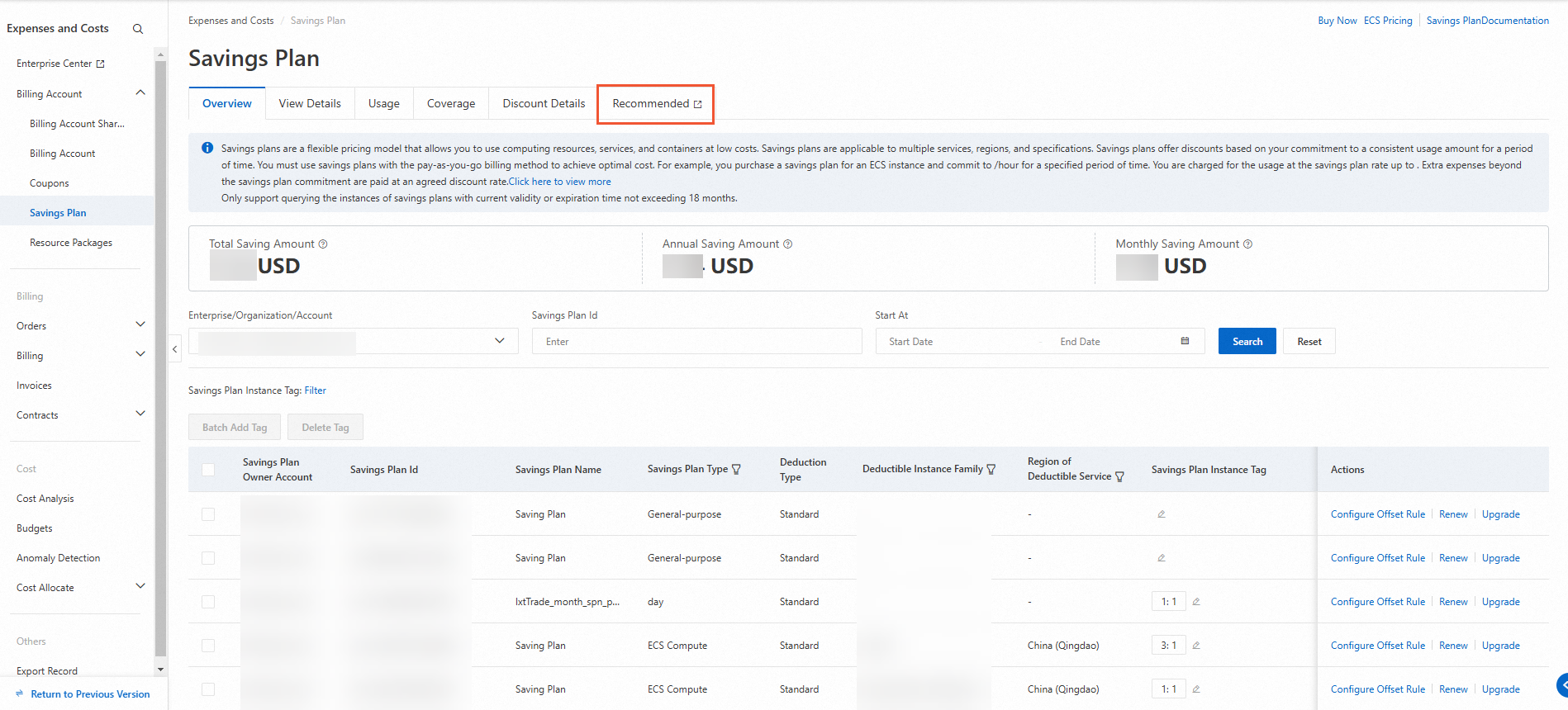
Log on to Expenses and Costs > Billing Account > Savings Plan and click the Recommended tab to access the Savings Plan Purchase Scheme Calculation page.
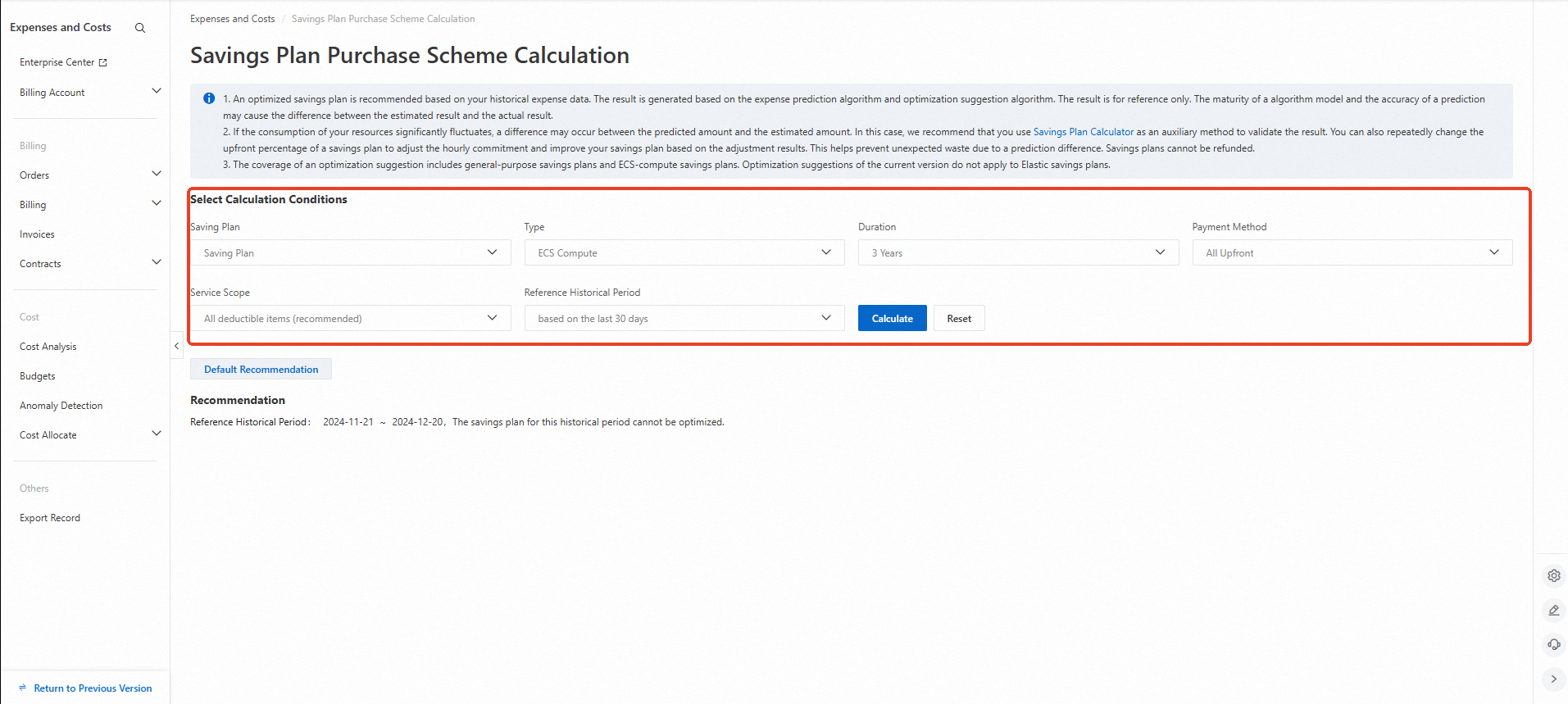
In the Select Calculation Conditions section, specify the savings plan name, type, duration, payment option, service scope, and reference historical period, then click Calculate.
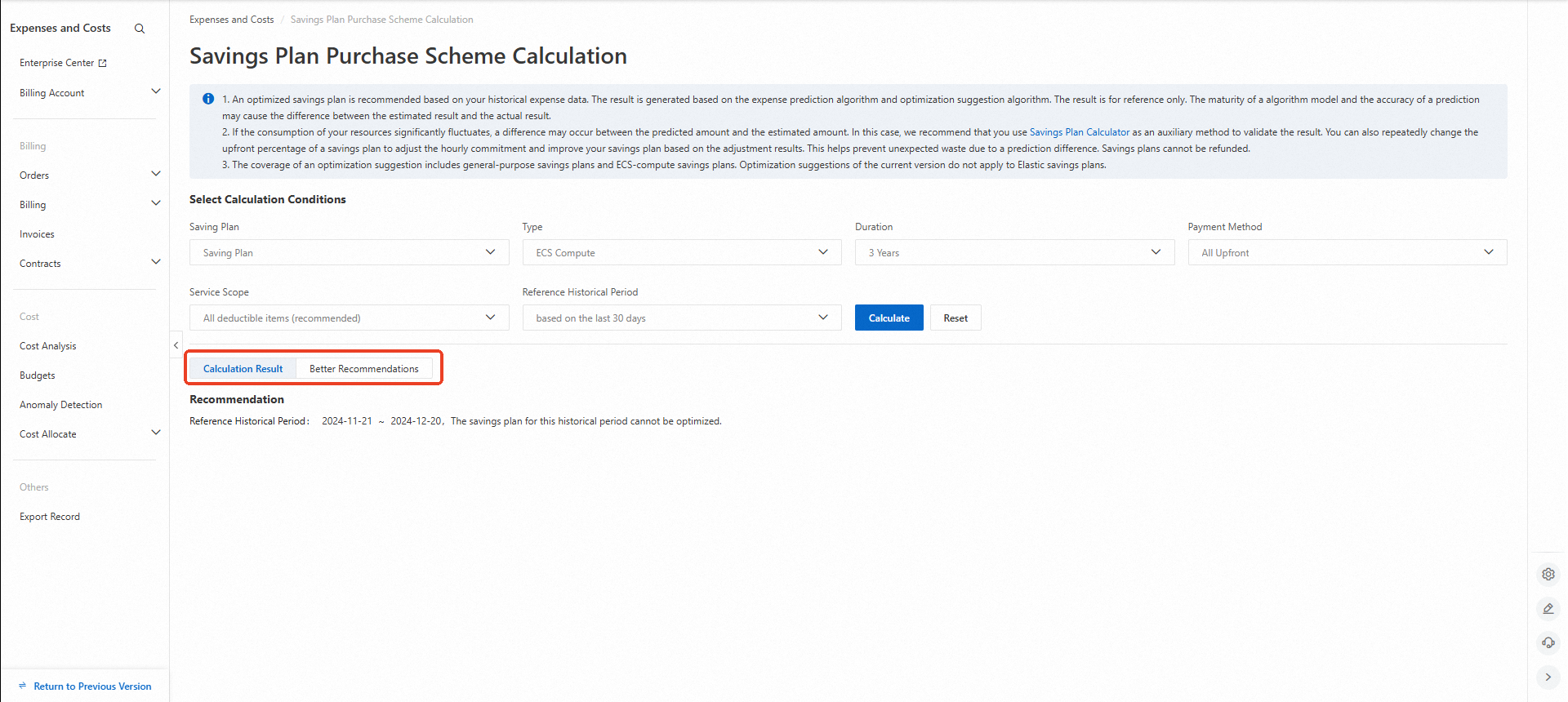
Purchase a plan based on the Calculation Result.
If you are not satisfied with the calculation result or if you have a limited spending history, click Better Recommendations to go to the savings plan purchase page and create a plan manually.
Upgrade a savings plan
Upgrade rules
You can upgrade eligible savings plans at any time before their expiration date.
Upgrades take effect at the next full hour. For example, if you initiate and pay for an upgrade at 15:30, the price difference is calculated starting from 16:00. At 16:00, the system automatically increases the plan's hourly committed spend to the new amount. The expiration date of the original savings plan does not change.
The upgrade fee is calculated as follows: (New hourly committed spending × Remaining hours - Old hourly committed spending × Remaining hours) × Upfront payment ratio.
The following savings plans can be upgraded:
Product line | Product name | Notes |
Elastic Compute | Savings Plan | Only General Purpose and ECS Compute Savings Plans can be upgraded. |
Upgrade steps
Log on to Expenses and Costs Billing Account > Savings Plan.
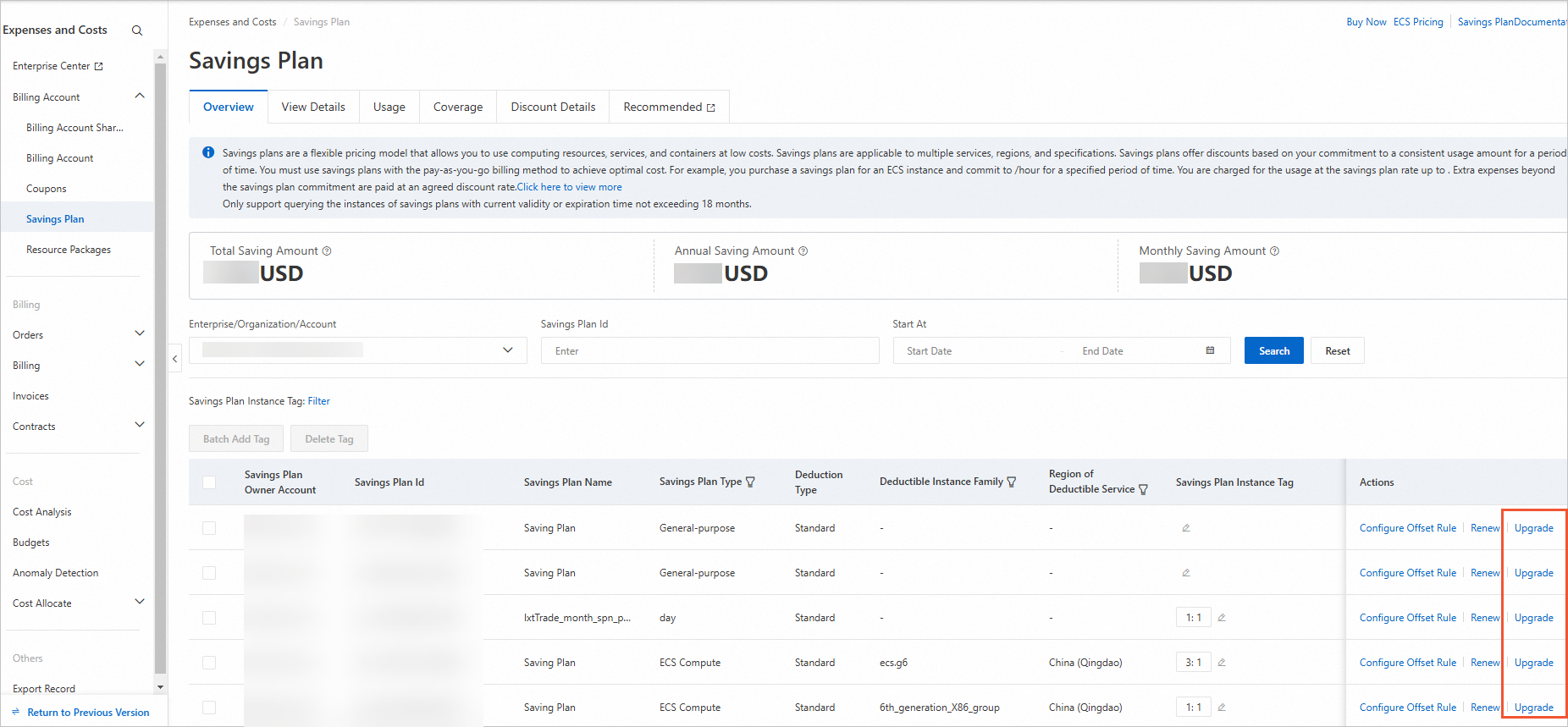
On the Overview tab, select an Enterprise/Organization/Account, enter the Savings Plan ID, select a time to Start At, and click Search. You can also use an Instance Tag to find the plan you want to upgrade.
In the Actions column, click Upgrade. Follow the on-screen instructions to complete the order and payment.
Renew a savings plan
Renewal rules
You can renew eligible savings plans or set up auto-renewal at any time before their expiration date.
You can only renew a savings plan for the same term as the original purchase. For example, if you purchased a one-year plan, you can only renew it for another one-year term.
You cannot renew a savings plan after it has expired.
The following savings plans can be renewed:
Product line | Product name | Notes |
Elastic Compute | Savings Plan | Only General Purpose and ECS Compute Savings Plans can be renewed. |
Renewal steps
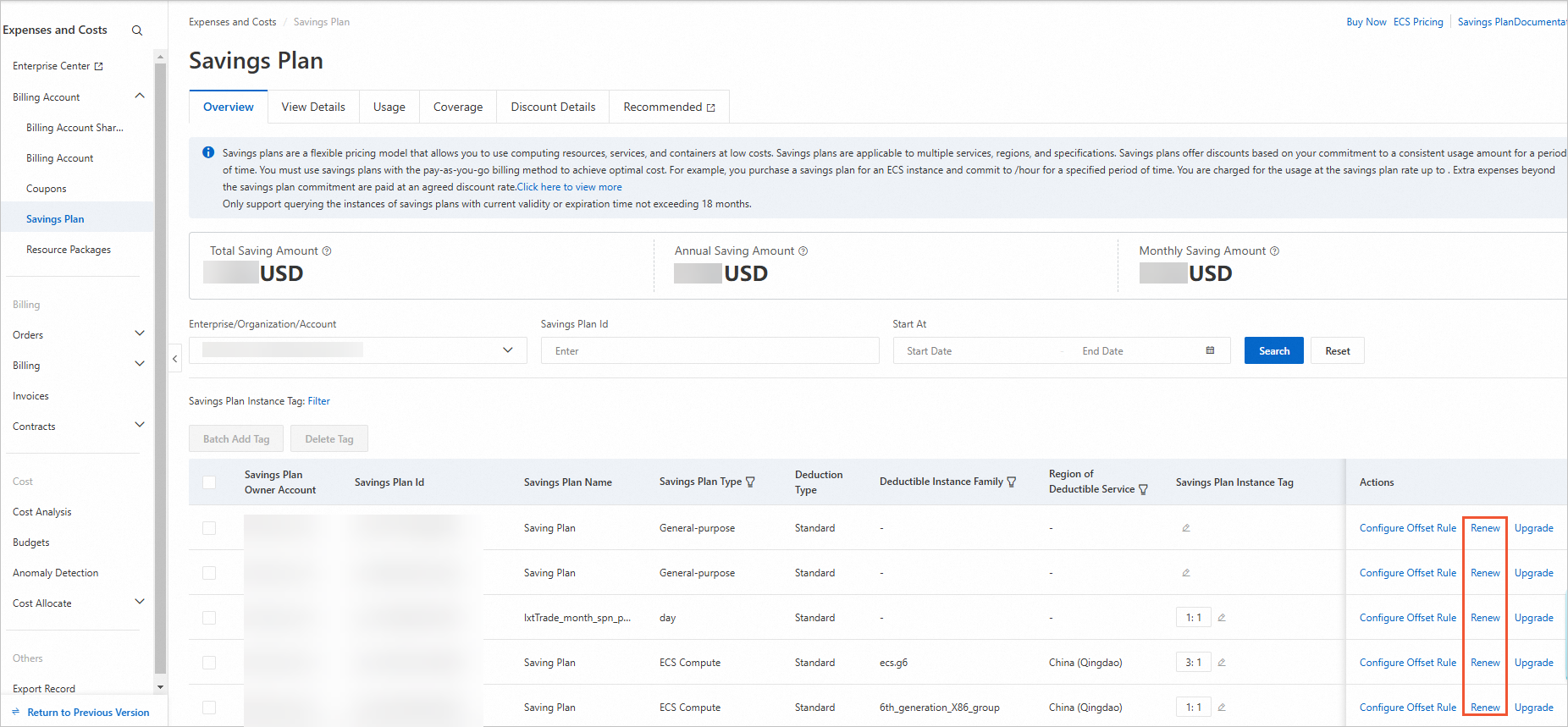
Method 1: Renew from the Savings Plan console
Log on to Expenses and Costs - Billing Account > Savings Plan.
In the left navigation pane, choose Account > Savings Plan > Overview.
On the Overview tab, select an Enterprise/Organization/Account, enter the Savings Plan ID, select a time to Start At, and click Search. You can also use an Instance Tag to find the plan you want to upgrade.
In the Actions column, click Renew. Follow the on-screen instructions to complete the order and payment.
Method 2: Renew from the Resource Renewal page
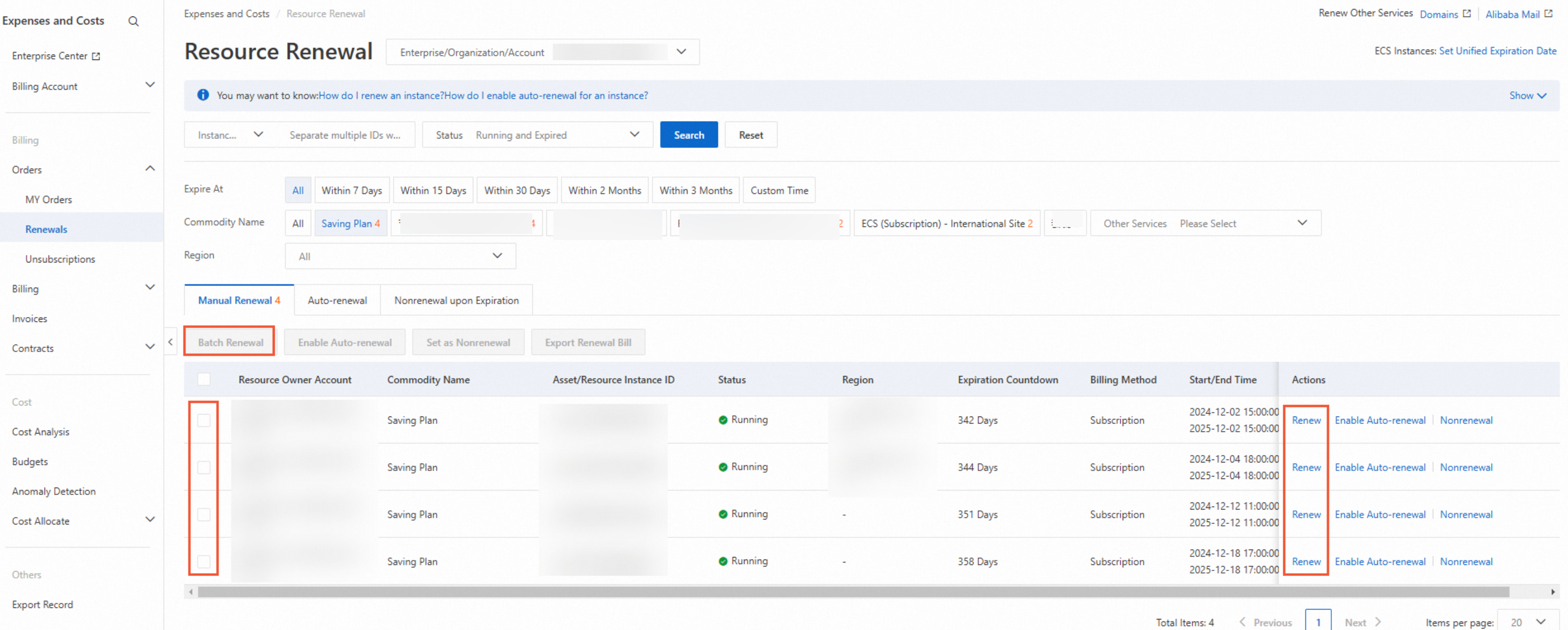
Log on to Expenses and Costs > Billing > Orders > Renewals to access the Resource Renewal page.
Enter the Instance ID, select an instance Status, and use other filters as needed. Click Search to find the savings plan instance you want to renew.
In the Actions column, click Renew (or Batch Renew for multiple instances). Follow the on-screen instructions to complete the order and payment.
Method 3: Set up auto-renewal from the Renewal Management page
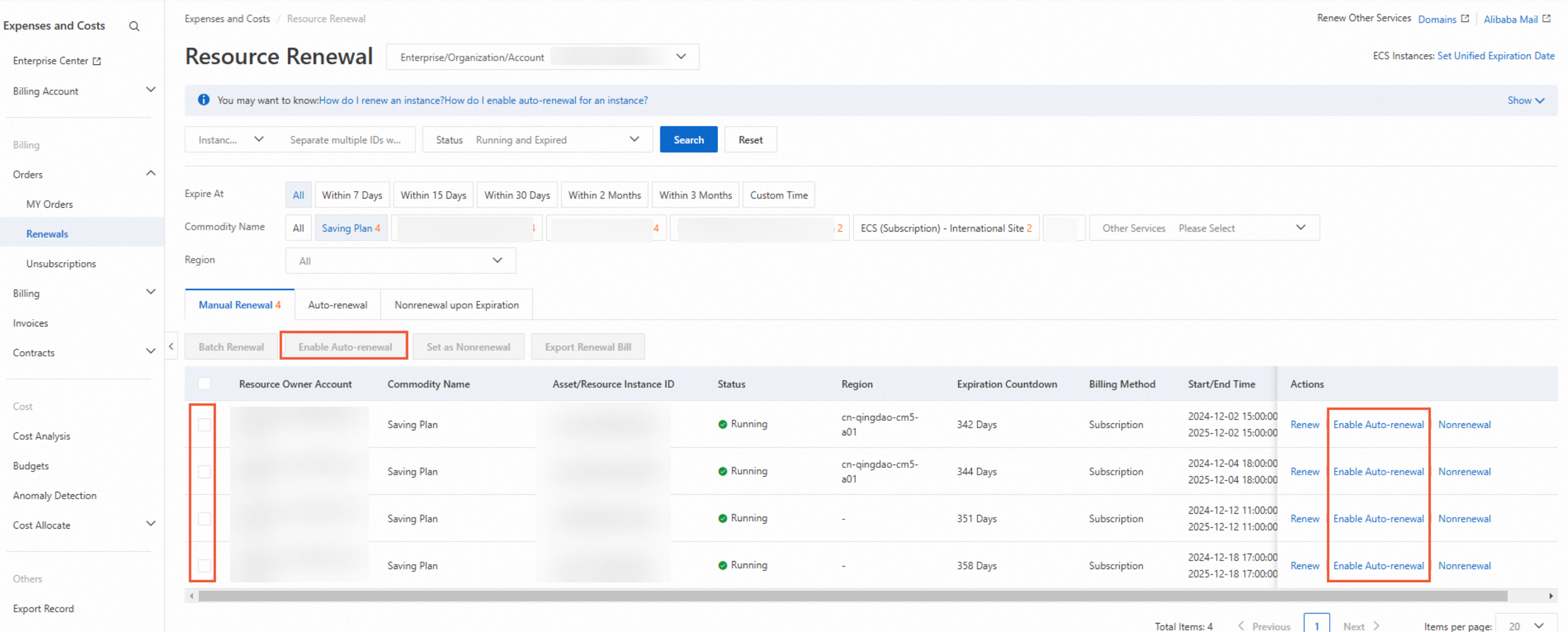
Log on to Expenses and Costs > Billing > Orders > Renewals to access the Resource Renewal page.
On the Manual Renewal tab, enter the Instance ID, select the instance Status, and use other filters as needed. Click Search to find the savings plan instance you want to enable for auto-renewal.
In the Actions column, click Enable Auto-renewal (or Batch Enable Auto-renewal for multiple instances). In the dialog box that appears, click Enable Auto-renewal.
After you enable auto-renewal, the first automatic payment attempt occurs at 08:00 on the 9th day before the plan expires. If your account balance is insufficient, the system will retry the payment daily until the expiration date. If the balance is still insufficient one day before expiration, the auto-renewal will fail.
After setting up auto-renewal, you can revert to manual renewal on the Auto-renewal tab.
Cancellation policy
Savings plans cannot be canceled or refunded once purchased. Upon expiration, the plan simply becomes inactive. Usage continues to be billed at standard pay-as-you-go rates.