PolarDB for PostgreSQL Enterprise Edition is a cloud-native database built on PostgreSQL's foundation and extended with a compute-storage decoupled architecture. If you already run PostgreSQL workloads, you get full compatibility with PostgreSQL 11, 14, 15, 16, and 17—your code, drivers, and tools work as-is. On top of that, PolarDB adds elastic scaling in minutes, fault recovery in seconds, and shared distributed storage that handles hundreds of terabytes without duplicating data across nodes.
How it works
PolarDB for PostgreSQL Enterprise Edition separates storage and compute. All compute nodes share a single copy of data, providing minute-level configuration upgrades and downgrades, second-level fault recovery, global data consistency, and free data backup and disaster recovery services.
Compute nodes (primary and read-only) access data on remote storage nodes rather than each maintaining its own copy. Data moves between compute and storage over a Remote Direct Memory Access (RDMA) network, eliminating I/O bottlenecks. Storage consistency is maintained by the Parallel-RAFT protocol, and the cluster endpoint uses a Log Sequence Number (LSN) to guarantee global read consistency across all nodes.
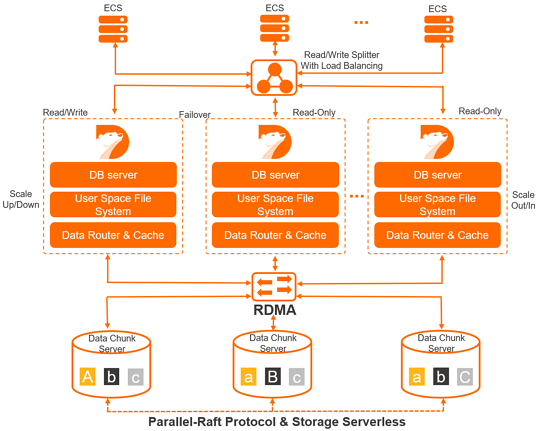
A cluster consists of one primary node and up to 15 read-only nodes:
Primary node — handles read and write requests.
Read-only nodes — handle read requests and participate in active-active failover with the primary node, so a read-only node can be promoted to primary in seconds if the primary fails.
Read/write splitting — the cluster endpoint automatically distributes SQL requests across nodes at no extra cost, providing transparent, high-throughput load balancing.
Because compute nodes store only metadata and data files live on shared distributed storage, adding a read-only node means connecting it to data that already exists—no data copy required.
Key capabilities
Elastic scaling
Scale configuration up or down in 5 minutes using container virtualization and shared distributed block storage.
Add or remove read-only nodes in 5 minutes. The cluster endpoint masks node changes from applications.
High availability and data reliability
Zero data loss on single-node failure: Shared storage eliminates the risk of replica divergence from asynchronous replication.
Multi-zone disaster recovery: Data is replicated across zones to protect against zone-level failures.
Redo-based physical replication: Replication is based on redo logs, not WAL logging. Even Data Definition Language (DDL) operations—such as adding an index or a column to a large table—do not cause replication delays.
Global read consistency: The cluster endpoint uses LSN to prevent stale reads caused by replication lag between the primary and read-only nodes.
Performance
Deeply optimized database kernel with RDMA-based networking and shared distributed storage.
Supports more than 500,000 read requests per second and more than 150,000 write requests per second for Online Transaction Processing (OLTP) workloads.
In a shared-storage cluster, a write to the primary is immediately visible to all read-only nodes—data is modified once and reflected everywhere.
Storage capacity
A single cluster supports up to 500 TB of storage by default. Storage scales automatically based on your data volume (serverless storage), so you pay only for what you use.
PolarStore (PSL4/PSL5) supports petabyte-level storage. To reserve these resources, contact us.
Lock-free backup
Snapshot technology on the underlying distributed storage lets you back up terabytes of data in minutes without locking tables or impacting performance.
Cost efficiency
Compute-only scale-out: When adding a read-only node, you pay only for the compute node—not additional storage replicas.
Serverless storage: Storage expands and contracts automatically; you pay only for actual usage.
Free backup and disaster recovery: Backup and disaster recovery services are included at no extra cost.
Security
Whitelists, Virtual Private Cloud (VPC) networks, and multi-replica data storage provide layered security for database access, storage, and management.
Manage your cluster
Use any of the following methods to create and manage a PolarDB for PostgreSQL Enterprise Edition cluster:
Method | Description |
Graphical web interface | |
Alibaba Cloud command-line interface | |
Programmatic access | |
Full API coverage of all console operations |
Connect to your cluster
After creating a cluster, connect using one of the following options:
DMS: Connect to a PolarDB cluster using DMS for browser-based database development.
Client: Use a general-purpose PostgreSQL client such as pgAdmin.