The always-confidential database feature for ApsaraDB RDS for MySQL uses confidential computing to encrypt sensitive data throughout its lifecycle while complying with data protection regulations. Cloud platform providers, unauthorized users, DBAs, developers, and O&M personnel cannot access plaintext data. For a comparison of encryption approaches, see Comparison of database encryption technologies.
How it works
The always-confidential database supports all database operations on encrypted data, including transactions, queries, and analysis. Data is processed inside a secure enclave, such as an application and a database. Outside the enclave, data remains in ciphertext. Query results are encrypted before they are returned.
This approach defends against both external and internal threats. It protects data throughout its lifecycle and keeps cloud data private.
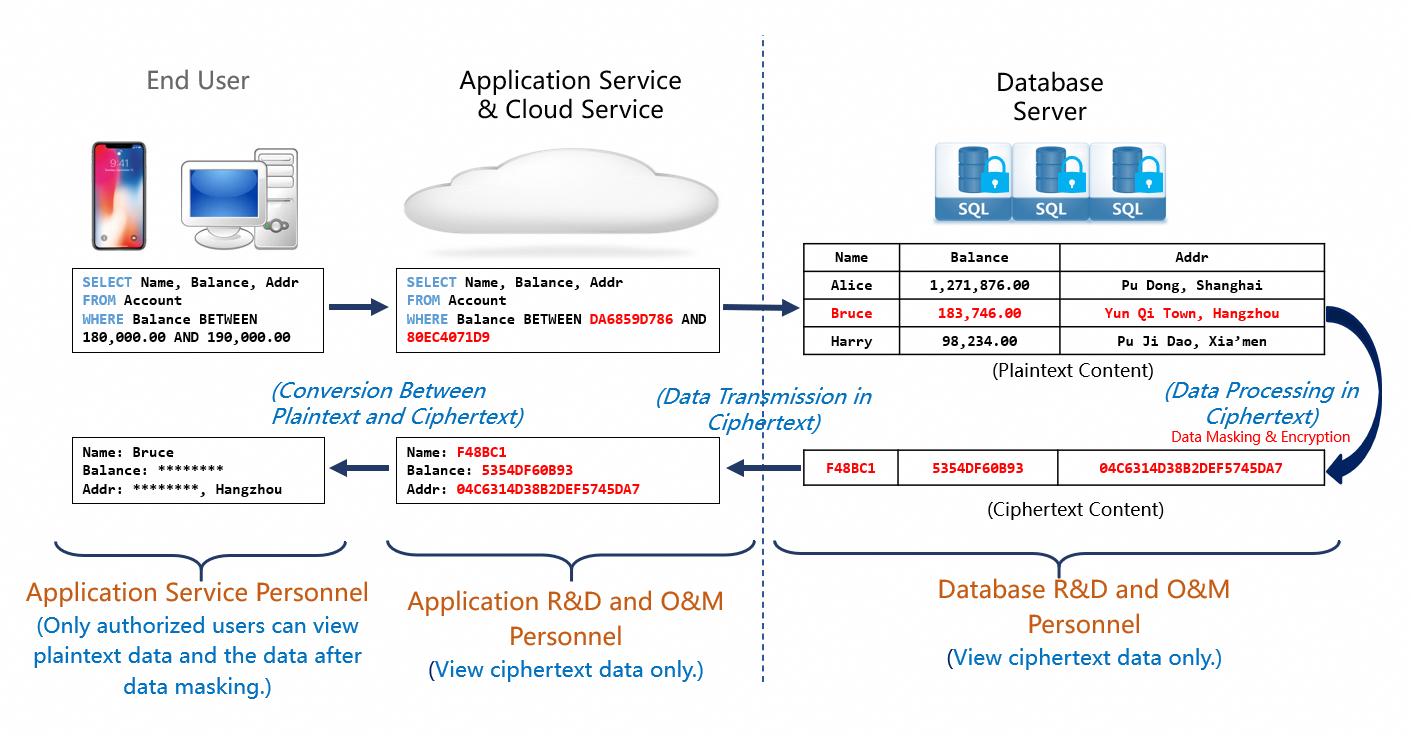
Preventing data leaks on the cloud
The always-confidential database encrypts protected data in query results. Even if account credentials are leaked, the data stays confidential.
Combine the always-confidential database with one of the following disk encryption features for multi-layer encryption:
Cloud disk encryption (recommended). For details, see Use the cloud disk encryption feature.
Transparent data encryption (TDE). For details, see Configure TDE.
Both cloud disk encryption and TDE deliver disk encryption capabilities. Combine them with the always-confidential database based on your business requirements.
Use cases
The always-confidential database provides native security capabilities to protect data confidentiality at the architecture level. It ensures the high stability, high performance, and cost-effectiveness of your database system.
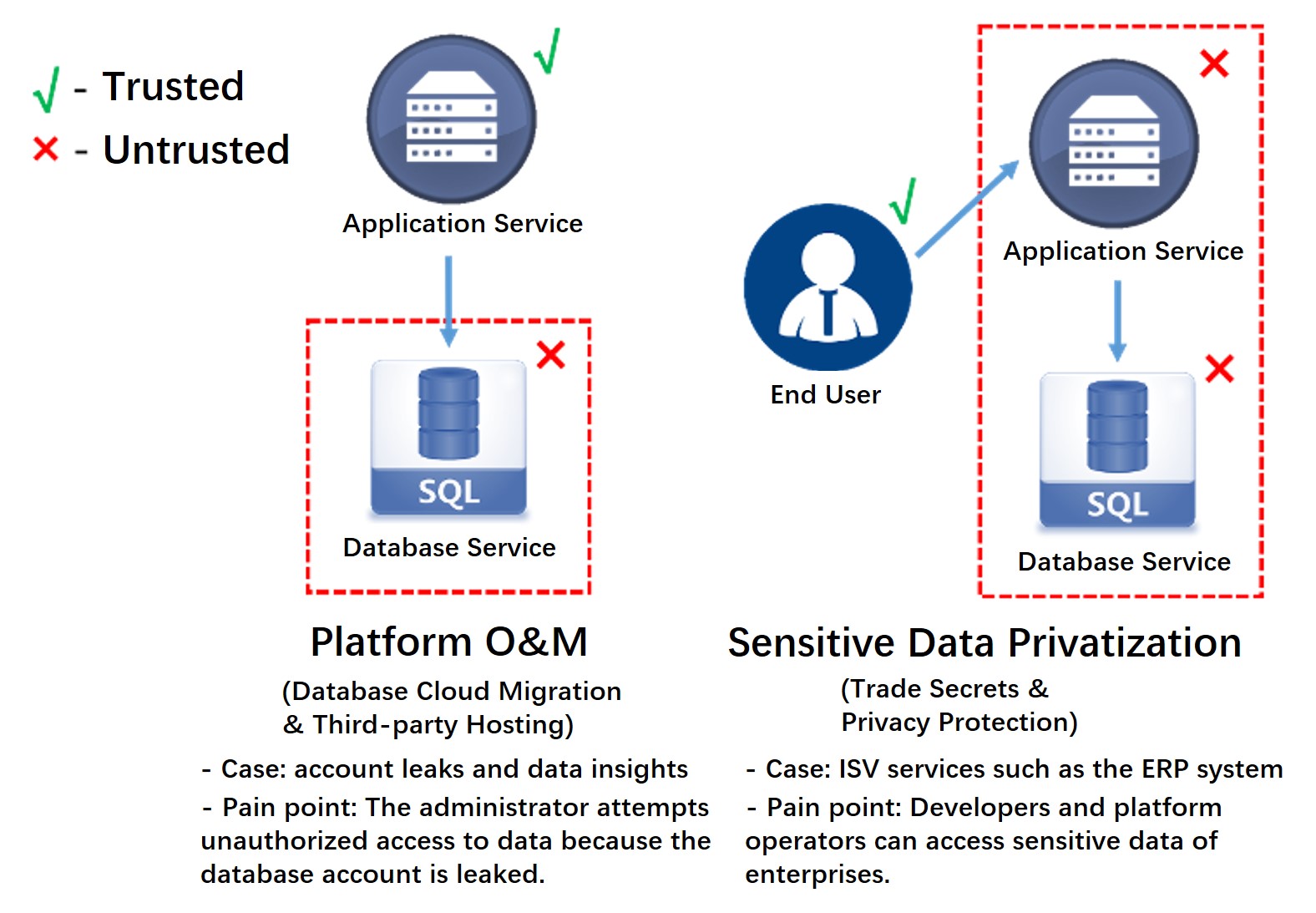
Platform O&M
Protects database services in untrusted environments, such as third-party platforms. Data owners are typically application service providers who want to prevent database service providers and their O&M personnel from accessing any application data while keeping the database running normally.
Examples:
A database is migrated to the cloud. The always-confidential database prevents unauthorized cloud platform providers and O&M personnel from accessing the data.
A database system is deployed on a server in a data center for application connection. The always-confidential database prevents unauthorized O&M personnel from accessing the data.
Protected data compliance
Protects application services in untrusted environments, such as third-party platforms. In user-facing applications, specific data such as health data and financial data is owned by users. Users want application services to provide data management and processing capabilities without accessing plaintext private data.
Examples:
Enterprises use third-party services to manage commercial data. The always-confidential database prevents trade secrets from being exposed to third-party service providers.
Third-party service providers manage confidential data such as personally identifiable information (PII) and gene information. The always-confidential database helps meet compliance requirements for end-to-end encryption.
Security levels
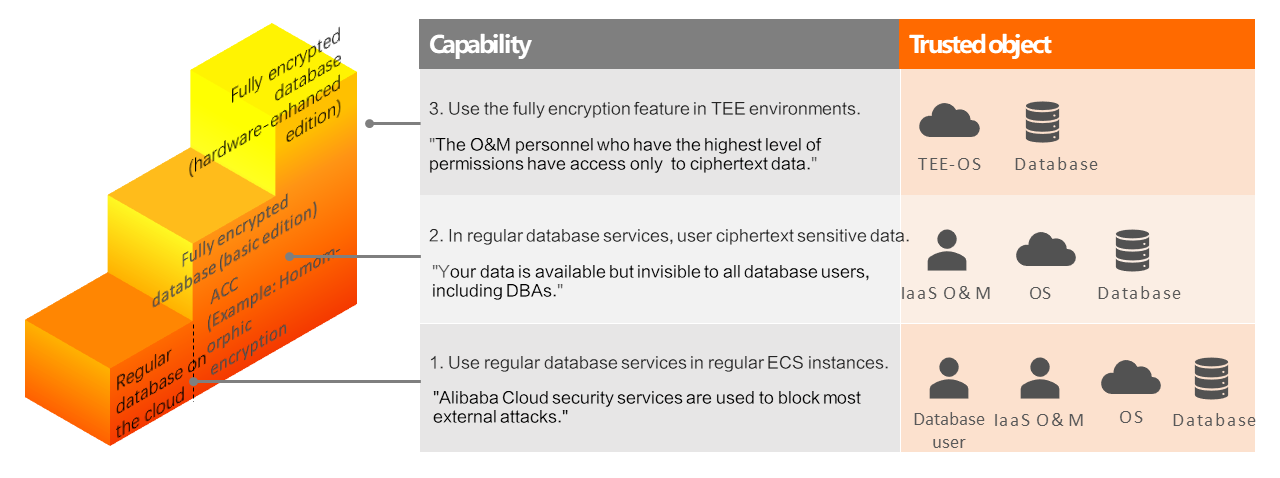
ApsaraDB RDS prevents security threats at the following levels, listed in ascending order of protection:
Security level | Protection | Trust requirements | Isolation method | Availability |
Regular database on the cloud | Blocks most external attacks when used with Alibaba Cloud security services | Operating system, database software, Infrastructure as a Service (IaaS) O&M personnel, and database users | Alibaba Cloud security services | Available |
Always-confidential database (basic edition) Recommended | Data is available but invisible to all database users, including DBAs. Works with the always-confidential access control module to limit the ability of database users to manipulate data. | Operating system, database software, and IaaS O&M personnel | Always-confidential access control module | Officially released for all instance types |
Always-confidential database (hardware-enhanced edition) | Uses TEE technologies to allow RDS instances that use the always-confidential database (basic edition) to run in TEE environments, with all external security threats isolated. | Operating system and database software | TEE technologies: Intel SGX, Intel TDX, ARM TrustZone, AMD SEV, Hygon CSV, and confidential containers | Not officially released. The TDX-based edition is preliminarily developed. |
All security levels share consistent features and advanced cryptographic capabilities, including fully homomorphic encryption (FHE) and property-preserving encryption. The always-confidential database (Basic Edition) is officially released for all instance types. The always-confidential database (hardware-enhanced edition) is not yet officially released. The Intel TDX-based always-confidential database (hardware-enhanced edition) has completed preliminary research. For more information, apply for a trial. For disk encryption, see transparent data encryption (TDE).