February 26, 2026 (Lingma IDE v0.3.1, JetBrains IDEs plugin v2.8.1)
Experience optimization
-
Improved the logic for handling requests in AI chat (Ask) mode when no tools are enabled.
February 14, 2026 (JetBrains IDEs plugin v2.8.0)
Feature updates
-
Introduced the Qwen-Coder-Qoder model:
-
A deeply customized model built to enhance the end-to-end programming experience in Qoder. This model is based on Qwen-Coder and has undergone large-scale reinforcement learning for the Qoder Agent framework, tools, and scenarios. In our real-world software engineering task evaluations, its task resolution rate has surpassed Cursor Composer-1. It is especially notable for a 50% higher accuracy in terminal commands on Windows systems.
-
-
Upgraded completion and NES to NEXT.
-
This full upgrade transitions from passive completion to proactive prediction, improving both capabilities and user experience. It supports features such as automatic dependency imports.
-
Added support for manually triggering NEXT code completion.
-
-
Added full support for databases (@database).
-
Added support for referencing a database as context in Qoder's Ask/Agent mode.
-
Added support for generating and executing SQL in the Query Console.
-
-
Added compatibility for AGENTS.md. If an AGENTS.md file exists in the project's root directory, the agent automatically detects and loads its content.
-
Added support for restricting files using the .aiignore.md extension.
-
Tools can now edit files outside the project.
Experience optimizations
-
Implemented several product experience improvements.
-
Added support for IntelliJ 2026.1 EAP+ versions.
-
Fixed several known issues.
February 5, 2026 (Lingma IDE v0.3.0)
Download now
Feature updates
-
Major model upgrade: Qwen-Coder-Qoder
A deeply customized model built to enhance the end-to-end programming experience. This model is based on Qwen-Coder and has undergone large-scale reinforcement learning for the Agent framework, tools, and scenarios. In our real-world software engineering task evaluations, it demonstrates excellent task resolution rates, with a 50% higher accuracy in terminal commands on Windows systems.
-
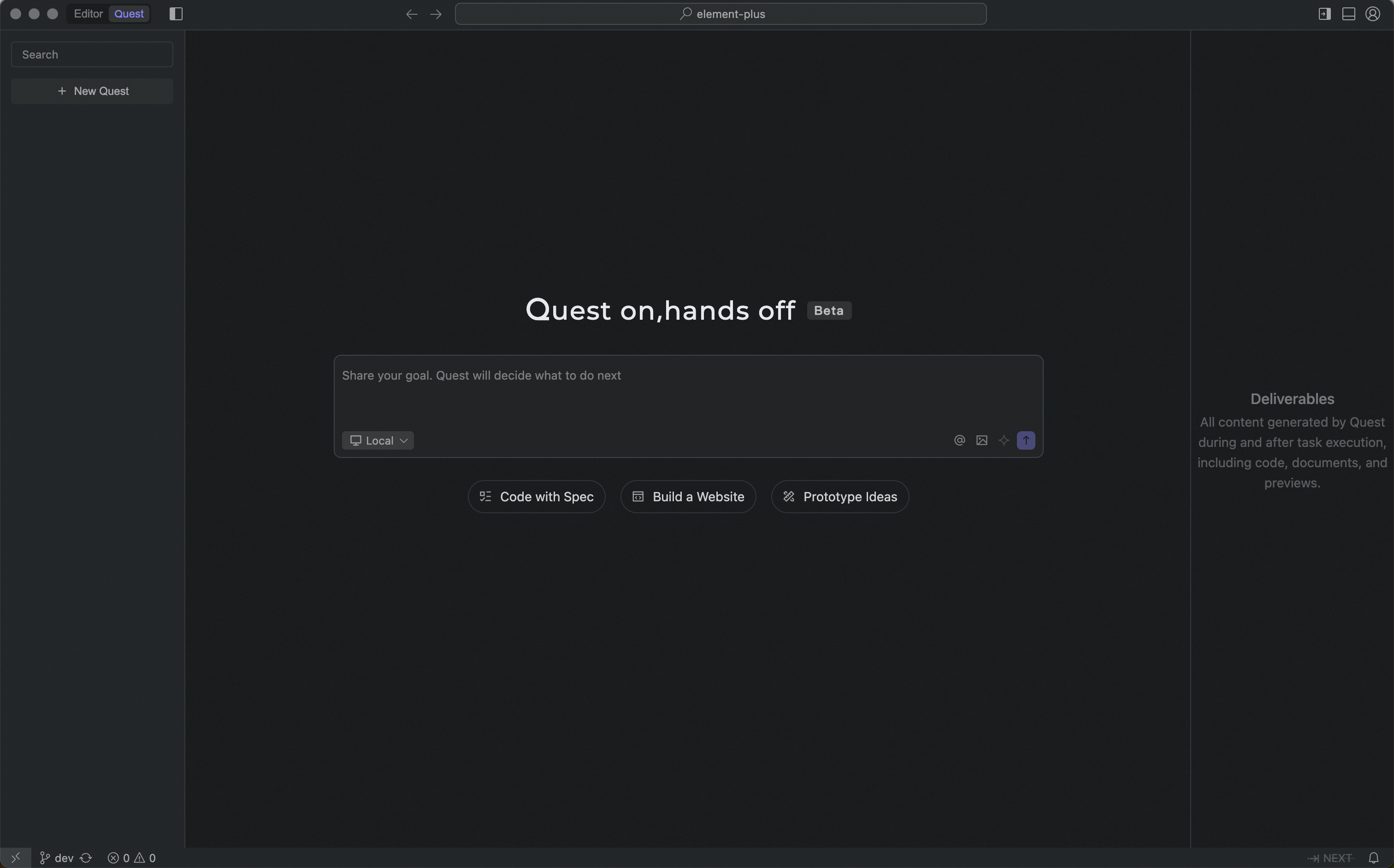
Lingma IDE now supports Quest autonomous programming, available in public beta
-
Autonomous programming agent: The agent independently completes high-quality, end-to-end, deliverable results without continuous human intervention.
-
Requirement alignment mechanism: Clarifies tasks before execution through intent recognition, requirement clarification, and collaborative spec creation.
-
Long-running task capability: Significantly improves the ability to run tasks continuously for extended periods. The agent supervises tasks until completion.
-
Autonomous quality assurance: Integrates result validation capabilities to independently verify and fix the quality of deliverables.
-
Continual autonomous evolution: Does more than just execute tasks. It actively evolves, remembers your style, and continually learns new technologies.
-
-
Support for more application scenarios: Quest performs intent recognition on user input and automatically routes it to the most suitable capability.
-
Spec-driven development: First, align on requirements and constraints. Then, execute and accept the results to ensure they are clear and traceable.
-
From idea to product: Supports creating websites and prototypes from scratch. It integrates top-tier visual models to significantly improve design quality and usability.
-
-
-
Agentic Chat: A full upgrade with multi-agent parallel execution, a built-in planning agent, and custom extension capabilities.
-
New built-in planning agent: When handling complex tasks, users can work with the agent in a human-computer collaboration mode to create a feasible execution plan in advance. This significantly improves task execution efficiency, avoids rework, and enhances the quality of agent-generated code and the controllability of the results.
-
Upgraded custom extension capabilities: Supports custom agents (subagents), Skills, and Commands to build your own intelligent workflows.
-
Multi-agent parallel sessions: Supports running multiple session windows in parallel to handle different tasks simultaneously. This significantly improves multitasking efficiency.
-
-
Repo Wiki is now available in public beta for Enterprise Dedicated Edition users.
-
Repo Wiki automatically generates structured documentation for your project and continuously tracks changes in both code and documents.
-
When you query knowledge points, request code explanations, or add features during development, Repo Wiki deeply analyzes the project structure and code implementation. It combines information from the Repo Wiki and the context to provide more accurate and detailed answers and documentation support, which also gives the agent a deeper understanding of the codebase.
-
Experience optimization
-
Session stream display optimization: Details for some tool calls are now collapsed by default.