This topic describes the scatter layer (linear gradient) of the chart style and the meaning of each configuration items.
Chart Style
The scatter layer (linear gradient) is a subcomponent of 3D Earth. It supports independent styles and data configurations, including the size, color, type, longitude, and latitude of the scatter. It can represent the point data information at a geographic location in the form of scatter points. 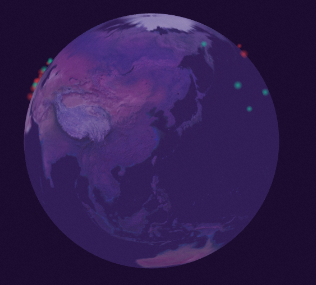
Settings Panel
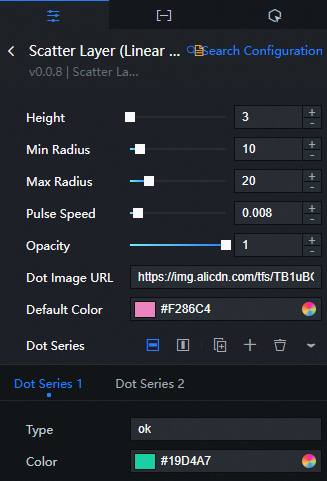
- Search for Configurations: In the right-side panel of Canvas Editor, click the Settings tab, and click Search for Configurations in the upper-right corner. Enter the required configuration item in the search box, and click the search icon to quickly locate the configuration item. Fuzzy match is supported. For more information, see Search for asset configurations.
Height: the height of the scatter layer relative to the spherical surface of the map. Valid values: 3 to 10.
Minimum Radius: the minimum radius of the scatter.
Maximum Radius: the maximum radius of the scatter.
NoteThe scatter between the maximum radius and the minimum radius. The scatter between the maximum radius and the minimum radius is displayed based on the value of the
valuefield.Animation Speed: the animation speed of the scattered dots. Valid value: 0 to 0.1.
Transparency: the transparency of the scatter layer. Valid values: 0 to 1.
Scatter Map: the map style of the scatter layer. You can paste the map URL to obtain the map.
Default Color: If the
typefield in the data is inconsistent with the configuration items of the , the scatter is displayed in the default color.Scatter Type: Click the
 or
or  icon to add or delete a scatter type. Click the
  or
or  icon to configure the arrangement style of multiple scatter points. Click the
  icon to copy the current scatter type configuration and add a scatter type with the same configuration.
 Parameter
Description
type
The value of the type corresponds to the
typefield in the data.Color
The color of the lower scatter of this type.
NoteThis configuration items can be an array. You can configure multiple series in this configuration items. The point corresponding to
typefield in the data is rendered with the color under this series. Iftypefields in the data are not present in this configuration items, they are rendered in the default color.
Data Panel
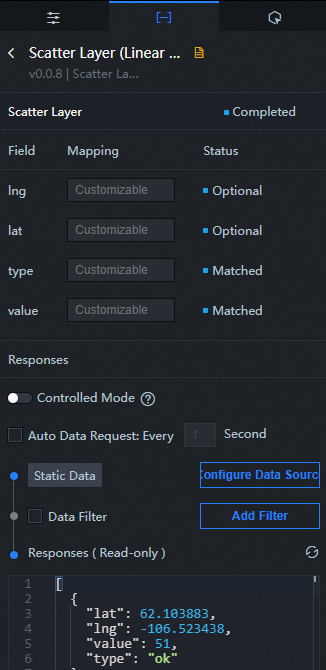
Configuration field description
Parameter | Description |
| Optional. The longitude of a dot. |
| Optional. The latitude of a dot. |
| The type of the scatter. It defines the color of the scatter together with the configuration items. |
| The numeric value corresponding to the scatter. |
| Parameter | Description |
| Controlled Mode | If you turn on the switch, data is not requested when a widget is initialized. Data requests are triggered only based on callback IDs or the method configured in Blueprint Editor. If you turn off the switch, data requests are automatically triggered. By default, the switch is turned off. |
| Auto Data Request | After you select the Auto Data Request check box, you can enable dynamic polling, and manually specify the polling interval. If you do not select this check box, data is not automatically requested. You must manually refresh the page to request data or use Blueprint Editor or callback ID events to trigger data requests. |
| Data Source | In the right-side panel of Canvas Editor, click the Data tab. Click Set next to Static Data. In the Configure Datasource panel, select a data source from the Data Source Type drop-down list. Enter code for data query in the code editor, click Preview Data Response to preview the response of the data source, and then view the response. For more information, see Configure asset data. |
| Data Filter | If you select the Data Filter check box, you can convert the data structure, filter data, and perform simple calculations. If you click the plus sign (+) next to Add Filter, you can configure the script for the data filter in the editor that appears. For more information, see Use the data filter. |
| Data Response Result | The response to a data request. If the data source changes, you can click the  icon next to Data Response Result to view the data response in real time. icon next to Data Response Result to view the data response in real time. |
Interaction Panel
This widget does not support interaction events.
Configure interactions in Blueprint Editor
In Canvas Editor, click the
 icon next to Scatter Layer (Linear Gradient) in the 3D Earth widget list.
 - Click the
 icon in the upper-left corner of the page.
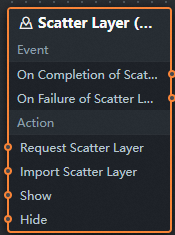
 In Blueprint Editor, click the Scatter Layer (Linear Gradient) widget in the Added Nodes pane. You can view the parameters of the Scatter Layer (Linear Gradient) widget on the canvas, as shown in the following figure.
Event
Event
Description
When the scatter layer request is completed
The event is triggered with the processed JSON data after a data interface request is responded and processed by a filter. For more information about specific data examples, see the Data Response Result section of the Data tab in the right-side configuration panel of the canvas editor.
When a scatter layer request fails
The event that is returned when a data interface request fails (the request may be due to network problems or interface errors) and is processed by the filter. The event also throws the processed JSON data. For more information about specific data examples, see the Data Response Result section of the Data tab in the right-side configuration panel of the canvas editor.
Policy Action
Policy Action
Description
Request Scatter Layer
This action is performed to request the server data again. The data sent by an upstream data processing node or layer node is used as a parameter. For example, if the API data source is
https://api.testfor the scatter layer (linear gradient) and the data passed to the request scatter layer action is{ id: '1'}, the final request interface ishttps://api.test?id=1.Import Scatter Layer
After data of a widget is processed in accordance with its drawing format, the widget is imported for redrawing. You do not need to request server data again. For more information about specific data examples, see the Data Response Result section of the Data tab in the right-side configuration panel of the canvas editor.
Display
A widget is shown without the need to specify parameters.
Hide
A widget is hidden without the need to specify parameters.