Test Automation in AI-Native Teams: 3x Code, 10x Complexity
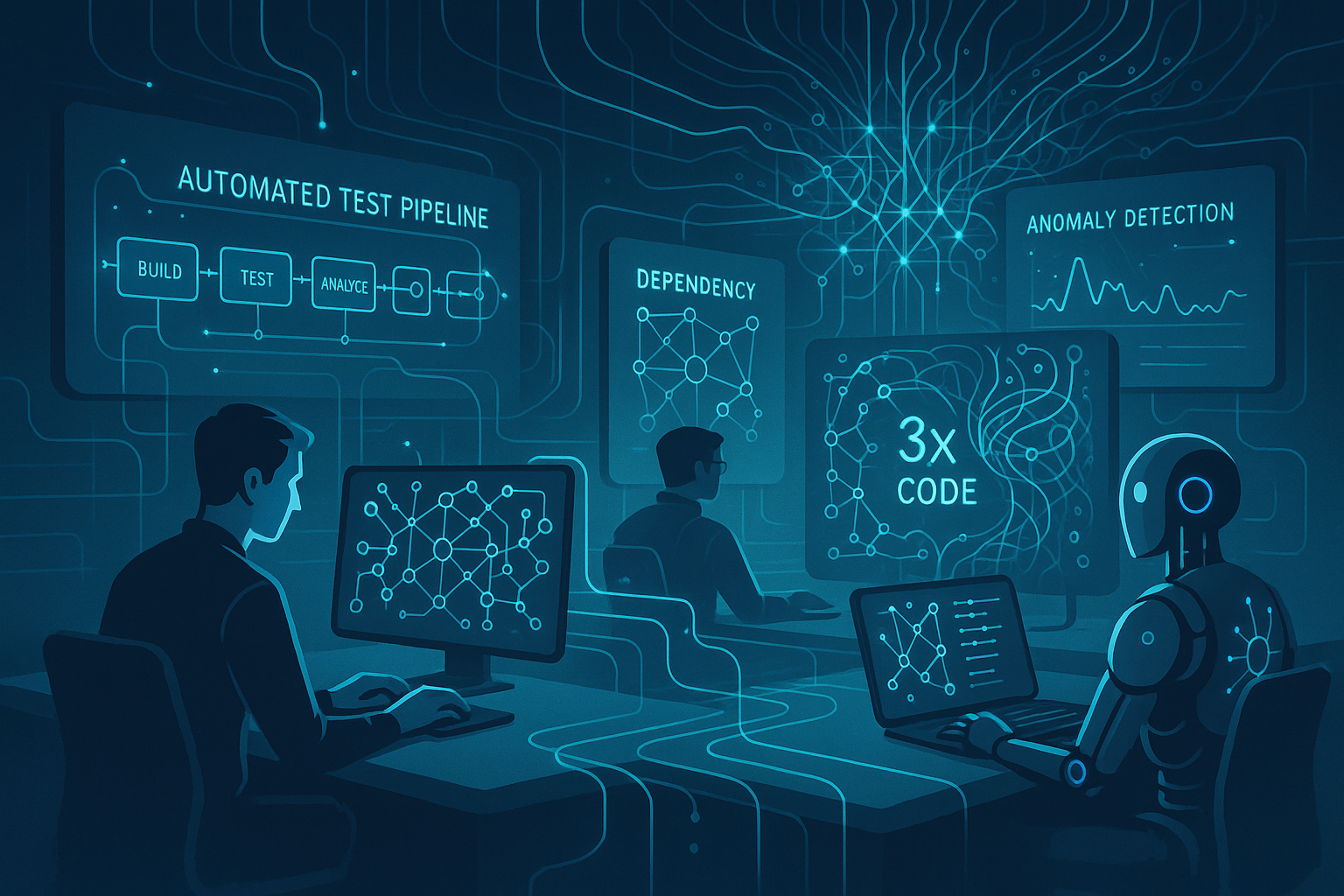
AI isn’t just another feature anymore. Entire teams are now building AI-native products and also adding AI to their existing products. AI can write complete microservices in just a few minutes, making us more productive - but with these enhancements, we have to face an engineering chaos: more code, more components, more unpredictability.
Nowadays, everybody is doing vibe-coding and shipping a lot of new features. But how do you test the code that AI generates? You can’t test it manually - that’s why test automation is no longer optional. It’s the only way teams can ship fast without breaking production or running into unexpected issues.
So in this article, we’ll explore why AI-native development creates unusual complexity, what modern test automation looks like, and how engineering teams can build a reliable testing strategy from day one while still doing vibe-coding. You’ll also get practical frameworks, examples, and a short list of tools that genuinely work for AI-intensive workflows.
What Makes AI-Native Development Radically Different?
Traditional software grows steadily. You know the pace - you build it slowly. But AI-native software grows exponentially. Why? Because every model, pipeline, or inference step adds layers of dynamic behavior. There are two main reasons:
1. Code Explosion
AI projects rarely stay small.
Example:
A team starts with a simple sentiment analysis API, but soon they add preprocessing, fine-tuning scripts, batch inference jobs, data labeling flows, and monitoring dashboards. Suddenly, a 2,000-line project becomes 25,000 lines in a few months. I hope most of you have felt this situation - your favourite vibe-coding platform creates more lines of code and more files than you expected.
2. AI Redefines the Software Lifecycle (SDLC)
AI teams juggle:
● data collection
● model training
● continuous evaluation
● deployment + testing
● monitoring and rollback
So it's no longer a straight Dev → Test → Deploy cycle.
It’s more like: Data → Model → Code → Experiment → Deploy → Test → Monitor → Repeat.
Once you integrate AI into the SDLC, the process is going to change. You have to keep repeating the process until you get the desired output.
The Complexity Multiplier: Why 3× Code Leads to 10× Complexity
The complexity is definitely going to increase with AI, because AI is not just code - it’s a system.
Sources of Code Growth:
We saw that the AI generates more code or needs more code, but let's see which phases need that
● Data pipelines built using Alibaba Cloud DataWorks introduce schema, quality, and dependency risks.
● Model fine-tuning and experimentation with Alibaba Cloud PAI generates multiple model versions that all require regression validation.
● Monitoring SDKs from CloudMonitor and Log Service (SLS) add observability code paths that must be tested for reliability.
● AI services deployed via Alibaba Kubernetes Service (ACK) introduce orchestration-level failure scenarios.
Complexity Vectors
● Data drift: output changes without touching the code
● Model drift: accuracy drops over time
● Dependency drift: libraries change model behavior
● Pipeline orchestration: multi-step workflows produce unexpected interactions
Real-World Implications
- Brittle tests – A tiny data change breaks dozens of tests.
- Flaky pipelines – One batch job fails only under specific conditions.
- Huge test surface – Every model version increases the number of scenarios to validate.
AI systems create a domino effect - if one thing breaks, it breaks the entire system’s operations. You have to handle the system properly.
How Modern Test Automation Solves the Complexity Problem?
In the previous section, we saw what problems AI creates and the complexity around it. Now let’s see how test automation solves it:
1. Automated Regression for Models + APIs
Let’s say, just like we validate regression for our normal application, we can do the same for AI. When a model’s behavior changes, test automation highlights:
● Accuracy regressions
● bias shifts
● unexpected edge-case predictions
APIs are validated the same way: input/output snapshots prevent silent changes.
For APIs deployed on ACK or ECS, teams can run automated regression suites during CI/CD pipelines triggered by Alibaba Cloud DevOps, ensuring model-serving endpoints behave consistently across releases.
2. Data Validation + Drift Detection
Before your model breaks production, drift indicators warn engineers about:
● schema changes
● spike anomalies
● missing values
● unbalanced feature distributions
In Alibaba Cloud environments, teams often combine tools like Great Expectations with DataWorks data quality rules and PAI model evaluation jobs to automatically detect drift before models impact production workloads.
3. Faster Releases Without Losing Quality
Instead of long manual QA cycles, teams deploy confidently because automation handles:
● reproducible tests
● auto-detected changes
● version comparisons
Practical Automation Testing Strategy for AI Teams
Let’s see the practical test automation strategy for teams who are using and building with AI.
What to Automate First (Priority Matrix)
| Priority | What to Automate | Why It Matters |
|---|---|---|
| High | Data tests | 80% of model failures come from data issues |
| High | Model behavior tests | Prevent silent degradation |
| Medium | Integration tests | Ensure pipelines and services work together |
| High | E2E tests | Valuable but expensive and slow |
From the table, you can see that most of the problems will be solved if you have E2E tests and data tests. If you have clean data and good tests, there is a high chance you will face fewer surprises when things go to production.
Automation Sequence you can try
- Data tests → Validate datasets flowing through DataWorks pipelines
- Model tests → Compare model versions trained in PAI using statistical thresholds
- Integration tests → Validate APIs running on ACK, message queues, and downstream services
- E2E tests → Critical workflows monitored using CloudMonitor dashboards
Shift-Left + Continuous Validation
No matter what, always follow the shift-left rule, whether for testing or security. Try to integrate testing in the early stages of development, because in the age of AI-based systems, integrating testing early will help.
So Testing must happen:
● Early (during development)
● Repeatedly (every training run)
● Automatically (CI/CD)
It’s not about testing more. It’s about testing smarter.
Principles That Help AI Teams Build Better Automated Tests
There are a few principles that help AI teams build better automated tests:
● Test your data as seriously as your code
● Make everything versioned - models, configs, datasets
● Use statistical thresholds, not exact comparisons
● Build observability into your pipelines using centralized E2E test reporting platforms like TestDino for Playwright suites
● Prefer tests that are stable, not overly strict
● Make tests self-healing where possible
Good tests don’t break every day - they evolve with your system.
Tools & Techniques That Actually Work
Now, let’s see the tools and techniques that automate the tests. AI-native teams use a mix of classic automation and ML-specific tools. A few categories:
1. Self-Healing Test Automation
These tools update tests automatically when minor changes happen:
● dynamic snapshot testing
● adaptive assertions
● auto-maintained mocks
Frameworks and platforms like Platforms like Keploy help generate and maintain API tests without a lot of manual effort.
2. Synthetic Data Generation
Useful when:
● real data is sensitive
● edge cases are rare
● testing needs volume
Synthetic data lets teams test failure modes that haven’t happened yet.
3. Shadow Deployments
New models run behind the scenes and compare predictions with production models.
Great for catching regressions before users do.
On Alibaba Cloud, shadow deployments are commonly implemented using ACK traffic routing and monitored via CloudMonitor, allowing teams to compare prediction outputs between old and new PAI-trained models without impacting end users.
4. Popular Test Automation Stack Options
Credible tools commonly used in the industry:
● Great Expectations for data validation in DataWorks pipelines
● Keploy for API test generation on services deployed via ACK
● PAI Model Evaluation for tracking accuracy and regression across model versions
● CloudMonitor + Log Service (SLS) for observability-driven test signals
● Argo Workflows or Alibaba Cloud DevOps for continuous validation pipelines
Measuring ROI: How Test Automation Actually Pays Off
Implementing test automation is no longer a “good-to-have” thing in the AI workflow, because you need a system that validates the end-to-end process.
1. Fewer incidents
A single bad model release can:
● cause wrong predictions
● trigger user complaints
● lead to business losses
Automation reduces these risks dramatically.
2. Faster experimentation
When tests run automatically:
● engineers try more ideas
● product teams ship features sooner
● failures are cheaper because they’re caught early
3. Example ROI Model
| Metric | Before Automation | After Automation |
|---|---|---|
| Rollback Rate | 20% | <5% |
| Release Frequency | Monthly | Weekly or faster |
| Critical Bug Cost | High | Significantly Lower |
| Team Velocity | Slower due to rework | Faster due to stability |
The ROI model also depends on the company and the teams. Try to integrate test automation and you will see the ROI.
Organizing Teams & Roles for Scalable Test Automation
Just like how AI is reshaping the SDLC and jobs, the whole team is responsible for testing the AI systems not just the QA team.
Cross-Functional Testing Squads
Testing shifts from “QA’s job” to a shared responsibility across:
● data engineers
● ML engineers
● software developers
● QA specialists
Embedding QA in ML Workflows
Integrate the QA in the ML and AI workflows
QA helps design:
● evaluation suites
● regression tests
● edge-case scenarios
● statistical checks
This prevents surprises during deployment.
Upskilling Plan
AI is evolving every day, so we must try to evolve along with AI too. Traditional QA jobs are changing there are new requirements for everyone. To tackle them, you have to upskill.
AI-native QA needs:
● data literacy
● statistical intuition
● debugging skills for models
● understanding pipeline orchestration
Think of QA not as gatekeepers - but as reliability engineers for the AI era.
Conclusion
AI gives us incredible power, but it also brings unpredictable complexity. Without solid test automation, teams move slower, break more things, and lose confidence in their releases.
With the right testing approach, teams can:
● ship faster
● stay reliable
● catch issues early
● experiment without fear
AI-native development isn’t simple - but with good automation, it becomes manageable, predictable, and fun to build.
Disclaimer: The views expressed herein are for reference only and don't necessarily represent the official views of Alibaba Cloud.
Read previous post:
API Security: How to Stop Injection and Data Leaks from Wrecking Your Apps
Read next post:
Beyond the SMS: Upgrading Your MFA Strategy for Cloud Security

Comments
Related Products
-
 Qoder
From Assisted to Autonomous — Adapting to Every Programming Need
Learn More -
 Robotic Process Automation (RPA)
 allows you to automate repetitive tasks and integrate business rules and decisions into processes.
Learn More -
 AgentCore
 unifies agent construction, governance, and execution capabilities so enterprises can deploy diverse agents with confidence.
Learn More -
 Qwen
Full-range, open-source, multimodal, and multi-functional
Learn More
More Posts by Neel_Shah
- Fine-tuning AI Models on Alibaba Cloud PAI: A Practical Guide
- How to Use Alibaba Cloud Model Studio for Generative AI Applications
- AI-Powered Recommendation Systems on Alibaba Cloud
- Building a RAG Pipeline on Alibaba Cloud with Vector Search
- Scalable App Solutions with Alibaba Cloud Services
- How Cloud Infrastructure Shapes Scalable Customer Communication Platforms
- Beyond the SMS: Upgrading Your MFA Strategy for Cloud Security
- API Security: How to Stop Injection and Data Leaks from Wrecking Your Apps
- Database Encryption Strategies: When to Use TDE, Column-Level, or Application-Level