Data transformation is a fully managed feature that provides high availability and scalability in Simple Log Service (SLS). Use the data transformation feature to standardize, enrich, transfer, mask, and filter data.
Transformation process
SLS transforms data in three steps:
A consumer group reads data from a source logstore.
SLS transforms each data entry based on a transformation rule.
SLS writes the transformed data to a destination logstore.
After data is transformed, you can view the results in the destination logstore.
Features
Data standardization: SLS can extract fields from logs in different formats and convert the log formats to obtain structured data for stream processing and computing in data warehouses.
Data enrichment: SLS can join the fields of logs and dimension tables to link logs with dimension information. For example, SLS can join the fields of order logs and a user information table. This facilitates data analysis.
Data transfer: SLS can transfer logs from regions outside the Chinese mainland to a central region by using the global acceleration feature. This helps you manage global logs in a centralized manner.
Data masking: SLS can mask sensitive information in data, such as passwords, mobile phone numbers, and addresses.
Data filtering: SLS can filter logs to obtain key service logs. This helps further analysis.
Use cases
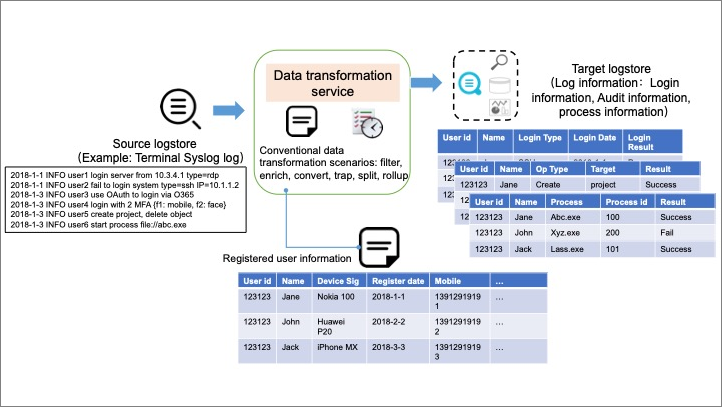
Data standardization: Log data is read from a source logstore, transformed, and then written to a destination logstore.
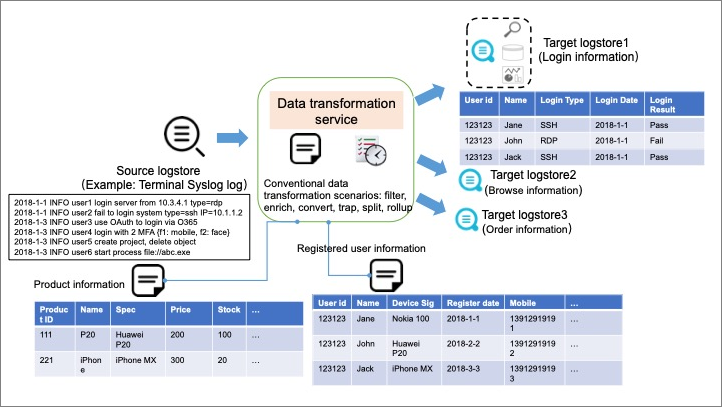
Data transfer: Log data is read from a source logstore, transformed, and then written to multiple destination logstores.
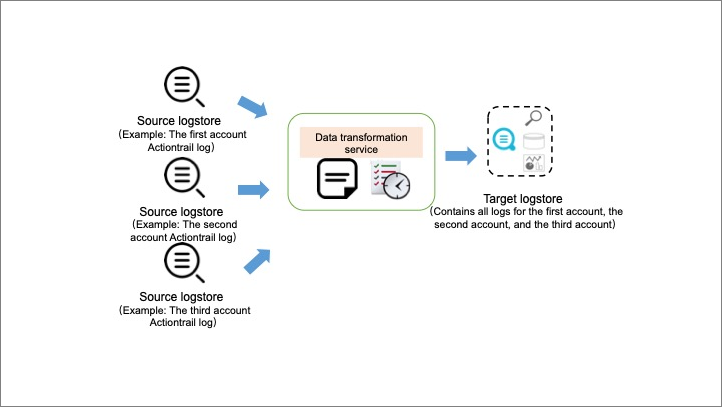
Multi-source data aggregation: Log data is read from multiple source logstores, transformed, and then written to a destination logstore.
Transformation syntax
The domain-specific language (DSL) for SLS provides more than 200 built-in functions and more than 400 regular expressions. For more information, see Syntax overview.
Benefits
Lets you use the DSL for SLS to orchestrate functions based on your business requirements. Use the orchestrated functions to filter, standardize, enrich, transfer, and mask data.
Processes data in real time and allows you to view data within seconds. The feature scales the computing capability based on the size of data and provides a high throughput.
Provides out-of-the-box functions, suitable for log analysis use cases.
Provides real-time dashboards, exception logs, and alerts.
Offers a fully-managed and maintenance-free service that can be integrated with big data services of Alibaba Cloud and open source ecosystems.
Billing
If your logstores use the pay-by-ingested-data billing mode, you are not charged for data transformation. However, if data is pulled over a public SLS endpoint, you are charged for read traffic over the Internet. The traffic is calculated based on the size of data after compression. For more information, see Billable items of pay-by-ingested-data.
If your logstores use the pay-by-feature billing mode, you are charged for data transformation based on the machine and network resources that are consumed. For more information, see Billable items of pay-by-feature.
You can disable the indexing feature for source logstores and shorten the data retention period of the logstores to reduce costs. For more information, see Performance guide and Cost optimization guide.