PolarDB for MySQL is available in two editions: Cluster Edition and Multi-master Cluster (Limitless). This topic outlines the architecture, benefits, and use cases of each edition.
The following table compares the use cases of the two editions:
|
Edition |
Description |
Use cases |
|
Cluster Edition |
Uses a compute and storage decoupling architecture to deliver rapid elastic scaling, large storage capacity, and low latency between the primary and read-only nodes. |
|
|
Multi-master Cluster (Limitless) |
This edition provides a multi-writer/multi-reader architecture using multiple read/write nodes. All nodes share data through the shared distributed storage (PolarStore) and are accessed via a cluster endpoint, where PolarProxy automatically routes SQL statements. |
|
Cluster edition
Cluster Edition uses a compute and storage decoupling architecture to provide rapid elastic scaling, larger storage capacity, and low latency between the primary and read-only nodes.
-
Single writer, multiple readers
PolarDB uses a distributed cluster architecture. A Cluster Edition cluster contains one primary node and up to 15 read-only nodes, or just a single primary node. These database nodes form the database engine layer. The primary node processes read and write requests, while read-only nodes process only read requests. The primary and read-only nodes use Active-Active failover to provide a high-availability database service.
-
Shared distributed storage (PolarStore)
Multiple compute nodes share a single copy of data instead of each node storing its own copy. This design significantly reduces your storage costs. Based on a distributed block store and file system, storage can be scaled smoothly online, independent of single-server capacity limits. This allows the cluster to support datasets up to several hundred terabytes.
-
Compute and storage decoupling
The compute and storage decoupling architecture enables elastic cluster scaling in public cloud environments. The database compute nodes store only metadata. Storage nodes store data files and redo logs in the shared distributed storage (PolarStore). Compute nodes only need to synchronize redo log metadata, which greatly reduces replication latency between the primary and read-only nodes. If the primary node fails, the system can quickly promote a read-only node to become the new primary.
-
Read/write splitting
The read/write splitting feature of PolarProxy is a transparent, highly available, and adaptive load balancing capability that is provided by default with the Cluster Edition. Through the cluster endpoint, SQL requests are automatically forwarded to the various database nodes of the Cluster Edition, which provides aggregated, high-throughput concurrent SQL processing. For more information, see What is read/write splitting.
-
High-speed interconnection
A high-speed network interconnects the compute and storage nodes of the database. These nodes use the Remote Direct Memory Access (RDMA) protocol to transfer data. This eliminates I/O performance bottlenecks.
-
Data reliability and consistency
Storage nodes replicate data across multiple copies to ensure reliability, and the system uses the Parallel-Raft protocol to guarantee data consistency.
Architecture
The following figure shows the architecture of a Cluster Edition cluster: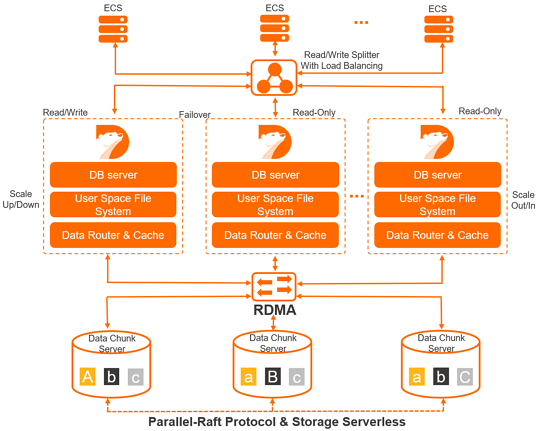
Supported kernel versions
Cluster Edition supports three kernel versions of PolarDB for MySQL: 5.6, 5.7, and 8.0.
Use cases
-
Production databases for medium- and large-sized enterprises.
-
Databases for industries such as Internet, IoT, retail, e-commerce, logistics, and gaming.
-
Core databases for industries with high data security requirements, such as finance, securities, and insurance.
Node specifications and pricing
Cluster Edition supports dedicated specifications and general-purpose specifications. For more information, see Billable items.
Multi-master cluster (Limitless)
PolarDB for MySQL launches Multi-master Cluster (Limitless), which upgrades the architecture from single-writer, multi-reader to multi-writer, multi-reader and enhances the database's concurrent read and write capabilities.
Architecture
The following figure shows the architecture of a Multi-master Cluster (Limitless) cluster: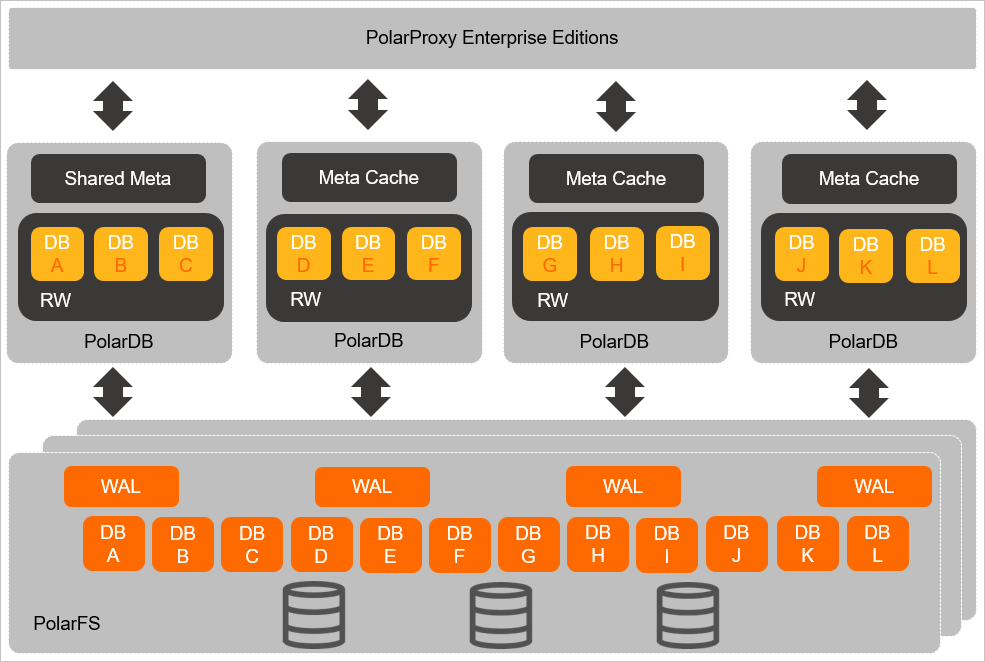
All data files in the cluster are stored in the shared distributed storage (PolarStore). The read/write nodes share these data files by using the distributed file system (PolarFileSystem). You can access the entire cluster through the cluster endpoint, and PolarProxy automatically routes SQL statements to the correct read/write node.
Supported kernel versions
Multi-master Cluster (Limitless) is available only with the 8.0 kernel version of PolarDB for MySQL.
Benefits
-
Horizontal write scaling in seconds
This architecture distributes concurrent writes across different compute nodes, supporting up to 32 nodes for simultaneous writes. You can dynamically schedule different databases across these nodes in seconds, which greatly improves overall concurrent read and write throughput.
-
Multi-primary failover (no standby nodes required)
If a read/write node fails, traffic fails over in seconds to another read/write node with low traffic. This model eliminates the need for idle hot standby resources, potentially reducing costs by half.
-
Global read-only nodes
A global read-only node provides a consolidated view of the data from all read/write nodes. This is useful for executing queries that require data consolidation.
Use cases
Multi-master Cluster (Limitless) is ideal for high-concurrency read/write workloads, such as multi-tenant SaaS applications, gaming, and e-commerce.
-
Multi-tenant SaaS applications: Meet high-concurrency performance demands and balance load among tenants
Multi-master Cluster (Limitless) allows you to migrate a tenant's database between different read/write nodes in seconds or add new read/write nodes to handle traffic spikes, achieving effective load balancing.
-
Global server games and e-commerce: Scale in or out in minutes to adapt to rapidly growing business requests
With second-scale horizontal scaling and transparent routing, Multi-master Cluster (Limitless) can work with middleware or database/table sharding to provide transparent scaling in seconds. This capability reduces scale-out time from days to minutes.
-
Sharded-server games: Improve performance and scalability with flexible scaling
During a game's growth phase, you can quickly move some databases to new read/write nodes to balance the load. During a game's decline phase, you can consolidate databases onto fewer read/write nodes to reduce operating costs.
Node specifications and pricing
Multi-master Cluster (Limitless) supports dedicated specifications and general-purpose specifications. For more information, see Compute node specifications for Enterprise Edition.
For information about the billing for Multi-master Cluster (Limitless), see Billable items.