The LLM-based AI Chat Edition of OpenSearch integrates unstructured data processing, vector models, text and vector search, and large language models (LLMs) into a one-stop, out-of-the-box retrieval-augmented generation (RAG) solution. Import data in various formats to build multi-modal conversational search services that support dialogue, links, and images.
Product introduction
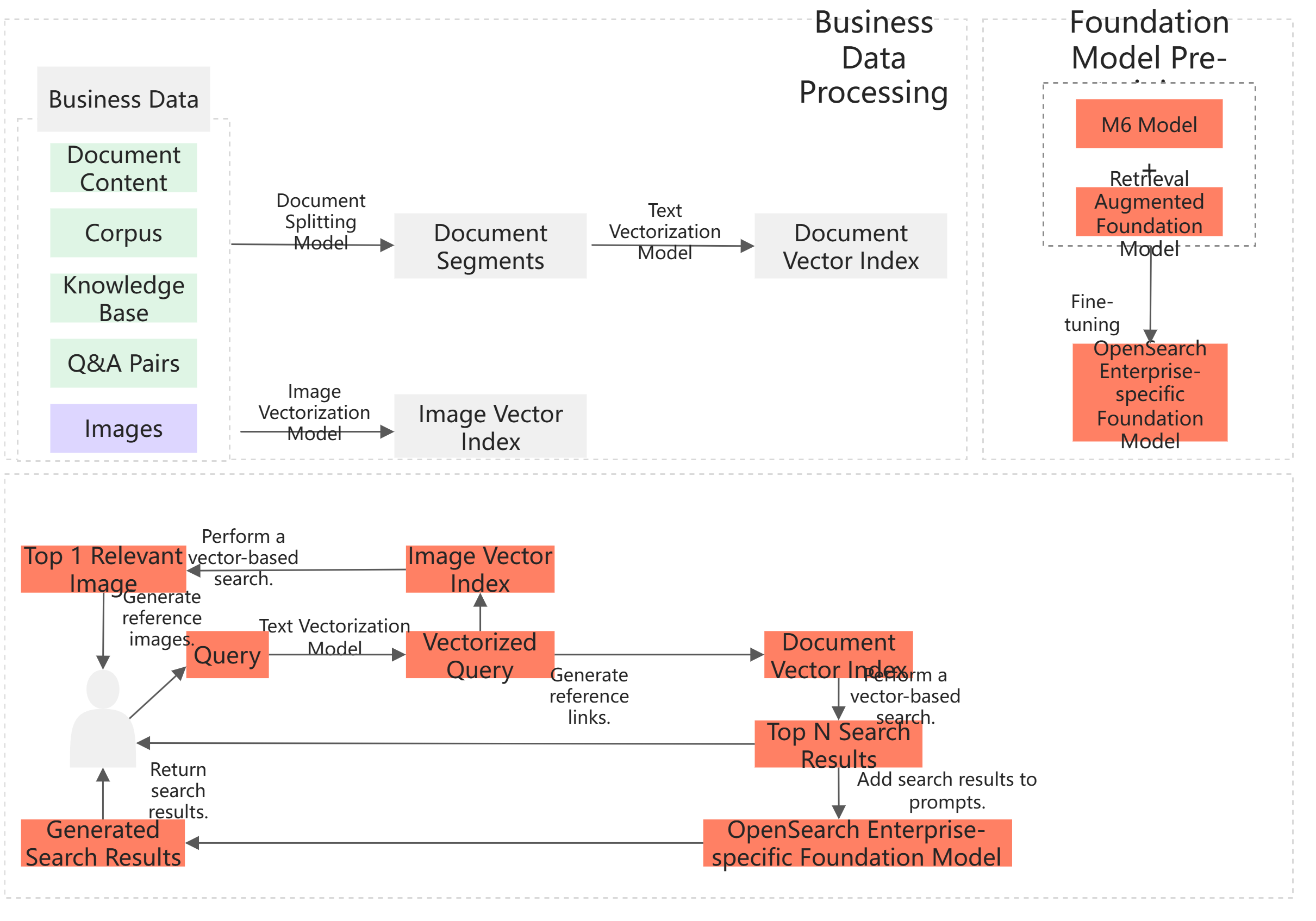
The LLM-based AI Chat Edition targets industry-specific search scenarios and provides enterprises with dedicated Q&A search services. With built-in LLMs, you can quickly deploy a Q&A search system that uses your business data to automatically generate answers, reference images, and reference links.
Service architecture
Product features
-
Multi-modal RAG: Understands image content. Build multi-modal knowledge bases using tools such as OCR and LLMs to deliver diverse outputs.
-
RAG performance evaluation: Evaluate end-to-end performance. Compare RAG results across different models and parameter settings to simplify performance comparison and model selection.
-
Rich model capabilities and custom model training: Includes a rich set of built-in vector, reranking, and large language models. Train custom large models using your business data.
-
Real-time data updates: Build incremental vector indexes in real time. Data is synchronized and updated instantly.
-
Table Q&A: Supports table-based Q&A using natural language to SQL (NL2SQL). This enables conversational search and Q&A over your enterprise's structured databases.
-
Zero deployment, fully managed, and O&M-free: A fully managed Model-as-a-Service (MaaS) on the cloud that requires no deployment or O&M.
Benefits
-
One-stop quick integration: A built-in, end-to-end RAG flow lets you build an RAG system in minutes by simply uploading business data in the console.
-
Superior RAG performance: Includes a rich set of built-in vector, reranking, and large language models. Our model capabilities have repeatedly topped industry leaderboards, ensuring RAG accuracy of over 95%.
-
Flexible tuning methods: Supports various performance tuning methods, such as custom prompts, parameter modifications, search result sorting, and custom model training. It includes a built-in model for end-to-end RAG performance evaluation.
-
Comprehensive related features: Supports a full suite of RAG-related features, such as multi-modal content understanding, parsing of structured and unstructured data, multi-turn conversations, streaming output, intent recognition, and agents.
-
Convenient connection methods: Supports no-code, quick integration with various ecosystems, such as DingTalk robots and Lark. It also supports flexible connection methods like APIs and software development kits (SDKs). You can use an API key to embed the service into various open source large model application development frameworks.
-
Complete enterprise-grade capabilities: Supports enterprise-level document permission fencing and real-time updates for incremental data.
Version selection
The LLM-based AI Chat Edition of OpenSearch is available in two versions: Standard Edition and Professional Edition. The following table compares their features.
|
Comparison Item |
Standard Edition |
Professional Edition |
|
Custom model training |
Not supported. |
Supports supervised fine-tuning (SFT) based on your own business data. |
|
LLM selection |
Supports the Qwen series, open source models, and external models. |
Supports the Qwen series, open source models, external models, and custom models. |
|
Limits |
Throttled at a maximum of 10 queries per second (QPS). |
No throttling. The purchased GPU resources just need to support a sufficient number of inference requests. |
|
Compute resource billing |
Pay-as-you-go based on the compute resources consumed per call. |
Billed according to the purchased GPU specifications. No extra fees for compute resources. |
|
Scenarios |
Suitable for scenarios such as general AI-powered customer service, enterprise knowledge bases, and e-commerce shopping guides. |
Suitable for scenarios with specialized business data that require training and using a custom LLM, such as AI-powered customer service, enterprise knowledge bases, and e-commerce shopping guides. |
Scenarios
AI-powered customer service:
Deliver intelligent pre-sales and after-sales support in apps, mini programs, and websites. The service classifies user intent and provides relevant answers.
-
Supports fixed Q&A pairs based on manual intervention.
-
Supports returning multi-modal content such as images and videos.
-
Supports using NL2SQL to query user orders, logistics information, and more from a database.
Enterprise knowledge base:
Build an enterprise knowledge base within internal portals and chat software to provide knowledge support and quick navigation for employees.
-
Supports enterprise-level document permission fencing.
-
Supports real-time data updates and index building.
-
Supports parsing and understanding of various types of unstructured data.
E-commerce shopping guide:
Add intelligent shopping guide capabilities to search boxes or customer service chats in e-commerce and retail apps. The service uses conversation history to recommend relevant products.
-
Supports understanding of multi-modal content such as images, including product pictures.
-
Supports returning original product search links for quick access to target products.
-
Supports adjusting product search result sorting based on operational needs.
Content and community summarization:
Add intelligent summarization to the search box in content and community apps. The service responds to user queries with guides and references derived from your site content.
-
Supports quick import of webpage and website content.
-
Supports understanding multi-modal content like images using OCR, large models, and other tools.
-
Supports returning links to the original reference documents.
Table Q&A:
For structured data in industries such as business and finance, use NL2SQL to query relevant content. An LLM then summarizes and returns the results.
-
Supports custom table schemas.
-
Supports automatic data synchronization from MaxCompute data sources.
-
Supports information extraction, summarization, and aggregation using NL2SQL.