When large SQL jobs exceed your instance's dedicated memory, or when reserved capacity sits idle for most of the day, Serverless Computing lets you offload those jobs to an isolated, on-demand resource pool — without touching your instance's dedicated resources.
Serverless Computing is available for commercial use starting July 1, 2024, at 00:00 (UTC+8). For pricing details, see Billing overview.
How it works
Serverless Computing runs eligible SQL jobs in a resource pool that is completely separate from your instance's dedicated resources. When a job is submitted, Hologres automatically provisions isolated compute capacity for that job. When the job completes, the resources are released.
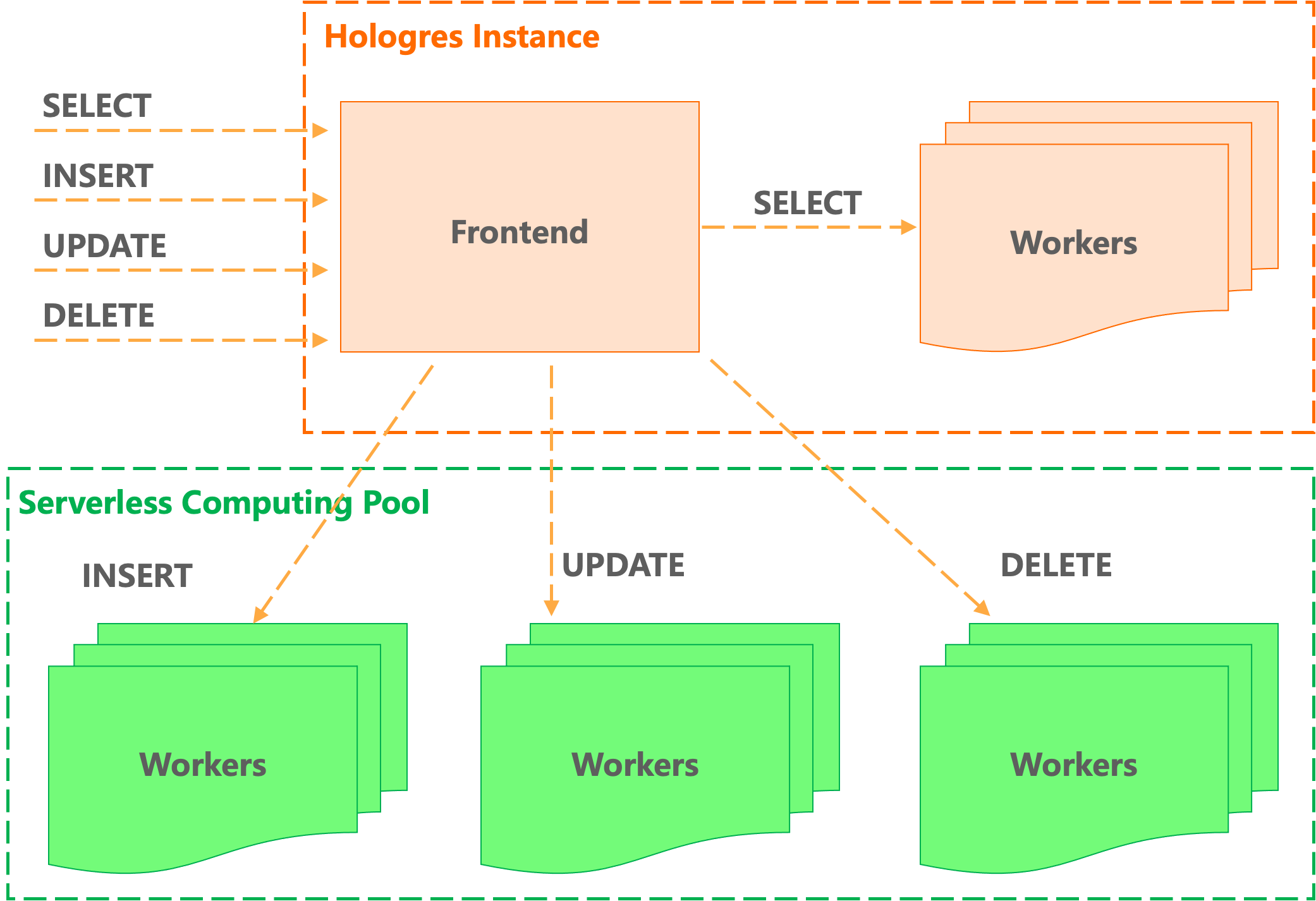
This resource model has three key properties:
| Property | What it means for you |
|---|---|
| On-demand | Resources are allocated only while the job runs. You pay only for what you use — no charge for idle capacity. |
| Elastic | Serverless Computing handles jobs that would otherwise fail with Out-of-Memory (OOM) errors by running them on isolated resources. |
| Isolated | Each job runs in its own environment, so one heavy query cannot affect the performance of other running jobs. |
When to use Serverless Computing
Serverless Computing is a good fit for three scenarios:
Large SQL jobs that exceed your instance's memory
If importing or querying large datasets regularly causes OOM errors, Serverless Computing runs those jobs on dedicated resources in isolation, improving success rates and protecting instance stability.
Reserved capacity that sits idle most of the time
If large jobs run less than 16 hours per day, you are paying for reserved capacity that goes unused most of the time. Downsize your dedicated instance and route heavy jobs to serverless resources — you pay only when those jobs run.
Traffic spikes that strain your dedicated resources
Route specific users or query queues to serverless resources during peak periods. This offloads demand from your dedicated instance without affecting latency-sensitive workloads running on it.
Serverless Computing vs. dedicated resources
Serverless Computing and dedicated resources are complementary, not interchangeable. Use the table below to decide which is right for each workload type.
| Serverless Computing | Dedicated resources | |
|---|---|---|
| Resource sharing | Shared across all users in the same zone. May experience queuing during high demand. | Fully reserved for your instance. No contention from other users. |
| Best for | Batch processing and large ad-hoc queries | Latency-sensitive, real-time workloads |
| Real-time workloads | Not supported | Required for real-time operations |
Limitations
Serverless Computing does not support real-time workloads. The following operations must run on your instance's dedicated resources:
-
Real-time data ingestion via Flink, DataWorks, or Holo Client
-
Immediate point queries using Fixed Plan