Global applications process requests from users around the world and require centralized management of inbound and outbound traffic. Global Accelerator (GA) relies on the high-quality BGP bandwidth and global transmission network of Alibaba Cloud to provide reliable and high-performance network acceleration services. The Internet firewall of Cloud Firewall provides fine-grained traffic control and protection capabilities. You can use GA together with Cloud Firewall to improve the security, performance, and stability of applications.
Scenario
An enterprise application is deployed in the US (Silicon Valley) region, and most clients are located in China. The enterprise faces the following issues:
The cross-border network is unstable. Network issues, such as high network latency, network jitter, and packet loss, frequently occur.
Malicious attacks, crawlers, and requests from non-users in regions outside China threaten application security, increase server loads, and affect overall performance.
To resolve the preceding issues and improve user experience, the enterprise uses GA. The enterprise also uses the access control feature of the Internet firewall of Cloud Firewall to block traffic from regions outside China.

Limits
The Internet firewall of Cloud Firewall protects the following types of assets: GA instances and accelerated IP addresses of the elastic IP address (EIP) type. The accelerated IP addresses must meet the following requirements:
The GA instance to which the accelerated IP addresses belong must be a standard GA instance.
The accelerated IP addresses must be of the EIP type.
The acceleration region to which the accelerated IP addresses belong cannot be an Alibaba Cloud point of presence (POP).
To check whether an acceleration region is a POP of Alibaba Cloud, call the ListAvailableBusiRegions operation.
Prerequisites
Applications are deployed on the origin server.
In this example, the Alibaba Cloud Linux 3 operating system is used. NGINX is used to configure the backend HTTP service that uses port 80.
Cloud Firewall is purchased. For more information, see Purchase Cloud Firewall.
Procedure
Step 1: Configure a GA instance
In this example, a pay-as-you-go standard GA instance is used.
On the page of the GA console, click Create Standard Pay-as-you-go Instance.
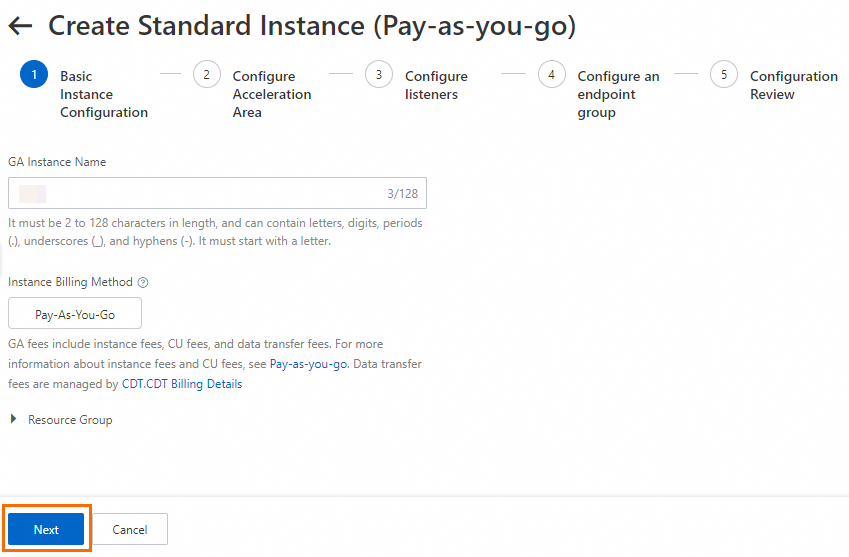
In the Basic Instance Configuration step, configure the basic information and click Next.
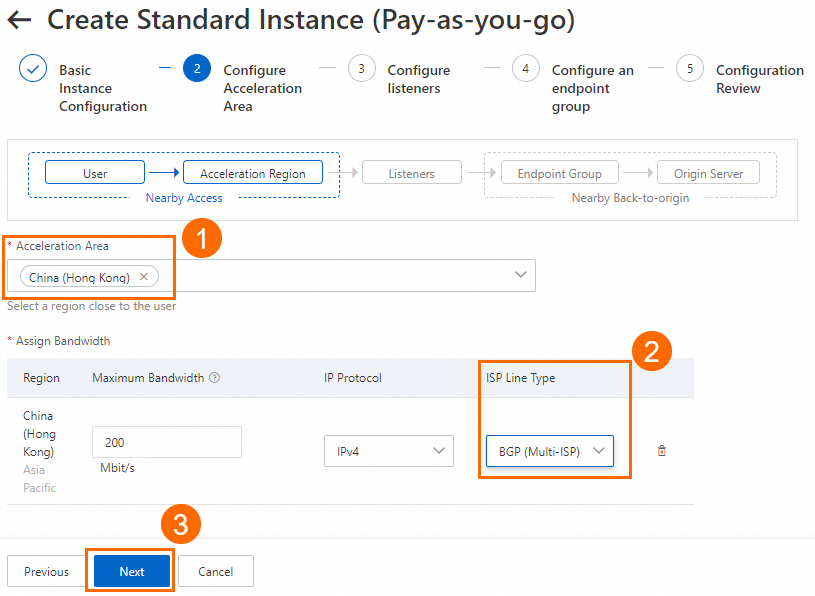
In the Configure Acceleration Area step, add an acceleration area, allocate bandwidth to the region, and then click Next.
In this example, set the Acceleration Area parameter to China (Hong Kong), and ISP Line Type to BGP (Multi-ISP). You can use the default values for the other parameters or modify the values as needed. For more information, see Add and manage acceleration areas.
ImportantIf your require acceleration areas in the Chinese mainland, you must obtain an ICP filing for the domain name to provide services.
Properly plan the bandwidth you need. Insufficient maximum bandwidths may lead to throttling and packet loss issues.
In the Configure listeners step, configure the forwarding protocol and the port, and then click Next.
In this example, the Protocol parameter is set to HTTP and the Port parameter is set to 80. You can use the default values for other parameters or modify them as needed. For more information, see Add and manage intelligent routing listeners.

In the Configure an endpoint group step, configure the endpoint and click Next.
In this example, Region is set to US (Silicon Valley), Backend Service Type is set to Custom Public IP, and Backend Service is set to the public IP address of the origin server. Read and select Compliance Commitments Regarding Cross-border Data Transfers. You can use the default values for other parameters or modify them as needed. For more information, see Add and manage endpoint groups for intelligent routing listeners.


In the Configuration Review step, confirm the configurations and click Submit.
(Optional) After you create a GA instance, you can click the instance ID on the Instances page to view the configurations of the instance. On the instance details page, you can click tabs, such as Instance Information, Listeners, and Acceleration Areas, to view more details.
For example, you can view the accelerated IP address of the GA instance from the Acceleration Areas tab.

Step 2: Configure Cloud Firewall
On the Firewall Settings page in the Cloud Firewall console, click the Internet Firewall tab. On the IPv4 tab, find the accelerated IP address of the GA instance and click Enable Protection in the Operation column.
You can set the asset type to GA EIP and enter a GA instance ID to filter assets. If Protected is displayed in the Firewall Status column, protection is enabled. For more information about how to enable the Internet firewall, see Internet firewall.
NoteThe traffic path from Global Accelerator (GA) to the backend NAT EIP is independent of the direct traffic path from clients on the public network to the NAT EIP. You must configure Cloud Firewall protection for both the GA acceleration IP (the ingest endpoint) and the backend NAT EIP (the egress endpoint) separately. Protection for one endpoint does not apply to the other.
Even if Cloud Firewall protection is enabled for the GA acceleration IP, back-to-origin traffic from GA still directly reaches the backend NAT EIP. Therefore, you cannot rely solely on protection for GA. You must also enable Cloud Firewall for the backend NAT EIP and configure appropriate mitigation policies.

On the page of the Cloud Firewall console, click the Inbound tab and click Create Policy.
In the Create Inbound Policy panel, click the Create Policy tab, configure the policy, and then click OK. Then, create an address book as prompted.
In this example, you can refer to the following table for the configurations. You can modify the policy as needed. For more information, see Create access control policies for the Internet firewall.
Parameter
Description
Example
Source Type
The initiator of network traffic. You must select a source type and enter source addresses from which network traffic is initiated based on the selected source type.
Location
Source
All Locations Outside China
Destination Type
The receiver of network traffic. You must select a destination type and enter destination addresses to which network traffic is sent based on the selected destination type.
IP
Purpose
Enter the accelerated IP address of GA. Use the /32 suffix.
Protocol Type
The transport layer protocol. Valid values: TCP, UDP, ICMP, and ANY. If you do not know the protocol type, select ANY.
ANY
Port Type
The port type and port number of the destination.
Port
Port
0/0, which indicates all ports
Application
The application type of traffic.
ANY
Action
The action on the traffic if the traffic meets the preceding conditions that you specify for the access control policy. Valid values:
Allow: The traffic is allowed.
Deny: The traffic is denied, and no notifications are sent.
Monitor: The traffic is recorded and allowed. You can observe the traffic for a period of time and change the policy action to Allow or Deny as needed.
Deny
Priority
The priority of the access control policy. Default value: Lowest. Valid values:
Top
Policy Validity Period
The validity period of the access control policy. The policy can be used to match traffic only during the validity period.
Always
Enabling Status
Specify whether to enable the policy. If you turn off Enabling Status when you create an access control policy, you can enable the policy in the list of access control policies.
Enabled

Step 3: Verify the result
Verification of the Cloud Firewall access control policy
In this example, requests are sent from clients in the China (Hong Kong) and Germany (Frankfurt) regions.
In the China (Hong Kong) and Germany (Frankfurt) regions, access the accelerated IP address of GA in a browser to check whether the backend service can be accessed.
A client in the China (Hong Kong) region accesses the accelerated IP address of the GA instance. The following result is returned.

A client in the Germany (Frankfurt) region accesses the accelerated IP address of the GA instance. The following result is returned.

The results show that the access control policy of Cloud Firewall takes effect and traffic from regions outside China is blocked.
In the access control policy list, view the number of hits in the Hits/Last Hit At column of the access policy. You can click the number of hits to go to the Traffic Logs page to view the traffic details.
For example, you can set Destination IP Address to the accelerated IP address of GA and Application Identification Status to Blocked by Policy to view the details of blocked traffic.

You can also view attacks and operation logs on the Log Audit page. For more information, see Log audit.
On the Protection Status tab of the Intrusion Prevention page, you can view the statistics and details of protection data.
For example, you can set the destination IP address to the accelerated IP address of GA to view the protection details.

For more information about intrusion prevention capabilities, see Intrusion Prevention.
Verify the GA acceleration performance
In this example, the instant detection tool is used in the China (Hong Kong) region. Before and after GA is configured, the public IP address of the origin server and the accelerated IP address of the GA instance are detected to check the acceleration performance. For more information, see Use the network detection tool to test the acceleration performance.
Initiate detection for the accelerated IP address of GA to check the network latency after GA is configured.

Initiate detection for the public IP address of the origin server to check the network latency before GA is configured.

The test results show that the network latency of data transmission from the China (Hong Kong) region to the US (Silicon Valley) region is reduced.
The acceleration performance varies based on the actual workload.
References
For more information about how GA is billed, see Billing.
For more information on how Cloud Firewall is billed, see Billing overview.
For more information about the protection capabilities of Cloud Firewall, see Features supported by different Cloud Firewall editions.