Dataphin stores run records for the last 15 days, covering data queries from various object types such as ad hoc queries, workflow runs, compute tasks, logical data table previews, derived metric smoke tests, and OpenAPI calls.
View run records
-
On the top navigation bar of the Dataphin homepage, choose Development > Data Development.
-
On the top navigation bar of the Develop page, select a project. If you are in Dev-Prod mode, you must also select an environment.
-
In the left-side navigation pane, click Run Record. In the run record list, select a run record for a specific date.
-
The run record page displays the run log, run result, and basic details such as object name, object type, code type, duration, start time, executor, and related table. You can also View Code, Stop, Delete, and Download Result.
-
View Code: View the executed code script.
NoteThe View Code option is not available for workflow tasks.
-
Stop: A super administrator, system administrator, project administrator, or the executor of the task can stop the task or object.
-
Delete: You cannot delete a record while its task is running. This action is irreversible.
-
Download Result: Download the run result for successfully completed tasks. You can perform a Full Data Download or a Sample Data Download.
-
Full Data Download: Full data is always downloaded in CSV format. This download may take a long time. Monitor the download progress in the message center or on the run record page.
Important-
The Download Result option, including Full Data Download and Sample Data Download, is not available for workflow tasks.
-
For database SQL ad hoc queries, only sample data downloads are supported.
-
A full data download creates a temporary table based on the query statement, and for SPARK_SQL ad hoc queries on a Hadoop-type compute engine, this process uses the default storage format specified in management center > system settings > Development > table management settings.
For example, if the default storage format in table management settings is hudi, the system adds a
using hudistatement when creating the temporary table. If the default storage format is engine default, no specific storage format is applied.
-
-
Sample Data Download: The data download approval settings determine the format for sample data downloads and the corresponding run records. For more information, see Data Download Configuration.
Note-
If download approval is enabled in the security specifications, you must submit a Data Download Application before you can download the data. After the application is approved, you can view the approval task, the current run result, or download the data from the run record. For more information, see Data download approval configuration.
-
If you have enabled the data download approval watermark feature, the system automatically adds a watermark to the downloaded Excel files. Downloaded files are retained for 30 days. For example, if the data was queried on 2023-04-12 and the download was requested on 2023-04-13, the file will expire on 2023-05-12. For more information, see Data Download Approval Configuration.
-
-
-
Manage run records
-
In the left navigation bar, click Run Record, and in the Run Record list, click Run Record List at the bottom to go to the Run Record List page.
-
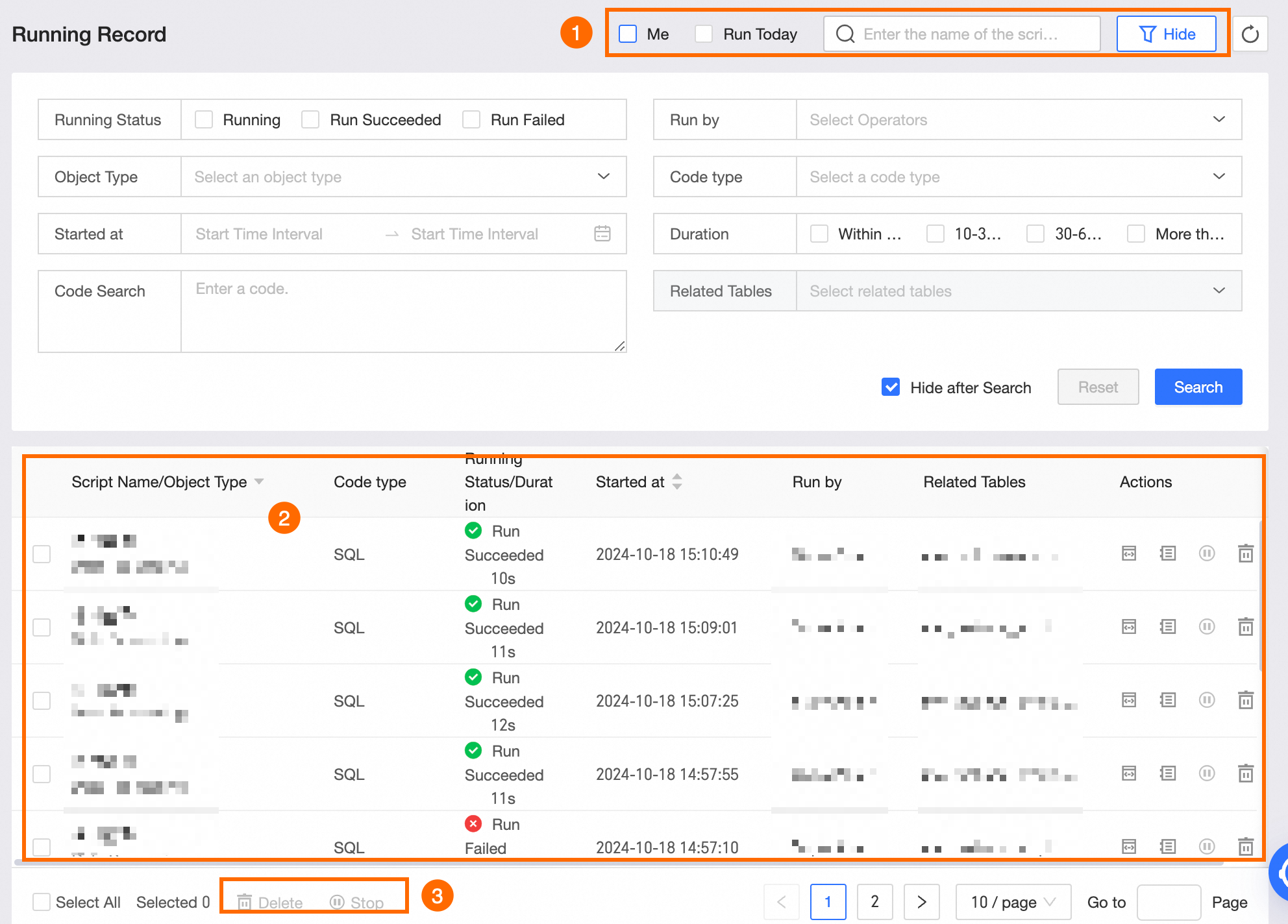
On the run record list page, you can view details for each run record and perform actions such as searching, viewing code, viewing logs, stopping tasks, and deleting records.
No.
Description
① Search and filter
Use the quick filters to show records for tasks that you ran (Run by Me) or all tasks that ran today (Run Today). Click the
 icon for an advanced search based on criteria such as run status, executor, object type, code type, start time, duration, Code Search, related table (for SQL code type), and related dataset (for workflow code type). You can also perform a quick search by script name.
② Run record list
Each run record shows the script name/object type, code type, run status/duration, start time, executor, and related table. The available operations are View Code, View Log, Stop, and Delete.
-
View Code: View the executed code script.
-
View Logs: View the run logs and run results.
-
Stop: A super administrator, system administrator, project administrator, or the executor of the task can stop the task or object.
-
Delete: You cannot delete a record while its task is running. This action is irreversible.
NoteThe View Code and View Log options are not available for workflow tasks.
③ Batch operation
You can select multiple run records to perform a bulk Delete or Stop.
-