With GPU compute from Container Compute Service (ACS), you can get started without managing underlying hardware or GPU nodes. Its pay-as-you-go model suits LLM inference tasks and reduces costs. Because DeepSeek-R1's high parameter count exceeds single-GPU capacity, a multi-instance distributed deployment is recommended. This guide shows how to deploy a production-ready, distributed DeepSeek-R1 inference service using ACS GPU compute.
Background
DeepSeek-R1 model
vLLM
ACS
LWS
Fluid
Solution overview
Model splitting
DeepSeek-R1 has 671 billion parameters, exceeding the 96 GB memory of a single GPU. This guide splits the model across two GPU container instances with model parallelism (PP=2) and data parallelism (TP=8).
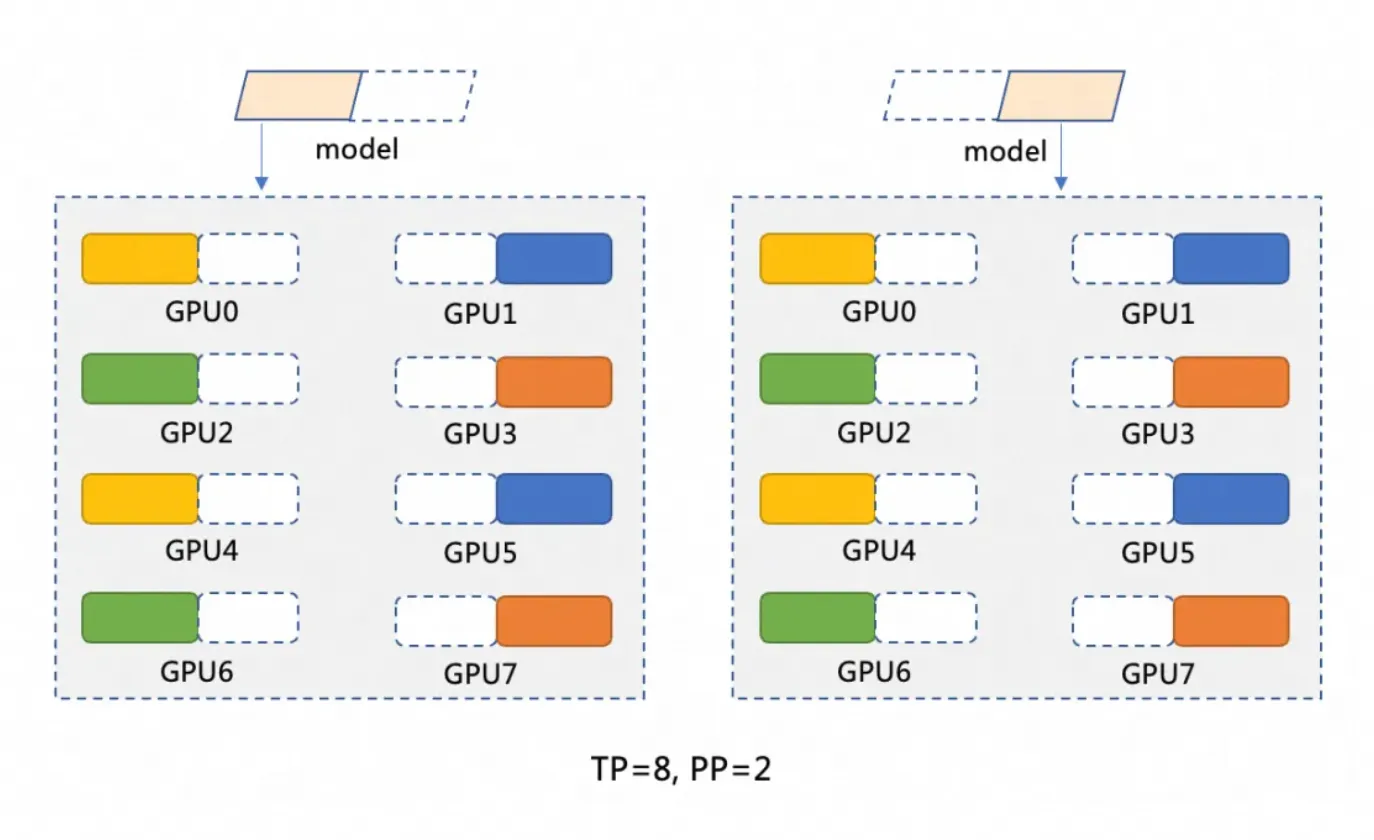
Model parallelism (PP=2) splits the model into two stages, each running on one GPU container instance. The first stage processes input and passes intermediate results to the second.
Data parallelism (TP=8) distributes computation within each stage across 8 GPUs, processing data in parallel and merging results.
Distributed deployment architecture
This solution deploys a distributed inference service for the full version of DeepSeek on ACS using vLLM and Ray. LWS manages the leader-worker deployment pattern, and Fluid provides distributed caching to accelerate model loading. vLLM runs on two ACS GPU pod instances with 8 GPUs each. Each pod acts as a Ray Group (a Ray head and a Ray worker) for model splitting. Different deployment architectures affect variables such as tensor-parallel-size and LWS_GROUP_SIZE in the YAML file.

Prerequisites
-
Assigned the system default role to the service account (required when you use Alibaba Cloud for the first time) so ACS can call dependent services such as Elastic Compute Service (ECS), Object Storage Service (OSS), Apsara File Storage NAS, Cloud Parallel File Storage (CPFS), and Server Load Balancer (SLB), create clusters, and save logs. ACS can use these capabilities only after this role is correctly granted. For details, see Get started with Container Compute Service.
GPU instance specifications and costs
Recommended per-instance configuration: GPU: 8 cards (96 GiB of GPU memory per card), CPU: 64 vCPUs, Memory: 512 GiB. Select an instance type from Recommended instance types and GPU compute types and specifications. Cost calculation is covered in Billing.
-
ACS GPU instance specifications must follow the ACS pod specification adjustment logic.
-
ACS pods provide 30 GiB of free ephemeral storage by default. The inference image
registry-cn-hangzhou.ack.aliyuncs.com/ack-demo/vllm:v0.7.2occupies about 9.5 GiB. To expand storage, follow Increase the ephemeral storage size.
Procedure
Step 1: Prepare DeepSeek-R1 model files
Large language models require substantial disk space. Create a NAS or OSS volume for persistent model file storage. This guide uses OSS.
Model file transfers can be slow. You can submit a ticket to quickly copy the model files to your OSS bucket.
-
Run the following command to download the DeepSeek-R1 model from ModelScope.
NoteEnsure git-lfs is installed. If not, run
yum install git-lfsorapt-get install git-lfs. Additional methods are in Installing Git Large File Storage.git lfs install GIT_LFS_SKIP_SMUDGE=1 git clone https://www.modelscope.cn/deepseek-ai/DeepSeek-R1.git cd DeepSeek-R1/ git lfs pull -
Create a directory in OSS and upload the model to it.
NoteTo install and configure ossutil, follow Install ossutil.
ossutil mkdir oss://<your-bucket-name>/models/DeepSeek-R1 ossutil cp -r ./DeepSeek-R1 oss://<your-bucket-name>/models/DeepSeek-R1 -
After storing the model in OSS, you can load it in one of two ways.
-
Mount the model directly by using a PVC and PV: Suitable for smaller models without strict startup or loading speed requirements.
Console
The following are the basic configuration details for the example PV:
Parameter
Description
Storage volume type
OSS
Name
llm-model
Access key
Configure the access key ID and access key secret for accessing OSS.
Bucket ID
Select the OSS bucket you created in the previous step.
OSS path
Select the path where the model is located, such as /models/DeepSeek-R1.
The following are the basic configuration details for the example PVC:
Parameter
Description
Storage claim type
OSS
Name
llm-model
Allocation mode
Select Existing Volume.
Existing volume
Click the Select Existing Volume link and select the PV you created.
kubectl
The following is an example YAML file:
apiVersion: v1 kind: Secret metadata: name: oss-secret stringData: akId: <your-oss-ak> # Your AccessKey ID for accessing OSS. akSecret: <your-oss-sk> # Your AccessKey Secret for accessing OSS. --- apiVersion: v1 kind: PersistentVolume metadata: name: llm-model labels: alicloud-pvname: llm-model spec: capacity: storage: 30Gi accessModes: - ReadOnlyMany persistentVolumeReclaimPolicy: Retain csi: driver: ossplugin.csi.alibabacloud.com volumeHandle: llm-model nodePublishSecretRef: name: oss-secret namespace: default volumeAttributes: bucket: <your-bucket-name> # The bucket name. url: <your-bucket-endpoint> # The endpoint, such as oss-cn-hangzhou-internal.aliyuncs.com. otherOpts: "-o umask=022 -o max_stat_cache_size=0 -o allow_other" path: <your-model-path> # In this example, the path is /models/DeepSeek-R1/. --- apiVersion: v1 kind: PersistentVolumeClaim metadata: name: llm-model spec: accessModes: - ReadOnlyMany resources: requests: storage: 30Gi selector: matchLabels: alicloud-pvname: llm-model -
Accelerate model loading with Fluid: Recommended for larger models that require fast startup and loading. Use Fluid to accelerate data access.
-
Install the ack-fluid component (version 1.0.11-* or later) from the ACS App Marketplace by using Helm. Create an application by using Helm.
-
Enable privileged mode for the ACS pod. You can enable it by submitting a ticket.
-
Create a Secret to access OSS.
apiVersion: v1
kind: Secret
metadata:
  name: mysecret
stringData:
  fs.oss.accessKeyId: xxx
  fs.oss.accessKeySecret: xxx
Set
fs.oss.accessKeyIdandfs.oss.accessKeySecretto the credentials for the OSS bucket created above. -
Create a Dataset and a JindoRuntime.
apiVersion: data.fluid.io/v1alpha1
kind: Dataset
metadata:
  name: deepseek
spec:
  mounts:
    - mountPoint:  oss://<your-bucket-name>       # Replace with your actual bucket name.
      options:
        fs.oss.endpoint: <your-bucket-endpoint>    # Replace with your actual bucket endpoint.
      name: deepseek
      path: "/"
      encryptOptions:
        - name: fs.oss.accessKeyId
          valueFrom:
            secretKeyRef:
              name: mysecret
              key: fs.oss.accessKeyId
        - name: fs.oss.accessKeySecret
          valueFrom:
            secretKeyRef:
              name: mysecret
              key: fs.oss.accessKeySecret
---
apiVersion: data.fluid.io/v1alpha1
kind: JindoRuntime
metadata:
  name: deepseek
spec:
  replicas: 16    # Adjust as needed.
  master:
    podMetadata:
      labels:
        alibabacloud.com/compute-class: performance
        alibabacloud.com/compute-qos: default
  worker:
    podMetadata:
      labels:
        alibabacloud.com/compute-class: performance
        alibabacloud.com/compute-qos: default
      annotations:
        kubernetes.io/resource-type: serverless
    resources:
      requests:
        cpu: 16
        memory: 128Gi
      limits:
        cpu: 16
        memory: 128Gi
  tieredstore:
    levels:
      - mediumtype: MEM
        path: /dev/shm
        volumeType: emptyDir
        ## Adjust as needed.
        quota: 128Gi
        high: "0.99"
        low: "0.95"
After creation, run the
kubectl get pod | grep jindocommand to check if the pods are in theRunningstate. Expected output:deepseek-jindofs-master-0 1/1 Running 0 3m29s deepseek-jindofs-worker-0 1/1 Running 0 2m52s deepseek-jindofs-worker-1 1/1 Running 0 2m52s ... -
Cache the model by creating a DataLoad resource.
apiVersion: data.fluid.io/v1alpha1 kind: DataLoad metadata: name: deepseek spec: dataset: name: deepseek namespace: default loadMetadata: true -
Run the following command to check the cache status.
kubectl get dataloadExpected output:
NAME DATASET PHASE AGE DURATION deepseek deepseek Executing 4m30s UnfinishedPHASEshowsExecutingwhile caching is in progress. Wait about 20 minutes and re-run the command.Completeindicates success. Track progress withkubectl logs $(kubectl get pods --selector=job-name=deepseek-loader-job -o jsonpath='{.items[0].metadata.name}') | grep progress. -
Run the following command to check the Dataset resource.
kubectl get datasetsExpected output:
NAME       UFS TOTAL SIZE   CACHED    CACHE CAPACITY   CACHED PERCENTAGE   PHASE   AGE
deepseek   1.25TiB          1.25TiB   2.00TiB          100.0%              Bound   21h
-
-
Step 2: Deploy the model with ACS GPU
-
Install the lws component from the ACS App Marketplace by using Helm. Create an application by using Helm.
-
Deploy the model by using a LeaderWorkerSet.
Note-
In the YAML file, replace
alibabacloud.com/gpu-model-series: <example-model>with a specific GPU model supported by ACS. For a list of currently supported GPU models, consult your PDSA or submit a ticket. -
Compared to TCP/IP, high-performance RDMA networking uses zero-copy and kernel bypass to avoid data copying and frequent context switches, resulting in lower latency, higher throughput, and reduced CPU usage. ACS supports RDMA by configuring the label
alibabacloud.com/hpn-type: "rdma"in the YAML file. For a list of GPU models that support RDMA, consult your PDSA or submit a ticket. -
If you use Fluid to load the model, change the
claimNamein both PVC sections to the name of the Fluid dataset. -
Different distributed deployment architectures affect the values of variables such as
tensor-parallel-sizeandLWS_GROUP_SIZEin the YAML file.
Standard deployment
apiVersion: leaderworkerset.x-k8s.io/v1
kind: LeaderWorkerSet
metadata:
  name: deepseek-r1-671b-fp8-distrubution
spec:
  replicas: 1
  leaderWorkerTemplate:
    size: 2 # Total number of leader and worker pods.
    restartPolicy: RecreateGroupOnPodRestart
    leaderTemplate:
      metadata:
        labels:
          role: leader
          alibabacloud.com/compute-class: gpu  # Specify the GPU type.
          alibabacloud.com/compute-qos: default # Specify the ACS QoS level.
          alibabacloud.com/gpu-model-series: <example-model> ## Specify the GPU model.
      spec:
        volumes:
          - name: llm-model
            persistentVolumeClaim:
              ## If using Fluid, enter the Fluid dataset name here, for example: deepseek
              claimName: llm-model
          - name: shm
            emptyDir:
              medium: Memory
              sizeLimit: 32Gi
        containers:
          - name: deepseek-r1-671b-leader
            image: registry-cn-hangzhou.ack.aliyuncs.com/ack-demo/vllm:v0.7.2
            env:
              - name: NCCL_SOCKET_IFNAME # Specify the network interface card (NIC).
                value: eth0
            command:
              - sh
              - -c
              - "/vllm-workspace/ray_init.sh leader --ray_cluster_size=$(LWS_GROUP_SIZE);vllm serve /models/DeepSeek-R1/ --port 8000 --trust-remote-code --served-model-name ds --max-model-len 2048 --gpu-memory-utilization 0.95 --tensor-parallel-size 8 --pipeline-parallel-size 2 --enforce-eager"
# Set tensor-parallel-size to the number of GPUs per pod.
            resources:
              limits:
                nvidia.com/gpu: "8"
                cpu: "64"
                memory: 512G
              requests:
                nvidia.com/gpu: "8"
                cpu: "64"
                memory: 512G
            ports:
              - containerPort: 8000
            volumeMounts:
              - mountPath: /models/DeepSeek-R1
                name: llm-model
              - mountPath: /dev/shm
                name: shm
    workerTemplate:
      metadata:
        labels:
          alibabacloud.com/compute-class: gpu  # Specify the GPU type.
          alibabacloud.com/compute-qos: default # Specify the ACS QoS level.
          alibabacloud.com/gpu-model-series: <example-model> ## Specify the GPU model.
      spec:
        volumes:
          - name: llm-model
            persistentVolumeClaim:
              ## If using Fluid, enter the Fluid dataset name here, for example: deepseek
              claimName: llm-model
          - name: shm
            emptyDir:
              medium: Memory
              sizeLimit: 32Gi
        containers:
          - name: deepseek-r1-671b-worker
            image: registry-cn-hangzhou.ack.aliyuncs.com/ack-demo/vllm:v0.7.2
            env:
              - name: NCCL_SOCKET_IFNAME # Specify the network interface card (NIC).
                value: eth0
            command:
              - sh
              - -c
              - "/vllm-workspace/ray_init.sh worker --ray_address=$(LWS_LEADER_ADDRESS)"
            resources:
              limits:
                nvidia.com/gpu: "8"
                cpu: "64"
                memory: 512G
              requests:
                nvidia.com/gpu: "8"
                cpu: "64"
                memory: 512G
            ports:
              - containerPort: 8000
            volumeMounts:
              - mountPath: /models/DeepSeek-R1
                name: llm-model
              - mountPath: /dev/shm
                name: shm
RDMA acceleration
If you use an open source base image (such as vLLM), add the following environment variables to the YAML file:
Name
Value
NCCL_SOCKET_IFNAME
eth0
NCCL_IB_TC
136
NCCL_IB_SL
5
NCCL_IB_GID_INDEX
3
NCCL_DEBUG
INFO
NCCL_IB_HCA
mlx5
NCCL_NET_PLUGIN
none
apiVersion: leaderworkerset.x-k8s.io/v1 kind: LeaderWorkerSet metadata: name: deepseek-r1-671b-fp8-distrubution spec: replicas: 1 leaderWorkerTemplate: size: 2 # Total number of leader and worker pods. restartPolicy: RecreateGroupOnPodRestart leaderTemplate: metadata: labels: role: leader alibabacloud.com/compute-class: gpu # Specify the GPU type. alibabacloud.com/compute-qos: default # Specify the ACS QoS level. alibabacloud.com/gpu-model-series: <example-model> ## Specify the GPU model. # Specify that the application runs in a high-performance RDMA network. Submit a ticket for information on supported GPU models. alibabacloud.com/hpn-type: "rdma" spec: volumes: - name: llm-model persistentVolumeClaim: ## If using Fluid, enter the Fluid dataset name here, for example: deepseek claimName: llm-model - name: shm emptyDir: medium: Memory sizeLimit: 32Gi containers: - name: deepseek-r1-671b-leader image: registry-cn-hangzhou.ack.aliyuncs.com/ack-demo/vllm:v0.7.2 env: - name: NCCL_SOCKET_IFNAME # Specify the network interface card (NIC). value: eth0 - name: NCCL_IB_TC value: "136" - name: NCCL_IB_SL value: "5" - name: NCCL_IB_GID_INDEX value: "3" - name: NCCL_DEBUG value: "INFO" - name: NCCL_IB_HCA value: "mlx5" - name: NCCL_NET_PLUGIN value: "none" command: - sh - -c - "/vllm-workspace/ray_init.sh leader --ray_cluster_size=$(LWS_GROUP_SIZE);vllm serve /models/DeepSeek-R1/ --port 8000 --trust-remote-code --served-model-name ds --max-model-len 2048 --gpu-memory-utilization 0.95 --tensor-parallel-size 8 --pipeline-parallel-size 2 --enforce-eager" # Set tensor-parallel-size to the number of GPUs per pod. resources: limits: nvidia.com/gpu: "8" cpu: "64" memory: 512G requests: nvidia.com/gpu: "8" cpu: "64" memory: 512G ports: - containerPort: 8000 volumeMounts: - mountPath: /models/DeepSeek-R1 name: llm-model - mountPath: /dev/shm name: shm workerTemplate: metadata: labels: alibabacloud.com/compute-class: gpu # Specify the GPU type. alibabacloud.com/compute-qos: default # Specify the ACS QoS level. alibabacloud.com/gpu-model-series: <example-model> ## Specify the GPU model. # Specify that the application runs in a high-performance RDMA network. Submit a ticket for information on supported GPU models. alibabacloud.com/hpn-type: "rdma" spec: volumes: - name: llm-model persistentVolumeClaim: ## If using Fluid, enter the Fluid dataset name here, for example: deepseek claimName: llm-model - name: shm emptyDir: medium: Memory sizeLimit: 32Gi containers: - name: deepseek-r1-671b-worker image: registry-cn-hangzhou.ack.aliyuncs.com/ack-demo/vllm:v0.7.2 env: - name: NCCL_SOCKET_IFNAME # Specify the network interface card (NIC). value: eth0 - name: NCCL_IB_TC value: "136" - name: NCCL_IB_SL value: "5" - name: NCCL_IB_GID_INDEX value: "3" - name: NCCL_DEBUG value: "INFO" - name: NCCL_IB_HCA value: "mlx5" - name: NCCL_NET_PLUGIN value: "none" command: - sh - -c - "/vllm-workspace/ray_init.sh worker --ray_address=$(LWS_LEADER_ADDRESS)" resources: limits: nvidia.com/gpu: "8" cpu: "64" memory: 512G requests: nvidia.com/gpu: "8" cpu: "64" memory: 512G ports: - containerPort: 8000 volumeMounts: - mountPath: /models/DeepSeek-R1 name: llm-model - mountPath: /dev/shm name: shm -
-
Expose the inference service with a Service resource.
apiVersion: v1
kind: Service
metadata:
  name: ds-leader
spec:
  ports:
    - name: http
      port: 8000
      protocol: TCP
      targetPort: 8000
  selector:
    leaderworkerset.sigs.k8s.io/name: deepseek-r1-671b-fp8-distrubution
    role: leader
  type: ClusterIP
Step 3: Verify the inference service
-
Forward a local port to the inference service.
Notekubectl port-forwardis for development and debugging only. For production networking, use Manage Ingresses.kubectl port-forward svc/ds-leader 8000:8000Expected output:
Forwarding from 127.0.0.1:8000 -> 8000 Forwarding from [::1]:8000 -> 8000 -
Send a model inference request.
curl http://localhost:8000/v1/chat/completions \
  -H "Content-Type: application/json" \
  -d '{
    "model": "ds",
    "messages": [
      {
        "role": "system",
        "content": "You are a friendly AI assistant."
      },
      {
        "role": "user",
        "content": "Introduce deep learning."
      }
    ],
    "max_tokens": 1024,
    "temperature": 0.7,
    "top_p": 0.9,
    "seed": 10
  }'
Expected output:
{"id":"chatcmpl-4bc78b66e2a4439f8362bd434a60be57","object":"chat.completion","created":1739501401,"model":"ds","choices":[{"index":0,"message":{"role":"assistant","reasoning_content":null,"content":"<think>\nOkay, the user wants me to introduce deep learning. I need to think about how to answer this well. First, I should clarify the basic definition of deep learning—it's a branch of machine learning, right? Then I should compare it to traditional machine learning methods to highlight its advantages, like automatic feature extraction. I'll probably need to mention neural networks, especially the structure of deep neural networks with multiple hidden layers.\n\nNext, I should talk about the core components of deep learning, like activation functions, loss functions, and optimizers. The user might not be familiar with these terms, so I'll need to briefly explain the role of each part. I can use examples like ReLU as an activation function, Adam as an optimizer, and cross-entropy loss.\n\nThen, I should cover application areas. Computer vision and natural language processing are common examples. I should provide some concrete examples like image recognition and machine translation to make it easier for the user to understand. I could also mention industry applications, like in healthcare and finance, as the user might be interested in these practical use cases.\n\nI should also mention popular frameworks like TensorFlow and PyTorch, which make it easier to implement deep learning. And the importance of hardware acceleration, like GPUs, which explains why deep learning has developed so rapidly.\n\nAdditionally, I should probably discuss the challenges and limitations of deep learning, such as its dependency on data, high demand for computational resources, and poor interpretability. This will give the user a well-rounded view of its pros and cons. I might also mention future development directions, like efficient training algorithms and research into interpretability.\n\nThe user likely wants a basic understanding of deep learning. They might have some technical background, but not a deep one. They probably want to quickly grasp the key points and applications, so the answer needs to be well-structured and highlight the main points without getting too deep into technical details, but it can't be too brief either. I need to balance technical accuracy with readability.\n\nI should avoid using too much jargon, or explain it briefly when I do, for terms like \"neural network\" or \"convolutional neural network.\" The user could be a student or someone new to the field, so I should use plain language. I'll also use examples to help them connect the concepts to real-world applications, which makes them easier to remember.\n\nI also need to be clear about the relationship between deep learning and machine learning, explaining that deep learning is a subfield of machine learning, but it's deeper and handles more complex problems. I might also mention the backpropagation algorithm as one of the key training techniques.\n\nFinally, I'll provide a summary, emphasizing the impact and potential of deep learning and its future directions, to give the user a comprehensive overview. I'll check if I've missed any important points, like common model architectures such as CNNs and RNNs, which might be worth a brief mention to show the diversity.\n\nSometimes users are interested in the principles, but it's important to keep it concise here. The focus should be on an overview rather than in-depth technical details. I'll ensure the answer flows logically, starting from the definition, then moving to core components, applications, frameworks, challenges, and future directions. That structure seems reasonable.\n</think>\n\nDeep learning is a subfield of machine learning that aims to simulate the learning mechanism of the human brain by building multi-layered neural networks (known as \"deep\" networks). It automatically learns complex features and patterns from large amounts of data and is widely used in fields like image recognition, speech processing, and natural language processing.\n\n### Key concepts\n1. **Artificial Neural Networks (ANNs)**:\n * Composed of an input layer, multiple hidden layers, and an output layer, with each layer containing multiple neurons.\n * Processes information by simulating the activation and transmission of signals between neurons.\n\n2. **Automatic Feature Extraction**:\n * Traditional machine learning relies on manually engineered features. In contrast, deep learning uses multi-layer networks to automatically extract abstract features from data (such as edges and shapes from pixels in an image).\n\n3. **Core Components**:\n * **Activation Function** (e.g., ReLU, Sigmoid): Introduces non-linearity, enhancing the model's expressive power.\n * **Loss Function** (e.g., Cross-Entropy, Mean Squared Error): Measures the difference between the model's predictions and the actual values.\n * **Optimizer** (e.g., SGD, Adam): Optimizes the network's parameters through backpropagation to minimize the loss.\n\n---\n\n### Typical models\n- **Convolutional Neural Network (CNN)**:\n Designed for images, it uses convolutional kernels to extract spatial features. Classic models include ResNet and VGG.\n- **Recurrent Neural Network (RNN)**:\n Processes sequential data (text, speech) by introducing a memory mechanism. Improved versions include LSTM and GRU.\n- **Transformer**:\n Based on a self-attention mechanism, it has significantly advanced natural language processing performance (e.g., BERT, GPT series).\n\n---\n\n### Use cases\n- **Computer Vision**: Face recognition, medical image analysis (e.g., detecting lesions in lung CT scans).\n- **Natural Language Processing**: Intelligent chatbots, document summarization, translation (e.g., DeepL).\n- **Speech Technology**: Voice assistants (e.g., Siri), real-time captioning.\n- **Reinforcement Learning**: Game AI (AlphaGo), robotics control.\n\n---\n\n### Advantages and challenges\n- **Advantages**:\n - Automatically learns complex features, reducing the need for manual intervention.\n - Far outperforms traditional methods when given large amounts of data and high computing power.\n- **Challenges**:\n - Relies on massive amounts of labeled data (e.g., requires tens of thousands of labeled medical images).\n - High model training costs (e.g., training GPT-3 cost over ten million USD).\n - \"Black box\" nature leads to poor interpretability, limiting its application in high-risk fields like medicine.\n\n---\n\n### Tools and trends\n- **Mainstream Frameworks**: TensorFlow (industry-deployment friendly), PyTorch (preferred for research).\n- **Research Directions**:\n - Lightweight models (e.g., MobileNet for mobile devices).\n - Self-supervised learning (reducing dependency on labeled data).\n - Enhanced interpretability (e.g., visualizing the model's decision-making basis).\n\nDeep learning is pushing the boundaries of artificial intelligence, from generative AI (like Stable Diffusion for image generation) to autonomous driving, and continues to transform the tech ecosystem. Future advancements will likely focus on reducing computational costs and improving efficiency and interpretability.","tool_calls":[]},"logprobs":null,"finish_reason":"stop","stop_reason":null}],"usage":{"prompt_tokens":17,"total_tokens":1131,"completion_tokens":1114,"prompt_tokens_details":null},"prompt_logprobs":null}
References
-
Alibaba Cloud Container Compute Service (ACS) is integrated into Container Service for Kubernetes. You can use the container compute provided by ACS with an ACK managed cluster Pro. For more information about using ACS GPU compute in ACK, see Example: Use ACS GPU computing power.
-
For information about deploying DeepSeek on ACK, see:
-
For more information about the DeepSeek R1 and V3 models, see:
-
ACS AI container images are specialized images for ACS clusters using GPU instances. For information about currently available images, see ACS AI container image release notes.