After you back up an Elastic Compute Service (ECS) instance, you can quickly restore the instance, clone it, or create a new instance across availability zones. This topic describes the differences between the ECS instance backup feature of Cloud Backup and the snapshot service.
Do not use the ECS instance backup service and the disk snapshot service for the same disk simultaneously. This can cause conflicting snapshot running times. Select a backup method that meets your needs.
Snapshot service
The Alibaba Cloud snapshot service is an agentless data backup method that creates crash-consistent snapshots for all disk types. These snapshots can be used to back up or restore an entire disk. The snapshot service is a convenient and efficient data disaster recovery tool used for data backup, image creation, and application disaster recovery. For more information, see Snapshot overview.
ECS instance backup
ECS instance backup is a Data Management service for ECS instances. It is provided by Cloud Backup and built on the disk snapshot service. Cloud Backup provides fully automatic backup policies for ECS instances, an intuitive interface for backup configuration and recovery, and a wide range of operations for recovery, cloning, and disaster recovery. It manages data from the perspective of an ECS instance instead of a disk, which simplifies ECS data protection. It also enables advanced scenarios, such as setting up ECS test and development environments and implementing low-cost geo-redundancy. This greatly enhances the value of data protection. For more information, see ECS instance backup overview and Back up an ECS instance.
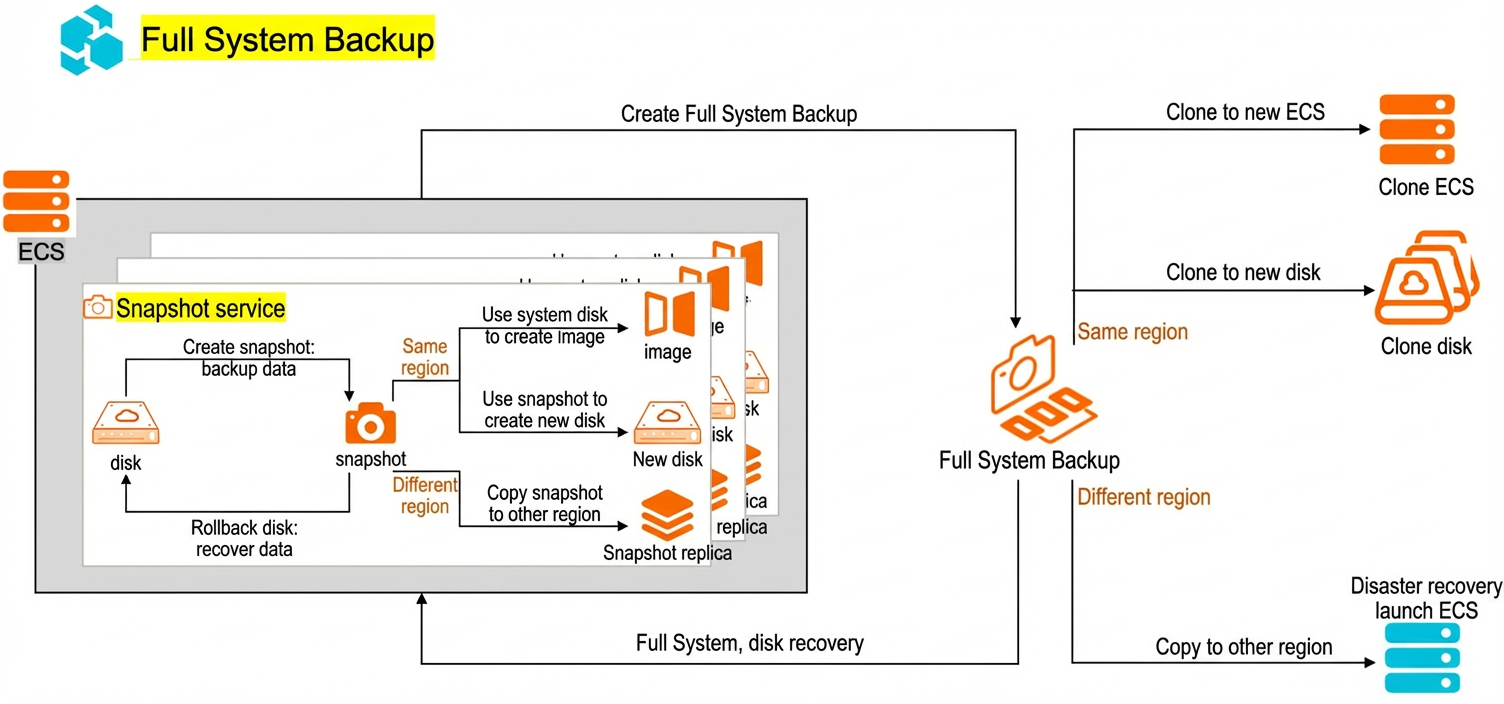
When you back up an ECS instance, you can restore the instance, clone it into a new ECS instance, or clone a new disk.
Key differences
ECS instance backup is based on the snapshot service and includes most of its capabilities and scenarios. It provides a simple and intuitive ECS-centric operational view. It can automatically discover and track all disks of an ECS instance. You can also flexibly restore and clone at the instance or disk level.
You can use ECS instance backup from Cloud Backup when you need to perform batch local or geo-redundant backups for ECS instances. You can also use it to quickly build and copy ECS test and development environments.
Comparison Item | Snapshot service | Full machine backup |
Fees | You are charged for snapshots. For more information, see Snapshot billing. |
|
Implementation method | This service is based on snapshot technology. For more information, see Snapshot overview and How snapshots work. | This service is based on the orchestration of snapshot service APIs, including disk snapshots, consistent snapshot groups for disks, and remote snapshot replication. For information about specific APIs, see Snapshot service API. |
Protected object | Protects only specified disks. Local disks are not supported. | You can specify a batch of ECS instances and optionally configure the disks for each one individually. Local disks are not supported. |
Backup by group | Supports only disks of the ESSD type. | Supports selecting all disks of an ECS instance. If all disks are of the ESSD type, Cloud Backup automatically creates a consistent backup group. Otherwise, Cloud Backup creates snapshots at the same time and ensures crash consistency for each disk. |
Tracking method | None | In full-disk backup mode for an ECS instance, all disks that are deleted or added are automatically tracked. |
Recovery method | Disk or image | Supports ECS instance rollback and cloning, including geo-redundant cloning. You can also recover or clone by disk. |
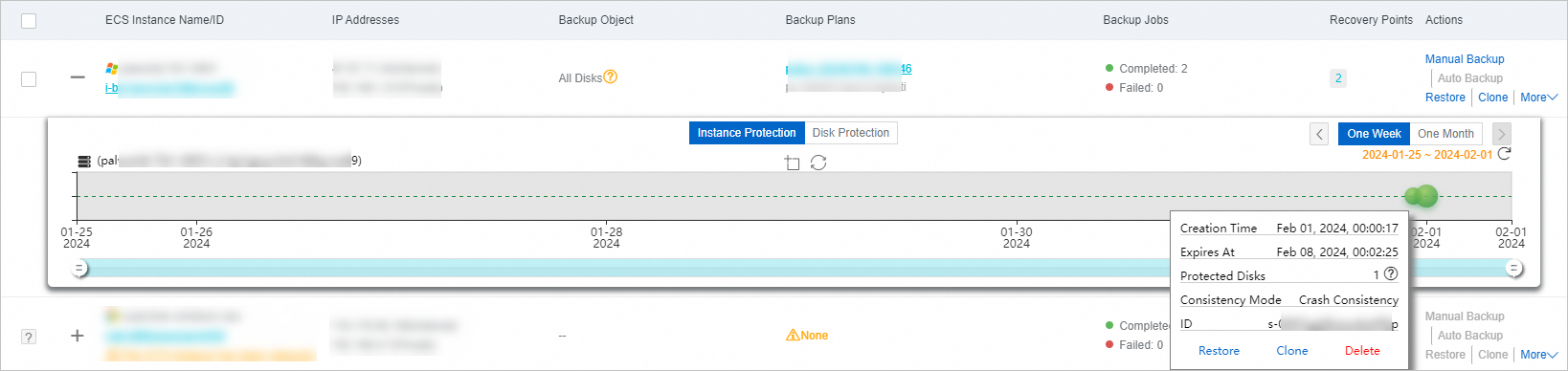
Management method | You can manage disk snapshots from a disk-centric perspective in a table view. | You can manage backup policies from an ECS instance-centric perspective and view backup history in a graphical interface. You can also intuitively restore and clone ECS instances. |
Snapshot visibility | In the snapshot console, you can view all snapshots, including the disk snapshots that are created by Cloud Backup. | In the Cloud Backup console, you can view only the disk snapshots that are created by Cloud Backup. |
Snapshot limit (per disk) | A disk supports up to 256 manual snapshots and 1,000 automatic snapshots. For more information, see Snapshot limits. | A disk supports up to 256 snapshots. Other limits are the same as those of the snapshot service. For more information, see Snapshot limits. |
References
Cloud Backup provides resource plans for various backup scenarios. These plans offer discounts to help you save costs. For more information, see Resource plan purchasing guide.
Cloud Backup supports backing up folders and files on ECS instances, which lets you view and recover data at any time. For more information, see Back up ECS files.
Cloud Backup supports backing up folders and files from local servers to the cloud, which lets you view and recover data at any time. For more information, see Back up local files.
To learn more about the product, see What is Cloud Backup?.