All Products
Search
Document Center

Container Service for Kubernetes:Distribute credentials using Secrets

Last Updated:Sep 22, 2025

Deploying enterprise applications requires managing sensitive data like database passwords and API keys. Hardcoding this information into your code poses severe security risks and can lead to data leaks. Kubernetes Secrets provide an encrypted storage mechanism to separate sensitive data from your application code. This helps prevent security incidents caused by code exposure.

Choose a method

Method

Features

Use cases

Mount as a volume (Recommended)

Isolates data using file permissions to prevent exposure between processes. Changes to the Secret are automatically synced to the mounted files.

Ideal for production environments, especially for highly sensitive data such as database passwords and API keys where fine-grained file permission control is required.

Inject as an environment variable

Easy to access by all processes within a container, but this increases the risk of accidental exposure through logs. Pods must be restarted for updates to take effect.

Suitable for simple configuration injection, such as log levels or service endpoints, and for legacy applications designed to consume environment variables.

Create a Secret

Console

  1. Log on to the ACK console. In the left navigation pane, click Clusters.

  2. On the Clusters page, click the name of the one you want to change. In the left navigation pane, choose Configurations > Secrets.

  3. On the Secrets page, select the default Namespace and click Create. Configure the new Secret:

    • Name: nginx-secret

    • Type: Opaque

      • Opaque: a base64-encoded secret used to store sensitive data, such as passwords and certificates.

      • Private Repository Logon Secret: stores authentication credentials for a private image repository.

      • TLS Certificate: stores a Transport Layer Security (TLS)/Secure Sockets Layer (SSL) certificate and private key.

    • Add the following key-value pairs:

      • username: admin

      • password: MySecurePassword!

      • api-key: ak-1234567890abcdef

      If you enter a plaintext value, select Encode Data Values Using Base64.

kubectl

  1. Connect to the cluster using kubectl.

  2. Create the Secret.

    Important

    This example is for demonstration only. In production, create secrets from files or other secure sources instead of using --from-literal.

    kubectl create secret generic nginx-secret \
      --from-literal=username=admin \
      --from-literal=password='MySecurePassword!' \
      --from-literal=api-key='ak-1234567890abcdef' \
      -n default
  3. Verify that the Secret was created.

    kubectl get secret nginx-secret

    Expected output:

    NAME           TYPE     DATA   AGE
    nginx-secret   Opaque   3      23h

Use a Secret

The Deployment and the Secret it uses must be in the same namespace.

Method 1: Mount as a volume

This method securely exposes Secret data as files inside your container.

Console

  1. Create a Deployment.

    1. On the Clusters page, find the cluster you want to manage and click its name. In the left navigation pane, choose Workloads > Deployments.

    2. Create a stateless workload (Deployment).

      1. On the Deployments page, click Create from Image.

      2. In the Basic Information step, configure the following parameters and click Next:

        • Name: nginx-volume-demo

        • Namespace: default

        • Replicas: 2

        • Type: Deployment

      3. Configure the container.

        1. In the Container step, configure the Image Name and Port:

          • Image Name: anolis-registry.cn-zhangjiakou.cr.aliyuncs.com/openanolis/nginx:1.14.1-8.6

          • Container Port: 80, Protocol: TCP

          Important

          Your cluster must have Internet access to pull this image. If you selected Configure SNAT for VPC (enabled by default) when creating the cluster, no further action is needed. Otherwise, see Enable an existing ACK cluster to access the Internet.

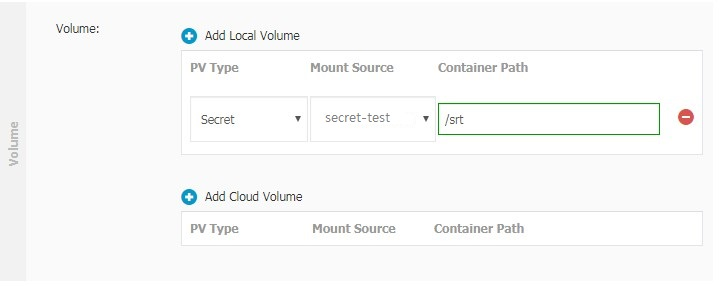
        2. In the Volume section, click Add Local Storage.

          • PV Type: Secret

          • Name: secret-volume

          • Mount Source: select the created Secret, such as nginx-secret.

          • Container Path: Specify the mount path inside the container, such as /etc/nginx/secrets.

          Then, click Next.

      4. In the Advanced step, configure access control, scaling, scheduling, labels, and annotations as needed. Then, click Create at the bottom of the page.

      5. In the Complete step, monitor the application task.

        In the Creation Task Submitted section, click View Details and verify that the container status is Running.

  2. Verify that the Secret files were mounted.

    Select the pod you want to access, such as nginx-volume-demo-7xxxxxx****. In the Actions column, click Terminal and choose the nginx container to open a terminal session.

    1. Verify that the Secret files were mounted.

      ls -la /etc/nginx/secrets

      Expected output:

      total 4
      drwxrwxrwt 3 root root  140 Sep 15 02:31 .
      drwxr-xr-x 1 root root 4096 Sep 15 02:31 ..
      drwxr-xr-x 2 root root  100 Sep 15 02:31 ..2025_09_15_02_31_13.2599431463
      lrwxrwxrwx 1 root root   32 Sep 15 02:31 ..data -> ..2025_09_15_02_31_13.2599431463
      lrwxrwxrwx 1 root root   18 Sep 15 02:31 api-key.txt -> ..data/api-key.txt
      lrwxrwxrwx 1 root root   22 Sep 15 02:31 db-password.txt -> ..data/db-password.txt
      lrwxrwxrwx 1 root root   22 Sep 15 02:31 db-username.txt -> ..data/db-username.txt
    2. Verify the content of the files.

      cat /etc/nginx/secrets/db-username.txt
      cat /etc/nginx/secrets/api-key.txt

      Expected output:

      admin
      ak-1234567890abcdef

    The output matches the data in the Secret, confirming that the application can access it.

kubectl

  1. Create a file named nginx-volume-demo.yaml.

    apiVersion: apps/v1
    kind: Deployment
    metadata:
      name: nginx-volume-demo
      namespace: default
      labels:
        app: nginx-volume
    spec:
      replicas: 2
      selector:
        matchLabels:
          app: nginx-volume
      template:
        metadata:
          labels:
            app: nginx-volume
        spec:
          containers:
          - name: nginx
            image: anolis-registry.cn-zhangjiakou.cr.aliyuncs.com/openanolis/nginx:1.14.1-8.6
            ports:
            - containerPort: 80
              protocol: TCP
            # Mount the secret volume
            volumeMounts:
            - name: secret-volume
              mountPath: /etc/nginx/secrets
              readOnly: true
          volumes:
          - name: secret-volume
            secret:
              secretName: nginx-secret
              # Set file permissions
              defaultMode: 0644
              # Optional: Customize file name mapping
              items:
              - key: username
                path: db-username.txt
              - key: password  
                path: db-password.txt
              - key: api-key
                path: api-key.txt
    
  2. Create a Deployment that uses the Secret.

    kubectl apply -f nginx-volume-demo.yaml
  3. Check the pod status.

    kubectl get pods -l app=nginx-volume -n default

    Expected output:

    NAME                                 READY   STATUS    RESTARTS   AGE
    nginx-volume-demo-7db46895bc-c98b5   1/1     Running   0          4h20m
    nginx-volume-demo-7db46895bc-pc6qg   1/1     Running   0          4h20m
  4. Verify that the Secret files were mounted.

    kubectl exec deployment/nginx-volume-demo -n default -- ls -la /etc/nginx/secrets

    Expected output:

    total 4
    drwxrwxrwt 3 root root  140 Sep 15 02:31 .
    drwxr-xr-x 1 root root 4096 Sep 15 02:31 ..
    drwxr-xr-x 2 root root  100 Sep 15 02:31 ..2025_09_15_02_31_13.2599431463
    lrwxrwxrwx 1 root root   32 Sep 15 02:31 ..data -> ..2025_09_15_02_31_13.2599431463
    lrwxrwxrwx 1 root root   18 Sep 15 02:31 api-key.txt -> ..data/api-key.txt
    lrwxrwxrwx 1 root root   22 Sep 15 02:31 db-password.txt -> ..data/db-password.txt
    lrwxrwxrwx 1 root root   22 Sep 15 02:31 db-username.txt -> ..data/db-username.txt
  5. Verify the content of the files.

    kubectl exec deployment/nginx-volume-demo -n default -- cat /etc/nginx/secrets/db-username.txt
    kubectl exec deployment/nginx-volume-demo -n default -- cat /etc/nginx/secrets/api-key.txt

    Expected output:

    admin
    ak-1234567890abcdef

    The output matches the data in the Secret, confirming that the application can access it.

Method 2: Inject as an environment variable

This method exposes Secret data as environment variables inside your container.

Console

  1. Create a deployment.

    1. On the Clusters page, find the cluster you want to manage and click its name. In the left navigation pane, choose Workloads > Deployments.

    2. Create a Deployment.

      1. On the Deployments page, click Create From Image.

      2. In the Basic Information step, configure the following parameters and click Next:

        • Name: nginx-env-demo

        • Namespace: default

        • Replicas: 2

        • Type: Deployment

      3. Configure the container.

        1. In the Container step, configure the Image Name and Port:

          • Image Name: anolis-registry.cn-zhangjiakou.cr.aliyuncs.com/openanolis/nginx:1.14.1-8.6

          • Container Port: 80, Protocol: TCP

          Important

          Your cluster must have Internet access to pull this image. If you selected Configure SNAT for VPC (enabled by default) when creating the cluster, no further action is needed. Otherwise, see Enable an existing ACK cluster to access the Internet.

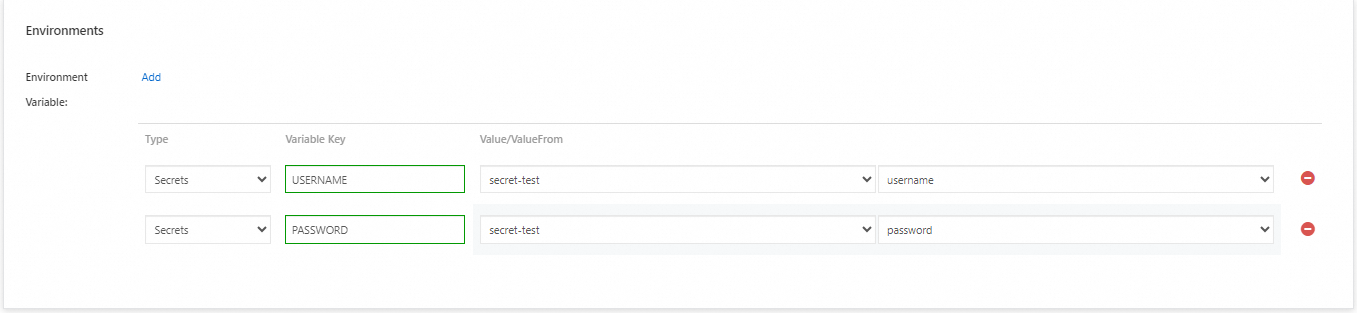
        2. In the Environments section, click Add.

          • Type: Secrets

          • Variable Key: USERNAME.

          • Value/ValueFrom: Select the source from the created Secret, such as nginx-secret. Then, specify an environment variable name for each key.

          Then, click Next.

      4. In the Advanced step, configure access control, scaling, scheduling, labels, and annotations as needed. Then, click Create at the bottom of the page.

      5. In the Complete step, monitor the application task.

        In the Creation Task Submitted section, click View Details and verify that the container status is Running.

  2. Verify that the environment variables were injected.

    Select the pod you want to access, such as nginx-env-demo-7xxxxxx****. In the Actions column, click Terminal and choose the nginx container to open a terminal session.

    env | grep -E 'DB_|API_|NGINX_'

    Expected output:

    API_KEY=ak-1234567890abcdef
    NGINX_api-key=ak-1234567890abcdef
    NGINX_password=MySecurePassword!
    NGINX_username=admin
    DB_USERNAME=admin
    DB_PASSWORD=MySecurePassword!

    The output matches the data in the Secret, confirming that the application can access it through environment variables.

kubectl

  1. Create a file named nginx-env-demo.yaml.

    apiVersion: apps/v1
    kind: Deployment
    metadata:
      name: nginx-env-demo
      namespace: default
      labels:
        app: nginx-env
    spec:
      replicas: 2
      selector:
        matchLabels:
          app: nginx-env
      template:
        metadata:
          labels:
            app: nginx-env
        spec:
          containers:
          - name: nginx
            image: anolis-registry.cn-zhangjiakou.cr.aliyuncs.com/openanolis/nginx:1.14.1-8.6
            ports:
            - containerPort: 80
              protocol: TCP
            # Inject a single key-value pair from the Secret
            env:
            - name: DB_USERNAME
              valueFrom:
                secretKeyRef:
                  name: nginx-secret
                  key: username
            - name: DB_PASSWORD
              valueFrom:
                secretKeyRef:
                  name: nginx-secret
                  key: password
            - name: API_KEY
              valueFrom:
                secretKeyRef:
                  name: nginx-secret
                  key: api-key
            # Optional: Inject all key-value pairs from the Secret with a prefix
            envFrom:
            - prefix: NGINX_
              secretRef:
                name: nginx-secret
    
  2. Create a Deployment that uses the Secret.

    kubectl apply -f nginx-env-demo.yaml
  3. Check the pod status.

    kubectl get pods -l app=nginx-env -n default

    Expected output:

    NAME                             READY   STATUS    RESTARTS   AGE
    nginx-env-demo-6dc7556d9-6pjhj   1/1     Running   0          3h33m
    nginx-env-demo-6dc7556d9-rcqsh   1/1     Running   0          3h33m
  4. Verify that the environment variables were injected.

    kubectl exec deployment/nginx-env-demo -n default -- env | grep -E 'DB_|API_|NGINX_'

    Expected output:

    API_KEY=ak-1234567890abcdef
    NGINX_api-key=ak-1234567890abcdef
    NGINX_password=MySecurePassword!
    NGINX_username=admin
    DB_USERNAME=admin
    DB_PASSWORD=MySecurePassword!

    The output matches the data in the Secret, confirming that the application can access it through environment variables.

Manage a Secret

After a Secret is created, you can perform the following actions on the Secrets page:

Action

Description

View a Secret

Click a Secret's name to view its details.

Edit a Secret

In the Actions column, click Edit to modify a Secret's data.

Important

Changes to a Secret are applied automatically and can cause immediate service disruptions if the Secret is in use. Proceed with caution.

Delete a Secret

In the Actions column, click Delete to remove a Secret you no longer need.

Important

Do not delete system-generated Secrets in the kube-system and kube-public namespaces, such as those related to service accounts.

References

  • To learn how to diagnose and troubleshoot common pod issues, see Troubleshoot abnormal pods.

  • To create a stateless application in an ACK cluster using the console and kubectl, see Create a Deployment.

  • See the Kubernetes official documentation for more information about Secrets.