Mobile Sync Service (MSS) is a core component of the Mobile PaaS (mPaaS) platform, originating from the E2E solution SYNC of Ant Financial Group. MSS pushes massive data from your server to client apps in real time — without waiting for the app to request them. MSS maintains a persistent TCP connection secured by SSL, so when data changes on the server, the updated data reaches the client immediately, reliably, and in the original send order.
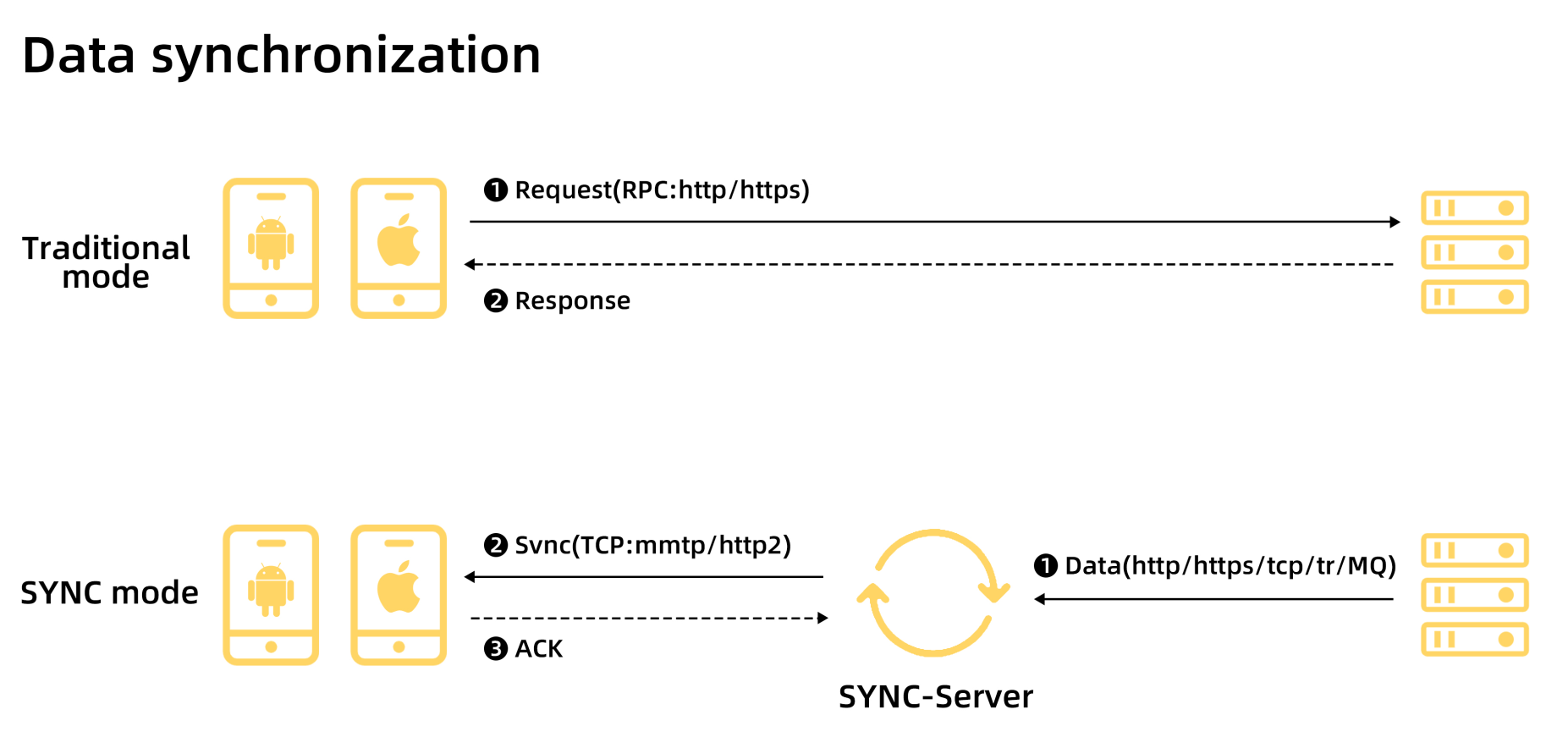
Traditional RPC-based architectures have several shortcomings in mobile environments:
The client must repeatedly poll the server to detect changes, even when little or no data has changed.
Each business module makes its own separate RPC request on startup, multiplying the number of network round-trips.
The client cannot detect server-side changes immediately — it can only refresh data by polling on a timer.
HTTP(S) short-lived connections require repeated handshakes, certificate exchanges, and encryption/decryption cycles even with keepalive enabled, consuming significant network time and resources.
MSS addresses all of these problems with a single persistent connection that delivers data to the client on demand.
How it works
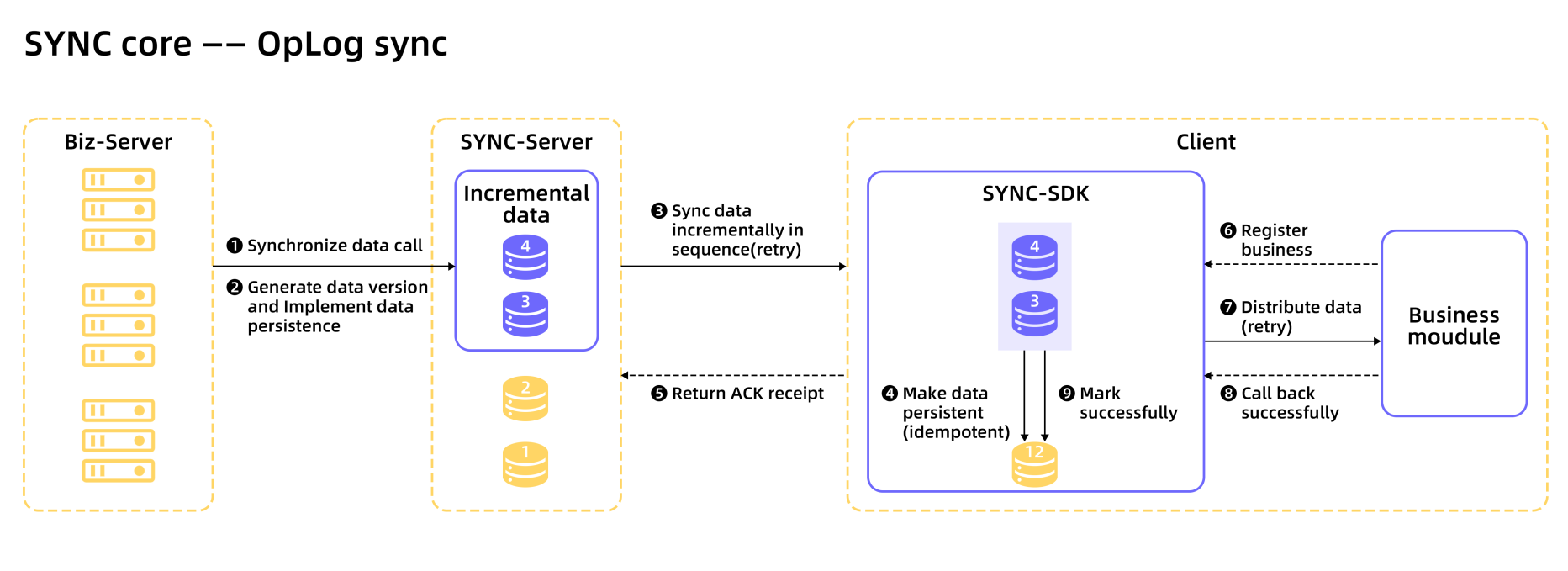
Think of MSS as the binlog mechanism in MySQL, applied to mobile data delivery. The basic unit of data transferred between the MSS server and the client SDK is an operation log, or oplog.
When a business needs to sync a data change to a specific user or device, it calls the MSS interface. The MSS server wraps the change into an oplog, persists it to the database, and pushes it to the client when the client is online. Each oplog carries a unique, monotonically increasing oplog ID scoped to a specific user and business — so the server always pushes oplogs in ascending ID order and no message is delivered out of sequence.
Both the MSS server and the client track the highest oplog ID the client has received. This record is called a sync point, and it acts as a data version number: when a client reconnects after being offline, MSS uses the sync point to resume delivery from where it left off.
Features
-
Reliable synchronization
MSS guarantees delivery for any business scenario that requires Quality of Service (QoS). As long as the user is active within the data's validity period and meets the push conditions — such as client version number and operating system type — the client receives every pushed message.
-
Incremental and ordered delivery
Messages in the same channel arrive in the exact order the business server sent them. All data is synchronized incrementally, so only changed data is transferred.
-
High real-time performance
With a good network connection, message push latency is determined almost entirely by network transmission time — typically within 1 second.
Benefits
-
Merged push
When the client initializes, the server pushes data for multiple businesses in a single operation, reducing the number of separate network requests.
-
Incremental push
Data is only pushed when there is something new. This eliminates redundant transfers and lowers network costs.
-
Fewer requests
When there is no incremental data, no request is made. This cuts redundant business requests entirely.
-
Improved timeliness
When data changes on the server, MSS pushes the change directly to the client with minimal delay — no client request needed.
-
Better user experience
Data is available before the client interface renders, so users see up-to-date content immediately without waiting.
Use cases
MSS fits any scenario that requires the server to push data changes to a client app in real time — for example, transfer results, payment results, and Message Center notifications. The following examples show how MSS handles specific requirements.
Instant messaging: MSS delivers chat messages to targeted users in send order, with guaranteed, incremental delivery.
Dynamic configuration: MSS pushes app feature toggles, dynamic parameters, and configuration updates to all devices in real time, enabling batch changes to business configuration while the app is running.
Online payments: MSS provides a secure tunnel for pushing transaction data. When the app is online, it receives pushed data immediately. When the app goes offline, MSS persists the data and delivers it the next time the app comes online.