All Products
Search
Document Center

Enterprise Distributed Application Service:What is EDAS?

Last Updated:Mar 11, 2026

Enterprise Distributed Application Service (EDAS) is a Platform as a Service (PaaS) for deploying, managing, and governing microservices applications on Alibaba Cloud. EDAS handles deployment pipelines, service governance, monitoring, and lifecycle management so you can focus on writing code instead of building and maintaining your own application platform.

EDAS supports Spring Cloud, Apache Dubbo, and High-speed Service Framework (HSF) applications. Deploy to Elastic Compute Service (ECS) instances, Container Service for Kubernetes (ACK) clusters, or hybrid cloud environments without modifying your application code.

EDAS_mg_animation_Overview.mp4

Who is EDAS for?

  • Application developers who want to deploy and iterate on microservices without managing infrastructure. EDAS handles service registration, load balancing, and canary releases so you can focus on business logic.

  • DevOps and operations teams who need to manage hundreds or thousands of applications across distributed environments. EDAS provides centralized monitoring, automatic scaling, and change tracking across ECS and Kubernetes clusters.

  • IT decision-makers evaluating a managed platform for modernizing monolithic applications into microservices or migrating existing microservices workloads to the cloud.

Key capabilities

CapabilityDescription
Deploy from code or imagesSubmit WAR files, JAR files, or container images through the EDAS console or API operations.
Govern microservices at scaleQuery services, trace calls, eject outlier instances, and authenticate service-to-service traffic across Spring Cloud, Dubbo, and HSF applications.
Monitor with built-in observabilityApplication Real-Time Monitoring Service (ARMS) integration provides health dashboards, key metrics, and configurable alert rules.
Release safelyChoose at-a-time, phased, or canary release strategies.
Scale automaticallyDefine scaling rules and let EDAS adjust capacity based on traffic patterns.
Integrate with your CI/CD pipelineConnect Alibaba Cloud DevOps or Jenkins to automate builds and deployments.

How it works

  1. Develop your application using Spring Cloud, Apache Dubbo, or HSF. Deploy to EDAS without the need to modify code or configurations.

  2. Create an EDAS application and select your target environment: ECS cluster, Kubernetes cluster, or hybrid cloud.

  3. Deploy your code by uploading a WAR file, JAR file, or container image through the console, API, or CI/CD pipeline.

  4. EDAS provisions and manages the runtime environment, service registration, and monitoring automatically.

  5. Operate and iterate. Use the EDAS console to monitor performance, manage traffic, release updates, and scale capacity.

Application management

After you deploy an application to EDAS, you get a unified management layer that covers the full application lifecycle.

Application hosting

Language and runtime support

EDAS runs Java applications natively. In Kubernetes environments, EDAS also supports applications built with PHP, Node.js, C++, and Go.

Infrastructure options

EnvironmentBest for
ECS clustersVM-based workloads, traditional deployment models
ACK (Kubernetes) clustersContainerized workloads, cloud-native architectures
Hybrid cloud clustersWorkloads that span on-premises and cloud environments

EDAS is seamlessly integrated with both ECS and ACK, so you can choose the infrastructure that fits your architecture and migrate between them as your needs evolve.

Deployment and release

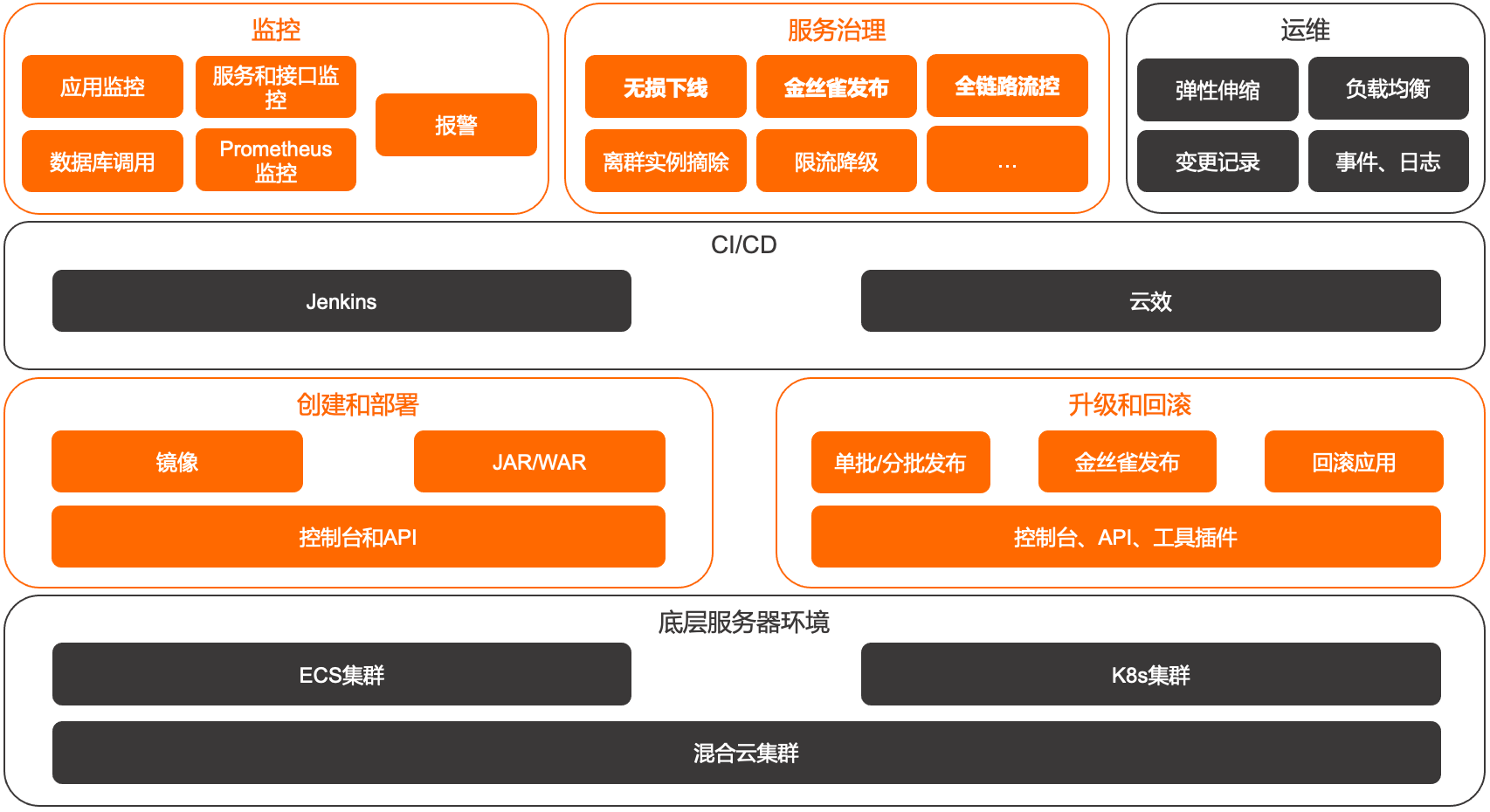
Deploy applications through the EDAS console, API operations, or plug-ins. EDAS supports three deployment formats:

FormatUse case
WAR filesTraditional Java web applications
JAR filesSpring Boot and standalone Java applications
Container imagesKubernetes-based deployments

For updates, EDAS provides three release strategies:

StrategyHow it works
At-a-time releaseUpdates all instances simultaneously.
Phased releaseUpdates instances in batches to reduce blast radius.
Canary releaseRoutes a small percentage of traffic to the new version before full rollout.

Automate deployments with Alibaba Cloud DevOps or Jenkins for continuous integration and continuous delivery (CI/CD).

Lifecycle operations

EDAS supports the following lifecycle operations for each application:

  • Start and stop

  • Release

  • Scale up and scale down

  • Delete

These operations work across thousands of applications from a single console.

Monitoring and alerting

EDAS integrates with ARMS for real-time application monitoring:

  • Track application health and performance metrics.

  • Configure alert rules to catch anomalies early.

  • Drill into trace data to diagnose issues.

Operations and maintenance

Beyond lifecycle management, EDAS provides additional O&M capabilities:

FeatureDescription
Application access managementControl who can access and modify each application.
Automatic scalingAdjust instance counts based on traffic or custom metrics.
Throttling and degradationProtect services from traffic spikes and cascade failures.
Load balancingDistribute traffic across healthy instances.
Change trackingAudit every configuration and deployment change.
Event centerView system events and operational alerts in one place.
Log managementCollect, search, and analyze application logs.

Microservices governance

EDAS provides built-in governance for microservices applications across all three supported frameworks.

Supported frameworks

FrameworkDescription
Spring CloudA widely adopted Java microservices framework with service discovery, configuration management, and load balancing.
Apache DubboA high-performance RPC framework for building distributed service architectures.
HSFHigh-speed Service Framework, an Alibaba-developed framework optimized for large-scale distributed systems.

Applications built with any of these frameworks can be deployed to EDAS without code changes. EDAS automatically handles service registration and discovery.

Governance features

FeatureSpring CloudApache DubboHSF
Graceful shutdownSupportedSupportedSupported (graceful release)
Canary release (Kubernetes)SupportedSupported--
Canary release (ECS)SupportedSupported--
Outlier ejectionSupportedSupportedSupported
Trace query----Supported
Service querySupportedSupportedSupported
Service authenticationSupportedSupportedSupported

Cloud service integration

EDAS connects with other Alibaba Cloud services in two ways:

Integration typeHow it worksWhere to manage
Service integrationA cloud service operates independently alongside EDAS.In the cloud service's own console.
Component integrationA cloud service is embedded directly into EDAS.In the EDAS console.

This dual model gives you flexibility: use EDAS as a centralized control plane for tightly integrated services, while still connecting to standalone cloud services through their native interfaces.

Permission management

EDAS provides an enterprise-grade permission management system that lets you isolate applications, resources, and data, and enforce access control. This ensures the security of your applications.

Customer stories

China Post

China Post migrated from a province-by-province self-built system to a distributed microservices architecture on EDAS. The new-generation express delivery system handled billions of daily service calls during Double 11 in 2018 while delivering smooth services despite the large volume of traffic.

Ford Motor

Ford Motor built a microservices PaaS platform on EDAS to power its new retail business, integrating online and offline channels into a unified customer experience. The platform uses EDAS for microservices governance, O&M and monitoring, and lifecycle management.

FASTFISH

FASTFISH built the industry's first distributed business system on EDAS, consolidating previously fragmented product and channel systems. The result: 25x improvement in processing efficiency, faster iteration cycles, and lower R&D costs.

Get started