Resource Orchestration Service (ROS) is an Alibaba Cloud service that automates cloud resource deployment through infrastructure as code (IaC). Define resources and dependencies in templates, and ROS provisions them automatically. ROS also provides hosted Terraform, so you can use Terraform templates directly in the console.
Why choose ROS
ROS simplifies cloud resource management:
-
Deploy multiple resources in one click with a template.
-
Use sample templates and solutions to deploy complex architectures quickly.
-
Deploy and release resources in batches to save costs.
-
Adopt IaC and integrate templates into your CI/CD pipeline for compliance.
Compared to other IaC tools, ROS offers:
-
Integrated with 100+ Alibaba Cloud services and 500+ resource types.
-
Templates are JSON or YAML text files.
-
Hosts Terraform for multi-cloud orchestration across Alibaba Cloud, AWS, and Azure.
-
Visual console for resource orchestration and management in the Alibaba Cloud Management Console.
-
Scenario-based templates for one-click deployment.
-
ROS is free of charge.
-
How it works
ROS creates a stack from your template to deploy resources automatically, as shown in the following figure.
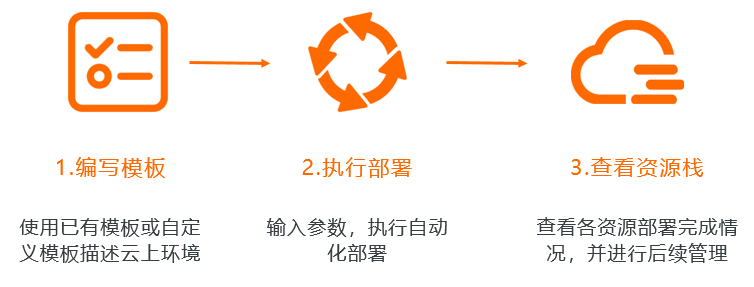
To modify deployed resources, Update a stack.
Use Change sets to preview and apply changes before updating a stack.
Features
|
Feature |
Description |
|
Free hosted service |
A fully hosted, serverless service. Define resources, parameters, and dependencies in a template, then create a stack to manage them. Free Terraform hosting for multi-cloud orchestration across Alibaba Cloud, AWS, and Azure. The Terraform feature is compatible with ROS APIs. |
|
Multi-account and cross-region deployment |
Deploy across multiple Alibaba Cloud accounts and regions with a single template. Use different parameters for development, staging, and production environments — for example, 2 ECS instances in staging versus 20 in production. |
|
Standardized deployment |
Ensure repeatable deployments with standardized templates. Reduce environment discrepancies and lower deployment costs. |
|
Visualized results |
View deployment results in the console or through an API without manually checking each resource. |
|
Drift detection |
Identify resource changes made outside of ROS and resync them with the template definition. |
|
Access control |
RAM integration provides unified account management and access control. ActionTrail integration lets you audit all operations, including those performed by ROS. |