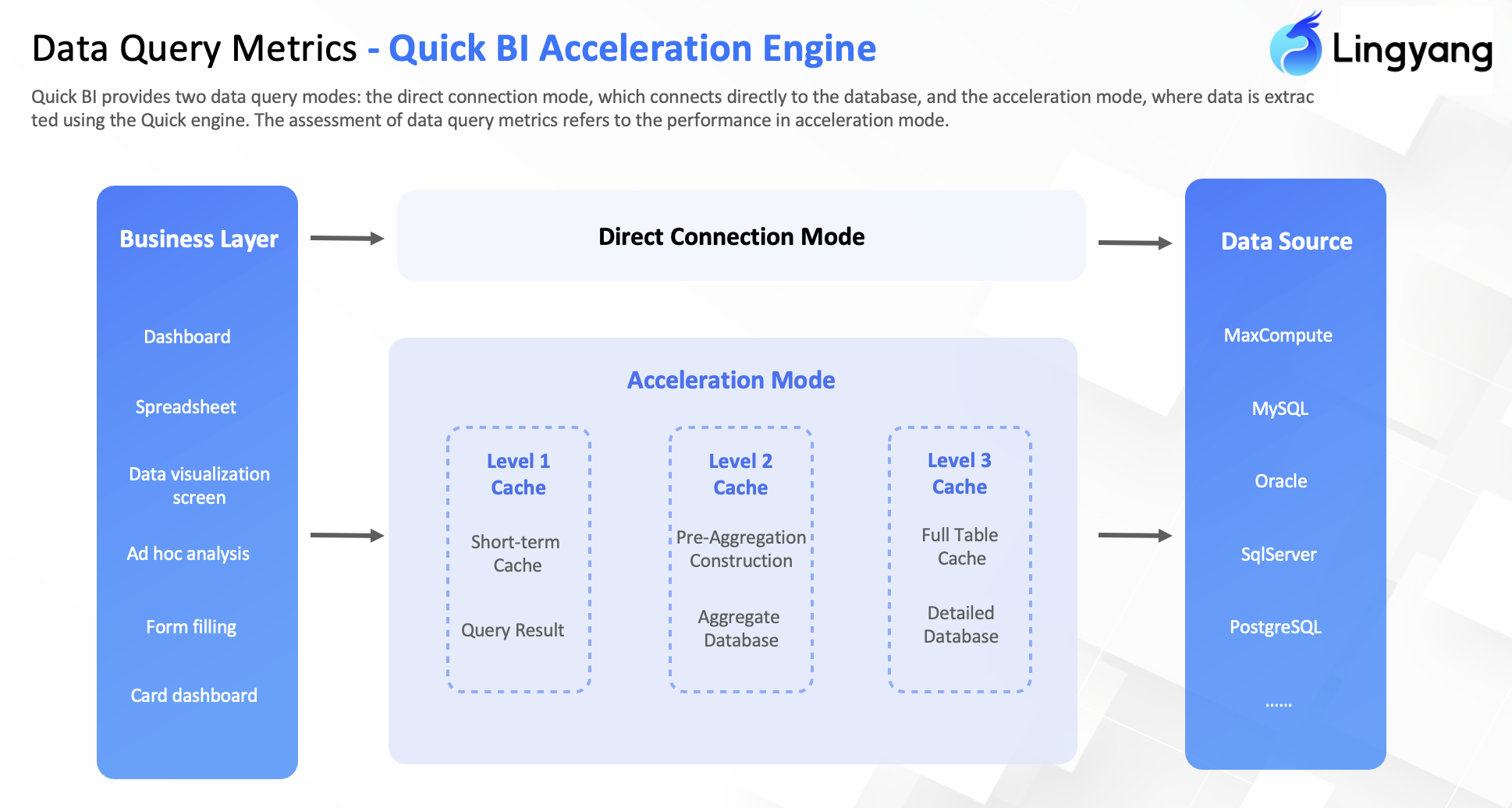
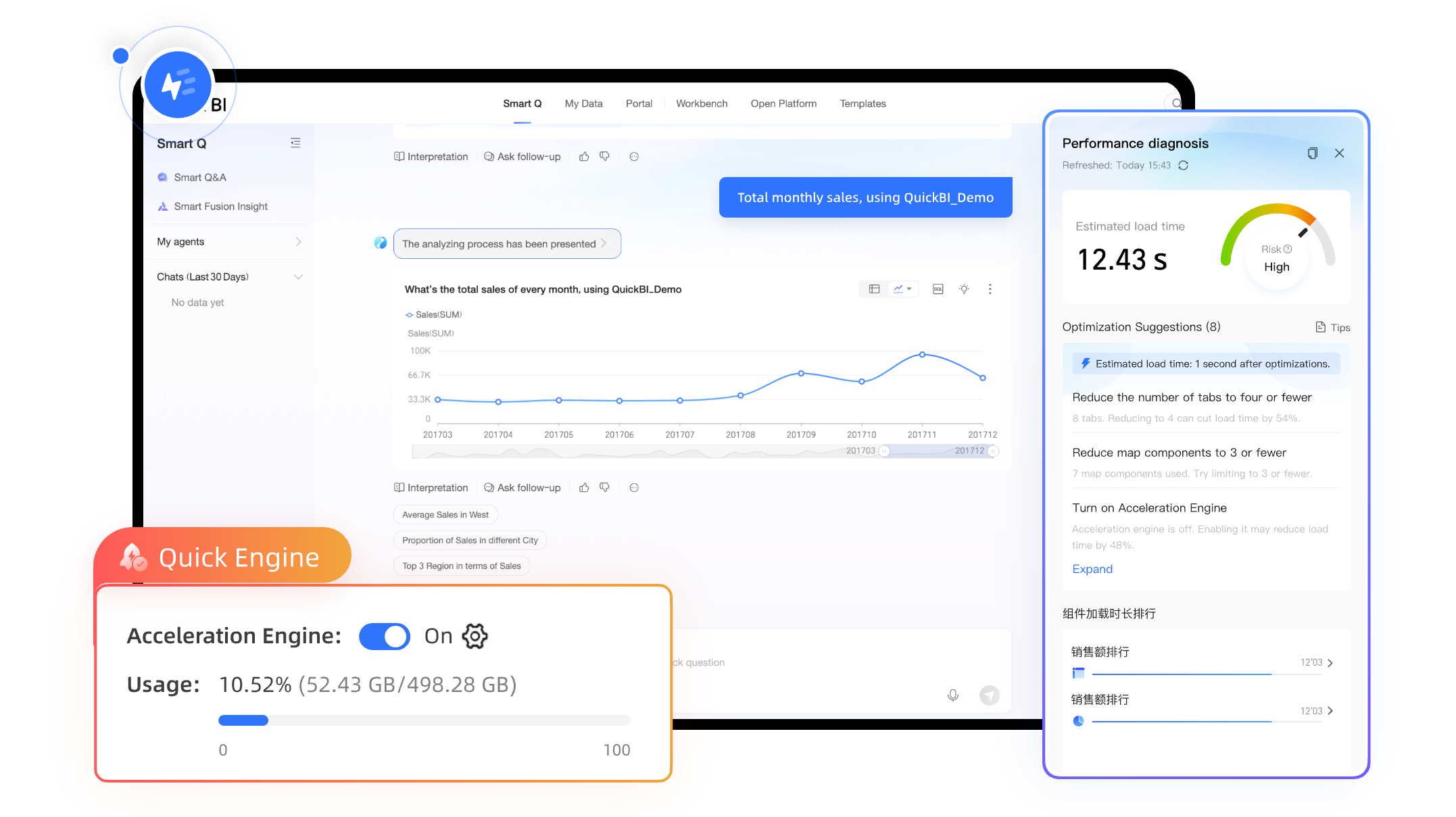
Quick Engine is Alibaba Cloud’s zero‑ops OLAP accelerator, purpose‑built to turn sluggish, high‑volume analytics into sub‑second experiences . Deployed as a fully managed SaaS feature, it sits transparently in front of your existing MySQL, Oracle or MaxCompute warehouse and automatically picks the optimal acceleration strategy.
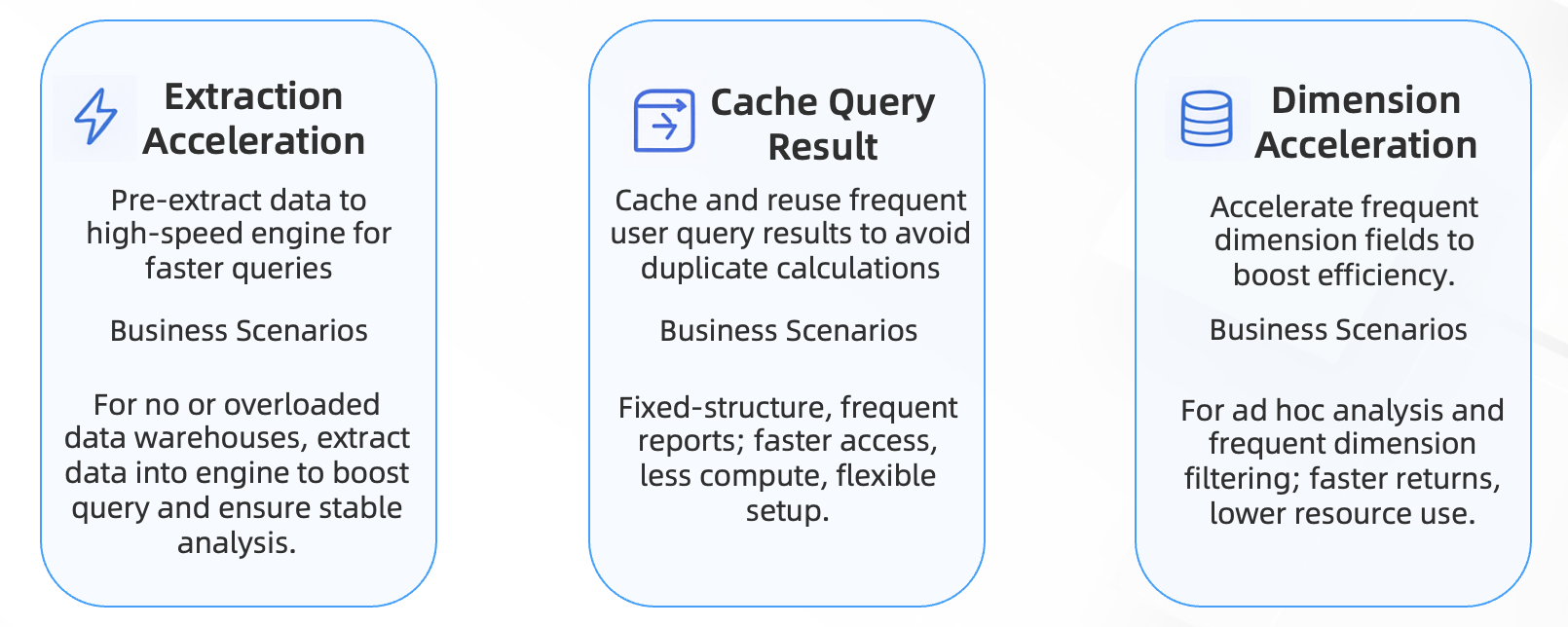
● Extraction Acceleration copies hot partitions into an in‑memory columnar store, delivering 5–25× faster aggregates on data sets up to 100 million rows .
● Query Caching converts repetitive dashboard hits into straight memory fetches, taming peak‑hour CPU spikes.
● Dimension Acceleration pre‑materialises high‑cardinality columns so drop‑downs and drill‑downs feel instant.
When the source already performs well, Quick Engine simply forwards SQL in Direct Mode, adding zero overhead. Horizontal scaling, CRON‑style refresh schedules, and a point‑and‑click UI for column selection and cache TTL keep tuning friction‑free. The result is real‑time insight without cluster management, SQL rewrites or analyst retraining.
● Available Editions:
| Personal Edition | Advanced Edition | Professional Edition | Independent Deployment |
|---|---|---|---|
| Not supported | 0 by default, and the expansion capacity supports additional purchases by 5GB, with a limit of 100GB. | 0 by default, and the expansion capacity supports additional purchases by 5GB, with a limit of 100GB. | Two payment methods One-time buyout or Annual subscription |
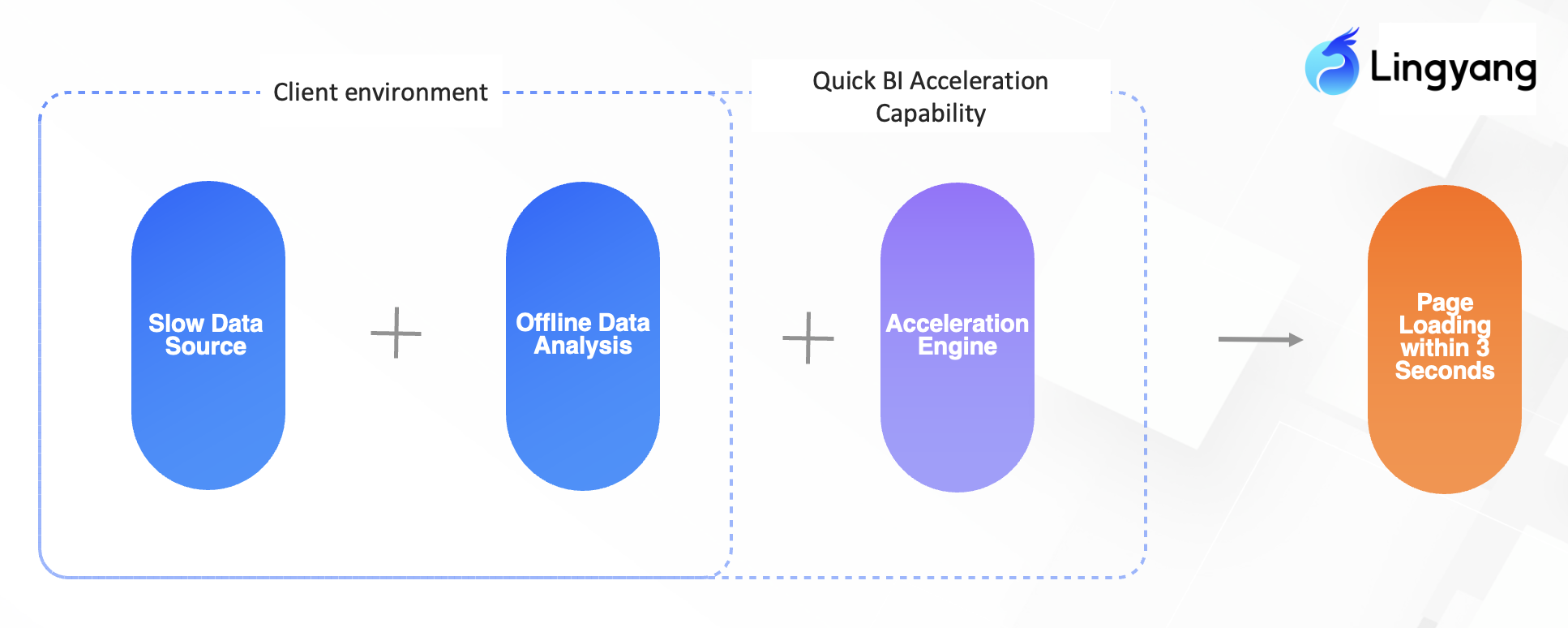
● Data‑volume overload – IoT and clickstream growth turn billion‑row tables into multi‑second scans; Quick Engine’s in‑memory columnar store and elastic scaling keep them sub‑second.
● Real‑time latency – Dashboards need “now”, not yesterday; the engine returns fresh aggregates on 100 M+ rows in < 0.5 s.
● Join‑heavy / complex SQL slowdowns – Multi‑table joins, variance or percentile calculations crawl in traditional warehouses; Extraction Acceleration pre‑materialises data and slashes runtimes by up to 25×.
● Peak‑hour CPU spikes on source databases – Concurrent analyst traffic can saturate OLTP or warehouse nodes; query caching off‑loads repetitive reads and flattens resource peaks.
● Laggy filters and drill‑downs – High‑cardinality dimension look‑ups make drop‑downs “sticky”; Dimension Acceleration materialises those columns so every click feels instant.
● Sub‑second aggregation at massive scale: Keeps dashboards and ad‑hoc analysis responsive even on billion‑row fact tables, so analysts don’t resort to sampling or pre‑extracts.
● Zero‑ops SaaS deployment: No clusters to size, patch or tune—just flip acceleration modes in the UI. Frees data teams from infrastructure toil.
● Three complementary acceleration modes: Lets you match the fix to the pain: Extraction for heavy joins/row counts, Query Cache for repeat traffic, Dimension Accel for filter UX. You can layer modes incrementally.
● Granular, CRON‑style refresh control: You decide whether data loads are full, incremental or manual and set TTLs per cache—balancing freshness and cost.
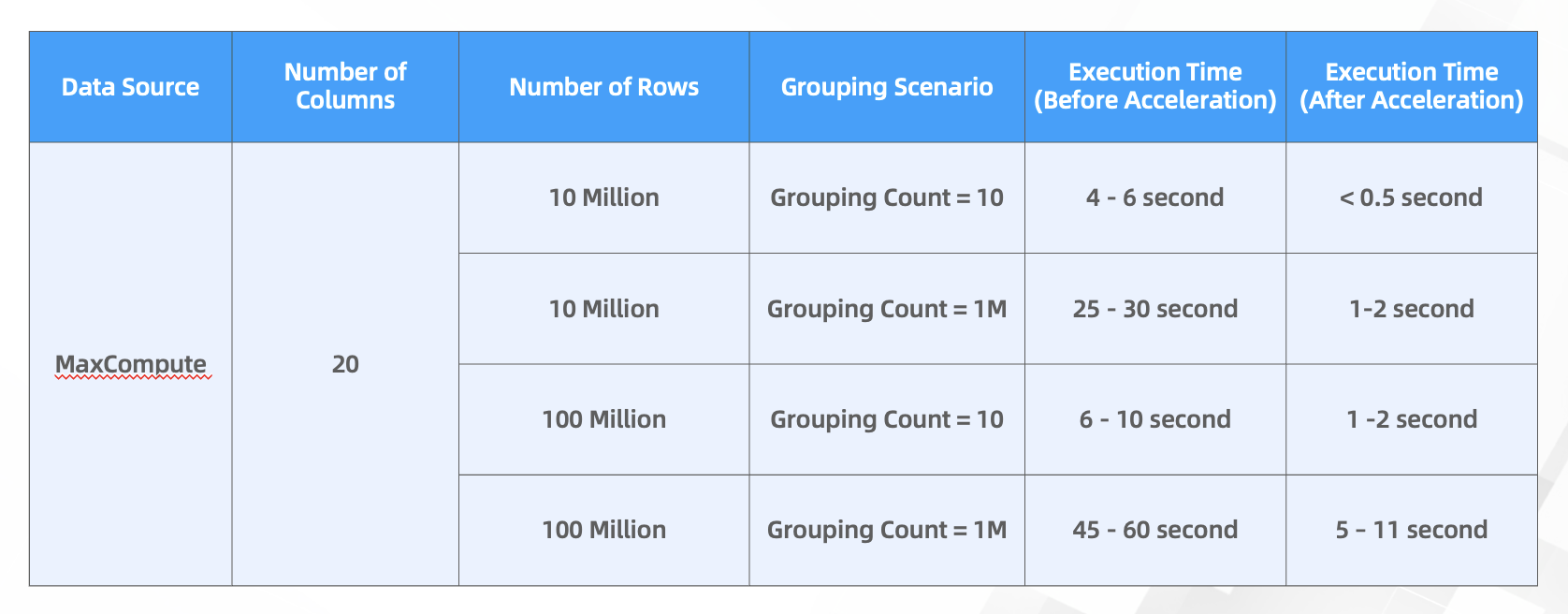
Firm A is china's leading human resources service provider, providing recruitment, training, consulting and other integrated human resources solutions. They built their own data warehouse based on Alibaba Cloud MaxCompute and used Quick BI to analyze the data. As a data warehouse, MaxCompute has good stability and technical support, but its real-time query and calculation are not dominant, and customer data query often takes more than ten seconds or tens of seconds. Customers need an acceleration means to speed up MaxCompute data queries.
Firm B, a global leader in drone manufacturing and aerial photography technology, offers products ranging from drones and aerial cameras to flight control systems and software. As the company expands, its internal data analysis demands grow, requiring more efficient performance monitoring for its increasing volume of reports, which now reach tens of thousands.
To address this challenge, Firm B integrates Quick BI’s performance tracking metrics into MySQL, using it as a data source for Quick BI. This enables real-time analysis of report performance, along with proactive monitoring through alerts and subscriptions, ensuring optimal efficiency.
Alibaba Cloud and HP Partner on Qwen-powered Smart Assistant to Drive AI PC Experience

1,546 posts | 518 followers
FollowPM - C2C_Yuan - August 1, 2023
Alibaba Cloud Community - June 5, 2025
Alibaba Cloud Community - June 25, 2025
Alibaba Clouder - February 2, 2021
Alibaba Cloud Community - April 2, 2026
Alibaba Cloud Community - April 30, 2026
1,546 posts | 518 followers
Follow QwenWork
QwenWork is dedicated to helping employees strengthen their professional competitiveness in the AI era and to enabling enterprises to improve organizational effectiveness.
Learn More Token Plan
Build more, spend less. One plan, every modality.
Learn More
Alibaba Cloud Model Studio
A one-stop generative AI platform to build intelligent applications that understand your business, based on Qwen model series such as Qwen-Max and other popular models
Learn More Big Data Consulting for Data Technology Solution
Alibaba Cloud provides big data consulting services to help enterprises leverage advanced data technology.
Learn MoreMore Posts by Alibaba Cloud Community

