You are searching for the perfect outfit for a corporate event. As you open your favorite e-commerce app, an AI bot asks what you need and accordingly fetches the best product recommendations within seconds. The products are relevant to your search, and they look designed according to your taste.
This personalized experience is made possible by generative AI.
With tools like AIRec, businesses can deliver high-quality and personalized recommendations in real-time. And this is true not just for e-commerce, but a range of other industries as well.
In this article, we will explore generative AI’s present applications, trends, and challenges with real-world use cases.
Let’s explore how businesses are using generative AI in their industry.
Before: Companies gave users generic product descriptions, the same recommendations, and impersonal experiences.
After: Gen AI creates product descriptions, dynamic recommendations, and a personalized shopping journey.
Before: Healthcare professionals heavily relied on human analysis and perceptions before gen AI.
After: Gen AI generates synthetic medical images, predicts future patient scenarios, and creates a plan according to a patient’s condition. It helps with the smarter allocation of staff members so that all operations are seamless.
Before: Analysts needed a lot of manual effort for financial reporting and risk assessment, which slowed things down.
After: AI models help in automating reporting and provide personalized investment guidance.
They can also support broader financial wellness initiatives by helping individuals explore options for managing debt and improving financial stability. For example, services such as Freedom Debt Relief negotiate directly with creditors to settle and reduce unsecured debts, offering a structured path toward regaining control of personal finances.
Before: Engineers needed trial-and-error experimentation and more manual input for product design and production optimization.
After: Generative AI creates scripts, visuals, logo design, music, and even converts static presentations into engaging content — tools like PowerPoint to video converters are a prime example, all within minutes.
Before: Creators spent a long time producing content, and it required a huge team.
After: Generative AI creates scripts, visuals, logo design, music, and personalized marketing content within minutes.
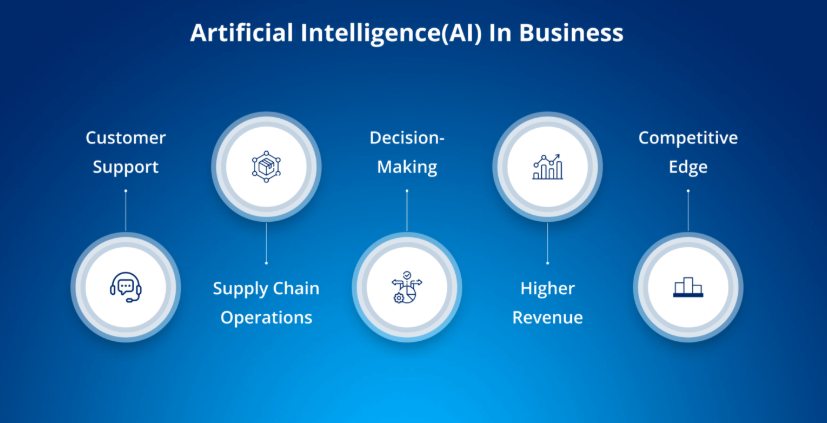
Generative AI automates repetitive tasks, improves decision-making, and personalizes customer interactions. AI transforms operations from slow and rigid to fast, flexible, and data-driven.
Traditional models depend on linear processes and fixed offerings. Generative AI innovates products and services based on their audience.
For example, consider a manufacturer that tests and launches new product designs based on customer demands and preferences using generative AI.
Businesses use generative AI to automate repetitive tasks and predict maintenance needs.
Task management tools like Nifty can help to organize tasks.
For example, the customer care industry uses generative AI chatbots powered by text to speech APIs to answer common queries, guide customers through simple troubleshooting, and route complex issues to human agents.
Generative AI helps businesses find the insights hidden in raw data.
For example, retailers predict consumer trends, healthcare providers predict treatment outcomes, and finance companies create personalized investment strategies.
By turning raw data into actionable intelligence, businesses can make effective decisions.
Generative AI transforms how companies think, plan, and deliver value. Organizations that integrate it effectively gain a competitive edge in the market.
Generative AI can transform your business operations forever, but it has its own set of challenges. Let us discuss each one in detail so that you deploy it with a proper strategy and plan.
Integrating generative AI with existing workflows requires upgrading your existing infrastructure, ensuring compatibility with legacy systems, and training staff to use AI tools effectively.
AI models require a huge amount of data to generate effective results. Businesses must align with privacy regulations to ensure the security of the data. Mishandling sensitive information can lead to compliance violations.
Generative AI can unintentionally produce biased or misleading content. Therefore, always cross-verify the information that it generates. Certain guidelines and monitoring systems can be implemented to ensure outputs remain objective and fair.
To strengthen their knowledge and validate skills, many professionals rely on platforms like Exam Collection for certification-focused practice materials.Organizations should consistently scale models, update algorithms, and ensure reliability for effective outcomes.
No one can guarantee that users are using AI for ethical purposes only. To ensure security and compliance, governments introduce various laws. Organizations must stay informed and compliant with these regulations.
Despite these challenges, companies that approach generative AI strategically can realize its full potential. By adopting AI for your business systematically, you can drive innovation, efficiency, and long-term value.
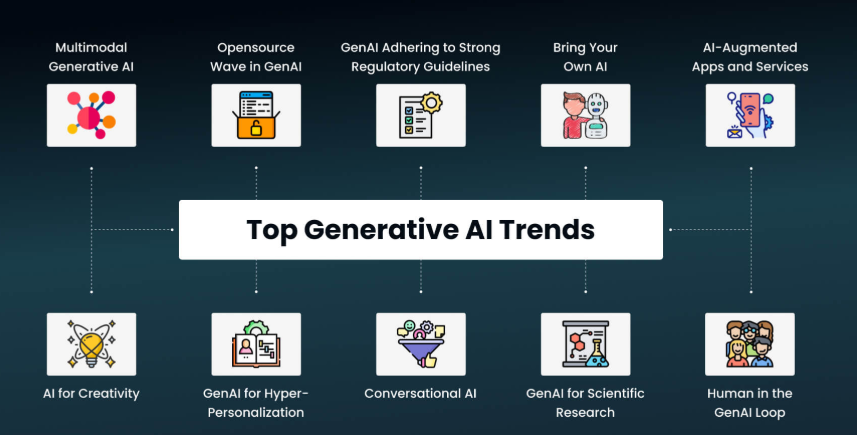
Generative AI is evolving, and the following trends are redefining how organizations innovate, interact, and create value.
Before multimodal AI, models handled only one type of content. Now, they combine text, images, audio, and video in one system. This enables companies to create more immersive and interactive experiences.
Users expect the purchasing experience with your company based on their preferences. Generative AI offers personalization across websites, apps, and customer interactions. This technology creates personalized product recommendations and customized virtual assistants, which can help increase conversions and customer retention
AI researchers design models that are more efficient, scalable, and adaptable. These architectures reduce computational costs, improve training, and produce higher-quality outputs.
Generative AI merges with AR, VR, robotics, and IoT devices. This integration provides interactive, autonomous systems and improves virtual experiences.
Organizations are focusing more on ethical and transparent AI deployment. They must develop generative AI that includes bias mitigation, explainable AI, and frameworks to ensure outputs are reliable, fair, and compliant with regulations.
.
These trends indicate that generative AI is becoming an integral part of business innovation.
Case Study: How Sephora Enhanced Customer Experience With AI
Generative AI is transforming industries by creating personalized experiences, automating tasks, and improving efficiency. The challenges, like data privacy and ethical concerns, exist, but strategic adoption delivers measurable results.
To harness this technology effectively, businesses can leverage Alibaba Cloud for scalable infrastructure, AI services, and various tools. With this, your business can focus on innovation and improve customer engagement without worrying about scalability.
Disclaimer: The views expressed herein are for reference only and don't necessarily represent the official views of Alibaba Cloud.
The Rise of Stream Data Analytics: Why Real-Time Insights Are the New Competitive Edge
From ETL to ELT: Modernising Pipelines for High-Volume Metrics
Alibaba Cloud Community - January 26, 2025
Alibaba Cloud Community - November 27, 2025
Alibaba Cloud Community - April 15, 2025
Alibaba Clouder - June 12, 2018
Alibaba Cloud Community - August 15, 2025
Alibaba Cloud Community - September 16, 2025
 QwenWork
QwenWork is dedicated to helping employees strengthen their professional competitiveness in the AI era and to enabling enterprises to improve organizational effectiveness.
Learn More Token Plan
Build more, spend less. One plan, every modality.
Learn More
Alibaba Cloud Model Studio
A one-stop generative AI platform to build intelligent applications that understand your business, based on Qwen model series such as Qwen-Max and other popular models
Learn More Qwen
Qwen
Full-range, open-source, multimodal, and multi-functional
Learn MoreMore Posts by Neel_Shah