PostgreSQL is renowned as "the world's most advanced open source database." In September 2025, the latest version, PostgreSQL 18.0, was officially released, featuring comprehensive upgrades in its performance engine, SQL capabilities, monitoring system, and security mechanisms.
Following this release, Alibaba Cloud ApsaraDB RDS for PostgreSQL now fully supports PostgreSQL 18. It deeply integrates enterprise-grade capabilities and innovative AI features on top of the community edition, creating an intelligent data foundation for AI applications. RDS for PostgreSQL 18 not only enhances the enterprise-grade experience with high availability, low cost, and ease of maintenance but also supports a wide range of complex business scenarios through various kernel and extension features. Furthermore, it fully embraces AI, from enhanced vector capabilities and Graph RAG to the DuckDB engine and Supabase ecosystem integration. This article will reveal how ApsaraDB RDS for PostgreSQL 18 becomes a super-engine for AI application development, helping enterprises build efficient and intelligent applications.
Alibaba Cloud ApsaraDB RDS for PostgreSQL 18 is more than just PostgreSQL 18. It is the premier intelligent data foundation for AI applications.
Alibaba Cloud ApsaraDB RDS for PostgreSQL 18 is now officially released. Several new features are available for free trial. We invite you to try RDS DuckDB-based and RDS Supabase capabilities.
Free trial for RDS DuckDB-based capabilities: https://www.aliyun.com/activity/database/postgresql-ai#J_SQL
Free trial for RDS Supabase: https://www.aliyun.com/activity/database/postgresql-ai#J_free
The power of PostgreSQL is well-established. Its exceptional stability, rich ecosystem of extensions, and high compatibility with standard SQL have made it a favored relational database for demanding industries such as finance, telecommunications, and the Internet. The release of PostgreSQL 18.0 further unlocks its potential as a data foundation for the AI era:
• It introduces an asynchronous I/O subsystem, significantly improving the efficiency of I/O-intensive operations.
• It supports B-tree index skip scan, enabling queries to use an index even when they do not include the leading column.
• It supports RETURNING OLD/NEW in DML statements, enhancing development flexibility.
• It allows parallel GIN index builds, significantly reducing index creation time.
• It enhances monitoring capabilities with new features like lock wait logs, WAL statistics, and backend I/O metrics, facilitating fine-grained operations.
For more updates on the community edition of PostgreSQL 18, please see: PostgreSQL 18 Released!
https://www.postgresql.org/about/news/postgresql-18-released-3142/
However, for most enterprises, "community capabilities" are far from enough. The real challenge is: how can these capabilities be transformed into a stable, efficient, easy-to-use, and AI-oriented production-grade service? The answer is to choose a cloud-hosted platform that understands both PostgreSQL and AI.
Alibaba Cloud RDS for PostgreSQL 18 not only inherits the powerful open-source DNA of the PostgreSQL community but also deeply integrates the technological advancements of the AI era with the needs of enterprise applications. By adding enterprise-grade enhancements and AI capabilities, it becomes the ideal data foundation for building AI applications. RDS for PostgreSQL 18 is a high-performance, highly compatible, highly extensible, and fully AI-ready database platform that can comprehensively support an enterprise's intelligent evolution.
RDS for PostgreSQL 18 achieves breakthroughs in its AI application ecosystem, kernel-level AI capabilities, and TP+AP performance:
• Full Supabase ecosystem compatibility: an out-of-the-box AI application development platform: RDS for PostgreSQL 18 fully supports Supabase, including the MCP Server, and integrates the RAG agent to provide multimodal processing and long-term memory capabilities.
• Comprehensive enhancement of kernel-level AI capabilities: Vector search performance is improved by 80%, and Graph RAG accuracy is increased by 50%, building an intelligent foundation for multimodal applications.
• Improved TP+AP performance: Deep integration with the DuckDB columnar analytics engine achieves a seamless fusion of OLTP and OLAP, improving TPC-H query performance by 10 to 100 times.
Regarding version upgrades: RDS now fully supports seamless upgrades from PostgreSQL 10 and higher to PostgreSQL 18.
RDS Supabase is now fully compatible with PostgreSQL 18 and has implemented all Supabase features on top of PostgreSQL 18.
RDS Supabase has been fully adapted for RDS for PostgreSQL 18. Its features and capabilities are identical to those of RDS Supabase deployed on PostgreSQL 17, ensuring a seamless and stable experience for users during the version upgrade process. RDS Supabase has become the data foundation for major AI Coding platforms at Alibaba, such as Ant Group's WeaveFox and Taobao's OneDay.
RDS Supabase offers the same open-source capabilities as community Supabase.
RDS Supabase is deeply aligned with the core features of the community version of Supabase, providing full support for key PostgreSQL extensions that Supabase relies on, including pgjwt (for JWT token handling), pg_cron (for scheduled tasks), pg_net (for secure HTTP requests), and pg_graphql (for native GraphQL query support). Additionally, RDS Supabase covers all four core modules of community Supabase:
• Database: Provides a high-performance, high-availability managed database service.
• Auth: Supports standard authentication methods like email/password and third-party OAuth.
• Storage: Offers scalable object storage capabilities.
• Realtime: Implements real-time data synchronization and message pushing based on PostgreSQL logical replication.
RDS Supabase enhances localization capabilities for Chinese scenarios.
RDS Supabase integrates several self-developed enhancements tailored for local Chinese scenarios, further improving usability and enterprise-level service capabilities:
• Auth Extension: In addition to standard authentication methods, it supports WeChat login and Alipay login, and integrates with Alibaba Cloud Short Message Service (SMS) to meet the diverse identity verification needs of domestic users.
• Storage Optimization: RDS Supabase integrates the out-of-the-box Object Storage Service (OSS) provide by Alibaba Cloud by default. It also supports flexible configuration of external OSS sources, increasing deployment flexibility. Furthermore, filenames now fully support Chinese characters, significantly improving the user experience for Chinese users.
• Full Lifecycle Management: Provides complete lifecycle management for Supabase instances, covering operations such as creation, startup, suspension, restart, database password reset, configuration changes, and secure deletion. Users can efficiently perform daily maintenance through the console or API, enabling flexible resource scheduling, cost optimization, and security control.
Through the organic combination of open-source capabilities and local innovation, RDS Supabase not only ensures high compatibility with the global Supabase ecosystem but also provides a one-stop AI application development platform that is more practical, secure, and reliable for Chinese developers and enterprise users.
RDS Supabase has a built-in RAG agent that leverages the vector, AGE, and BM25 capabilities of PostgreSQL 18 to extend long-term memory. This creates a "three-path recall" mechanism, delivering more powerful RAG capabilities.
• Reduces Hallucinations, Improves Recall: The "vector + full-text + graph" three-path recall mechanism provides multi-source cross-verification, reducing hallucinations and missed recalls, and significantly improving Top-K hit rates and final answer consistency.
• Fine-Grained Permission Control: Achieves fine-grained role and dataset permission control based on Supabase Auth and PostgreSQL's multi-tenant schema isolation.
• Built-in Auto Embedding Service: Supports scheduled and incremental synchronization, automatically detecting knowledge base updates and reducing the risk of manual batch processing and missed updates.
• Multimodal-Ready: Parses various data types, including files, tables, images, PDFs, charts, audio, and video, to accommodate complex enterprise knowledge formats.
• Unified Authentication and Routing via API Gateway: Storage, indexing, retrieval, and re-ranking are all managed within the RDS for PostgreSQL ecosystem (pgvector + Apache AGE), reducing system fragmentation and maintenance costs.
MCP (Model Context Protocol) is a key protocol for a new generation of AI programming paradigms, designed to allow large models to access external systems securely and efficiently.
RDS for PostgreSQL 18 introduces the RDS Supabase MCP Server, an AI integration tool specifically built for Supabase instances deployed on RDS. It helps various AI tools (such as Claude and Qwen) seamlessly connect to the database. Its main capabilities include:
• Automatic Credential Retrieval: Automatically fetches authentication information required by Supabase (such as anon-key, service-key, and jwt-secret) via Alibaba Cloud OpenAPI, eliminating the need for manual configuration.
• Simplified Authentication: Authorization can be completed simply by providing an Alibaba Cloud AccessKey ID and AccessKey Secret.
• Multi-Instance Support: Manages multiple Supabase instances and supports interactive selection of the target instance.
• Deep Integration with Alibaba Cloud: Designed specifically for Supabase instances running in the Alibaba Cloud RDS AI environment, it facilitates secure and efficient interaction between AI tools (like Claude) and the database.
RDS for PostgreSQL has made significant optimizations to the native vector extension. In cosine distance calculation scenarios, query performance is improved by 80%, index build speed is increased by 40%, and index size is reduced by 50%.
1. Scalar Quantization (SQ)
Scalar Quantization (SQ) is a technique that maps continuous or high-precision values (like float32) to a finite set of discrete values (like int16). Its core idea is to quantize each dimension independently without considering the correlations between dimensions within a vector. We have implemented a float32-to-int16 mapping, achieving a 50% reduction in index space.
2. SIMD Instruction Optimization
SIMD (Single Instruction, Multiple Data) instructions are a CPU technology that allows a single instruction to process multiple data elements (a data vector) simultaneously, enabling efficient distance calculations for high-dimensional vectors. We have handwritten SIMD instructions to improve the computational efficiency of vector index creation and vector search.
3. Batched Distance Computation and SQL-Layer Result Filtering Optimization
During HNSW index creation, we use batched computation for distances and optimize the original normalization logic to speed up index builds. We also avoid computational overhead for all-zero vectors. During vector recall based on distance, we skip unnecessary projection calculations to improve vector search efficiency.
Current mainstream RAG (Retrieval-Augmented Generation) relies purely on vector matching, which can easily lead to "hallucinations" or "missed recalls." To solve this problem, structured knowledge must be introduced—this is where graph capabilities come in.
Based on the AGE extension, RDS for PostgreSQL provides complete Graph RAG capabilities and supports openCypher syntax, making it easy to build knowledge graphs. Compared to pure vector RAG, it uses a knowledge graph to construct triplet relationships between texts, providing higher accuracy and completeness in information retrieval. It offers stronger support for complex queries and multi-step reasoning, making it superior for scenarios involving numerous interconnected entities and complex relationships. It excels in use cases such as financial risk control rule construction, legal case studies, supply chain analysis, private knowledge bases, and medical diagnostics.
The AGE extension relies on the RDS for PostgreSQL kernel to generate equivalent SQL execution plans for the openCypher language, but these plans are often inefficient for large-scale graphs. RDS for PostgreSQL optimizes the AGE extension in the following ways:
• Automatically creates indexes on relevant fields to reduce I/O for graph queries and improve execution efficiency.
• Optimizes the cardinality estimation for some index-related operators in the AGE extension, allowing the RDS for PostgreSQL optimizer to choose more efficient execution plans.
• Pins execution plans, enabling the RDS for PostgreSQL kernel to execute plans better suited for nearest neighbor search in Graph RAG.
With these optimizations to indexes and query plans, a single instance of RDS for PostgreSQL can manage knowledge graphs at the scale of tens of billions (vertices + edges). The response time (RT) for common nearest neighbor searches in Graph RAG is in the millisecond range, providing efficient retrieval and information mining for knowledge bases with hundreds of billions of tokens.
Many enterprises face the dilemma where "transactional databases are too slow for analysis, and querying data back from data warehouses is too cumbersome." RDS for PostgreSQL introduces DuckDB and has launched the rds_duckdb engine to bridge the final mile between OLTP and OLAP, enhancing the analytical performance of TP systems.
The rds_duckdb engine utilizes the PostgreSQL extension interface to deeply integrate DuckDB, achieving integrated real-time transaction processing and real-time data analysis capabilities. This provides a one-stop solution to meet both OLTP and OLAP business needs. By using rds_duckdb, users can achieve performance nearly identical to native DuckDB, with a 10-100x improvement on TPC-H benchmarks.
We can export local tables, views, and materialized views in RDS for PostgreSQL as columnar tables, and we also support automatic data synchronization from row-based to columnar storage. Once the analytical query acceleration feature is enabled, queries are executed in DuckDB, making it ideal for complex analytical scenarios such as real-time reporting.
Below are the TPC-H performance test results using the rds_duckdb engine.
Test data size: TPC-H 100X. The test process can be found in the TPC-H example in the official rds_duckdb documentation.
Official Documentation: https://help.aliyun.com/zh/rds/apsaradb-rds-for-postgresql/use-the-rds-duckdb-extension
• rds_duckdb vs. RDS for PostgreSQL
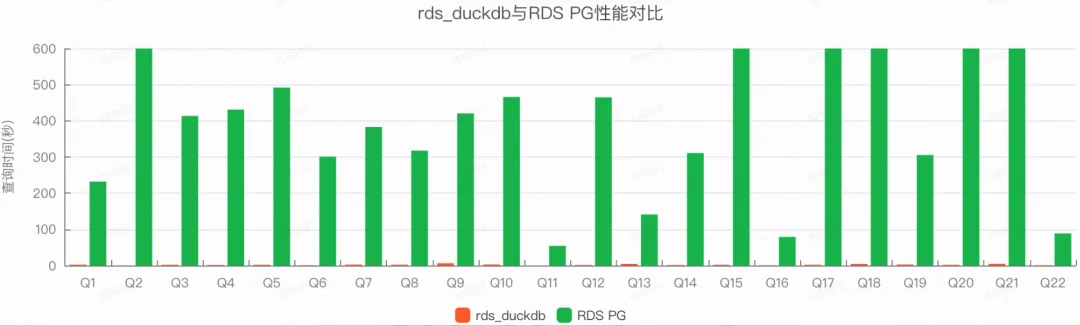
After enabling rds_duckdb AP acceleration, query performance shows a dramatic improvement compared to RDS for PostgreSQL. The chart displays a comparison of execution times for the 22 TPC-H queries. All TPC-H queries in rds_duckdb completed within 3 seconds, whereas in RDS for PostgreSQL, several queries exceeded 10 minutes (the single-SQL timeout was set to 10 minutes in the test).
• rds_duckdb vs. Open-Source ClickHouse
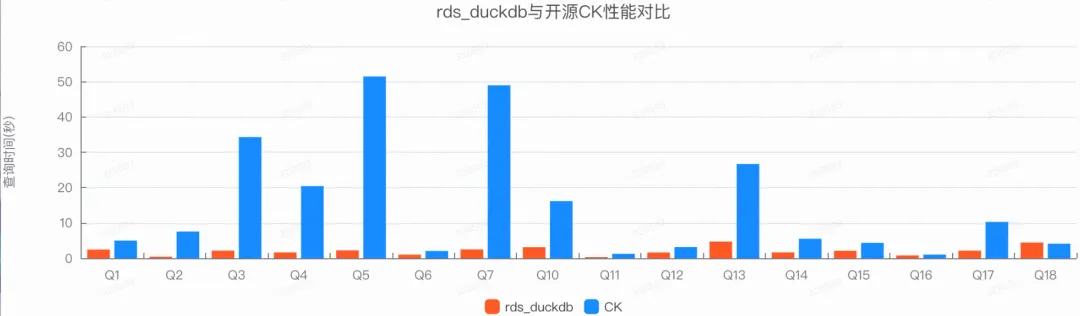
Among the 16 queries shown in the chart, rds_duckdb outperforms ClickHouse on a majority of them.
ClickHouse TPC-H Official Documentation: https://clickhouse.com/docs/getting-started/example-datasets/tpch
The release of Alibaba Cloud ApsaraDB RDS for PostgreSQL 18 is not just a comprehensive upgrade to the community version of PostgreSQL 18; it is a milestone in the deep fusion of databases and AI. Through technological breakthroughs like vector capability optimization, the Graph RAG revolution, and the DuckDB engine, as well as support from tools like the Supabase ecosystem integration and the MCP Server, ApsaraDB RDS for PostgreSQL 18 is more than just PostgreSQL. It is an intelligent data foundation that understands both AI and its users.
How to Upgrade Major Version of ApsaraDB for MongoDB Instances in One Click
Is Your AI Agent Getting Dumber? Alibaba Cloud AnalyticDB Unveils AI Context Engineering
ApsaraDB - September 2, 2026
ApsaraDB - January 27, 2026
ApsaraDB - May 21, 2026
ApsaraDB - June 26, 2026
Alibaba Cloud Community - January 23, 2025
Alibaba Cloud Community - April 8, 2024
 QwenWork
QwenWork is dedicated to helping employees strengthen their professional competitiveness in the AI era and to enabling enterprises to improve organizational effectiveness.
Learn More Token Plan
Build more, spend less. One plan, every modality.
Learn More
Alibaba Cloud Model Studio
A one-stop generative AI platform to build intelligent applications that understand your business, based on Qwen model series such as Qwen-Max and other popular models
Learn More PolarDB for PostgreSQL
Alibaba Cloud PolarDB for PostgreSQL is an in-house relational database service 100% compatible with PostgreSQL and highly compatible with the Oracle syntax.
Learn MoreMore Posts by ApsaraDB


